Enterprise software has spent decades helping people manage work.
CRM systems store customer information. ERP platforms manage financial and operational processes. HR systems manage employees. Project management platforms coordinate tasks. Analytics tools help leaders understand what is happening.
But a major shift is underway.
The next generation of enterprise software won’t simply help employees perform tasks.
It will increasingly perform those tasks itself.
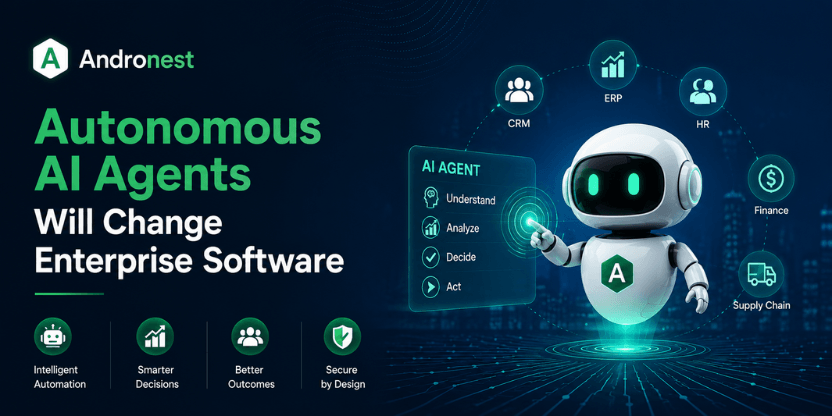
Autonomous AI agents are emerging as a new layer of enterprise technology—systems that can understand goals, reason about information, make decisions, use software tools, execute multi-step workflows, and adapt based on changing circumstances.
This doesn’t mean traditional enterprise applications will disappear.
Instead, the way businesses interact with them is likely to change dramatically.
Rather than employees navigating dozens of screens to complete a process, AI agents could increasingly operate across those systems on their behalf.
The result could be a fundamental transition:
From software that employees operate to software that works alongside—and increasingly on behalf of—employees.
Read: Why Every Enterprise Needs an AI Strategy Before Adopting AI
What are Autonomous AI Agents?
An autonomous AI agent is an AI-powered system designed to pursue a defined objective with a certain degree of independence.
Unlike traditional software automation, which generally follows predefined rules, AI agents can interpret context, determine appropriate actions, use available tools, and execute multiple steps toward a goal.
For example, a traditional workflow might work like this:
New lead → Assign salesperson → Send email → Create task
An autonomous AI agent could approach the same objective differently:
Goal: Follow up with qualified leads
The agent could:
- Review new leads.
- Analyze customer and account information.
- Determine which leads require immediate attention.
- Research relevant context.
- Draft personalized outreach.
- Update the CRM.
- Schedule follow-ups.
- Escalate unusual situations to a salesperson.
- Monitor responses.
- Recommend the next action.
The important difference is that the system isn’t simply executing one predefined sequence.
It is working toward an objective.
Why Autonomous AI Agents Matter for Enterprise Software
Autonomous AI agents matter for enterprise software because they close the gap that has always existed between data and action. Every major enterprise system — ERP, CRM, HCM, finance — was built on the assumption that a human would look at the information, interpret it, and decide what to do with it. The software stored and surfaced data; people provided judgment and execution. That model breaks down at the volume and complexity modern enterprises operate at, because the work of interpreting and acting on routine, rules-based information is consuming human capacity that should be spent on decisions that genuinely require human judgment.
Autonomous AI agents change this by reasoning over business data, coordinating across systems, and taking action — writing to records, triggering workflows, routing exceptions, initiating transactions — without step-by-step human instruction. Unlike RPA, which breaks when inputs deviate from a fixed script, agents handle variability. Unlike earlier enterprise AI, which produced recommendations a human still had to act on, agents close the loop.
The result is that high-volume, rules-based work that previously required significant human capacity to execute — invoice processing, customer service Tier-1, order management, compliance monitoring, demand forecasting — can be handled autonomously, at consistent quality, continuously, and at a speed and scale no human workforce can match. Human attention gets redirected to the edge cases, exceptions, and strategic decisions that are genuinely worth it.
Also read: How to build an AI adoption roadmap without disrupting your operations
What Makes Autonomous AI Agents Fundamentally Different
Understanding why AI agents represent a categorical shift rather than an incremental improvement requires clarity about what they do that previous generations of enterprise AI could not.
Previous-generation enterprise AI — machine learning models, natural language processing, robotic process automation — was narrow and task-specific. An ML model predicts churn probability. An NLP system classifies support tickets. An RPA bot copies data from one application field to another. Each capability addresses one defined, bounded function. None of them adapts, plans, or coordinates with other systems autonomously.
Autonomous AI agents introduce four capabilities that change the enterprise software relationship entirely:
Reasoning. AI agents don’t just classify or predict — they reason. Given a goal, an agent evaluates the current state, determines what information is needed, what steps must be taken, in what sequence, and what the decision criteria are at each branch point. This reasoning happens dynamically, in response to the specific situation, not from a pre-defined script.
Action. AI agents don’t just generate output — they execute. They can write to ERP systems, update CRM records, trigger financial transactions, send communications, create documents, query databases, route workflows for human review, and coordinate with other agents. The agent is not producing a recommendation for a human to act on. It is taking the action.
Memory. AI agents maintain context across sessions and interactions. They know what they did before, what state a process is in, what decisions were made and why. This persistent memory is what enables agents to handle complex, multi-step, multi-day processes rather than only single-turn interactions.
Orchestration. AI agents coordinate with other agents and systems. A workflow that requires retrieving data from a CRM, checking inventory in an ERP, validating compliance in a legal database, generating a contract document, and routing it for signature — previously requiring a human to coordinate across all four systems — can be executed by an agent ecosystem where each agent handles its specialized domain and hands off to the next.
As Gartner’s Senior Director Analyst Anushree Verma stated: “AI agents will evolve rapidly, progressing from task and application specific agents to agentic ecosystems. This shift will transform enterprise applications from tools supporting individual productivity into platforms enabling seamless autonomous collaboration and dynamic workflow orchestration.”
Check out: How Private AI Reduces Long-Term Operational Costs
Autonomous Agents vs Traditional Automation
It is important to distinguish AI agents from conventional automation.
| Traditional Automation | Autonomous AI Agents |
| Rule-based | Goal-oriented |
| Predictable workflows | Adaptive workflows |
| Structured inputs | Can handle more unstructured information |
| Predefined logic | Can reason within defined boundaries |
| Task-focused | Can coordinate multiple tasks |
| Limited flexibility | Greater contextual adaptability |
| “If X, do Y” | “Achieve X using available actions” |
This doesn’t mean AI agents are always better.
For deterministic processes, traditional automation may be safer, cheaper, and easier to maintain.
The real opportunity is determining where agentic capabilities actually add value.
From Systems of Record to Systems of Action
For years, enterprise software has primarily been built around systems of record.
CRM stores customer data.
ERP stores financial and operational data.
HR platforms store employee information.
Data warehouses store analytical data.
These systems remain essential.
But organizations increasingly want software that can act on the information stored within them.
Consider a customer who hasn’t renewed a subscription.
A traditional CRM might show:
- Customer details
- Purchase history
- Support tickets
- Contract information
- Renewal date
An AI agent could potentially go further.
It could analyze the account, identify renewal risk, review recent support interactions, summarize the customer’s concerns, recommend an appropriate engagement strategy, and initiate approved follow-up actions.
The enterprise application becomes more than a database.
It becomes an active decision and execution layer.
Also check: How to Choose the Right AI Workflow Automation Platform for Your Business
Eight Ways Autonomous AI Agents Will Transform Enterprise Software
1. ERP Systems Become Action-Taking Platforms
Enterprise Resource Planning systems have historically been systems of record — databases of business state that require humans to interpret and act on. AI agents transform ERPs into systems of action.
The HSO Order Management Agent, deployed within Microsoft Dynamics 365, illustrates the practical reality. Purchase orders arrive in every format — email, PDF, structured API, WhatsApp message. Each one previously required a person to extract data, validate it against pricing and inventory, and key it into the ERP. The agent reads communications in any format, extracts structured data with generative AI, validates against live Dynamics 365 pricing and inventory data in real time, and creates the sales order automatically. Orders that fail validation — incorrect pricing, out-of-stock items, missing information — route to a person with all relevant context already surfaced. Clean orders complete without human input.
Financial close processes are accelerating by 30% to 50% in production deployments of AI-powered financial operations. AP automation agents extract structured data from invoices and receipts, validate against purchase orders, flag anomalies, route for approval, and update ERP systems — compressing a multi-day manual process to hours.
In 2026, half of enterprise ERP vendors will launch autonomous governance modules combining explainable AI, automated audit trails, and real-time compliance monitoring, according to Forrester. ERP is becoming not just a system of record, but a governed, auditable action layer.
2. CRM Evolves from Data Repository to Revenue Intelligence Engine
CRM systems have always collected customer data. The quality of what sales and service teams do with that data has depended entirely on their capacity to review it, interpret it, and act at the right moment. AI agents remove that human bottleneck from the high-volume, time-sensitive interactions where it has the most cost.
AI agents embedded in CRM environments now analyze customer behavior, purchase history, service interactions, and market signals in real time — generating hyper-personalized recommendations and proactive service interventions before issues escalate. 80% of consumers report feeling more valued when autonomous assistants deliver hyper-personalized interactions, according to Master of Code Global’s 2026 analysis. 65% of B2B companies report stronger client engagement rates since implementing such solutions.
Salesforce Agentforce — the leading CRM-native agent platform with approximately 8,000 customers and 4,000 paying deployments — operates through the Atlas Reasoning Engine, enabling agents to take multi-step actions across Salesforce data and connected systems via MuleSoft. Microsoft Copilot embedded in Dynamics 365 connects CRM functions (sales, marketing, service) with ERP back-office functions (finance, operations, supply chain) through a unified data and intelligence layer.
The revenue impact is measurable. Forrester’s Total Economic Impact study documents a 315% ROI and $14.7 million in financial savings over three years for a composite enterprise deploying Microsoft Dynamics AI capabilities. Human agents are repositioned toward complex, high-empathy, and high-value interactions — which is where human judgment is irreplaceable.
3. Customer Service Undergoes Cost and Quality Transformation Simultaneously
Contact centers represent one of the highest-volume, highest-labor-cost functions in enterprise operations — and one of the highest-ROI deployment environments for AI agents.
Contact centers deploying autonomous agents will reduce cost-per-contact by 20% to 40% by 2026 as Tier-1 resolution becomes automated. 55% of organizations are already seeing measurable impact from AI agents in customer service, according to industry surveys.
The distinction between a chatbot and an AI agent in customer service is not a marketing distinction — it is functional. A chatbot retrieves an FAQ answer. An AI agent reads the customer’s account history, identifies the open issue, queries the order management system, determines that a delayed shipment meets the criteria for an automatic reship, initiates the reship, updates the case record, and sends a confirmation — all within the same interaction, without human involvement.
What changes for human service agents is the nature of the work. They handle escalations, complex multi-issue situations, emotionally sensitive interactions, and cases where policy exceptions require genuine human judgment. AI agents handle the Tier-1 volume that previously consumed most of a service team’s capacity. The result is better customer outcomes for both types of interaction: faster resolution for routine issues, and properly resourced human attention for the issues that require it.
4. Finance Operations Shift from Manual Processing to Autonomous Governance
Financial operations — accounts payable, accounts receivable, expense management, financial close, regulatory reporting — have historically been among the most labor-intensive processes in any enterprise, requiring significant headcount to maintain accuracy across high transaction volumes.
AI agents address this at the workflow level, not the task level. Fraud detection agents analyze transaction patterns in real time, applying models trained on historical signals to flag suspicious activity before settlement. Fraud detection held the highest market share among AI cybersecurity and financial applications in 2024, reflecting clear and documented ROI.
Invoice processing agents extract data from documents in any format, validate against purchase orders, identify discrepancies, route for approval, and post to the accounting system — turning a process that required hours of manual work per document into an automated workflow that requires human review only for exceptions.
35% of organizations using AI agents specifically report cost savings through automation, with finance and operations among the highest-impact functions. The shift from periodic reconciliation to continuous, AI-monitored transaction integrity is changing what finance teams look like and what they spend their capacity doing.
5. Supply Chain Achieves Real-Time Optimization at Scale
Supply chain management has always been a coordination problem at scale — thousands of SKUs, suppliers, logistics providers, and inventory positions that interact dynamically in ways that are impossible to optimize manually. AI agents address this by operating continuously across the data environments that supply chain management requires.
AI-driven demand planning agents analyze sales patterns, seasonal signals, promotional calendars, and external factors — including weather patterns, economic indicators, and supplier signals — to generate forecasts and procurement recommendations that update in real time rather than weekly or monthly.
Inventory agents monitor stock levels across distribution networks, identify replenishment needs before they become stockouts, and trigger procurement orders automatically within configured parameters. When supplier signals indicate delivery risk, agents proactively identify alternatives and present options for human approval rather than waiting for the disruption to surface as a production or fulfillment problem.
AI agents in operations also coordinate across the agent-to-agent communication layers that are emerging in 2026. The Model Context Protocol (MCP), now broadly adopted by enterprise software vendors, enables agents from Microsoft, Salesforce, SAP, and ServiceNow to coordinate on the same workflow across vendor boundaries — without requiring a custom integration between each pair. This composable architecture is what makes enterprise-wide supply chain optimization practically achievable.
6. Software Development Accelerates Across the Entire Lifecycle
Software development is the function where AI agent impact is most visible and most immediately measurable. 57% of organizations report seeing measurable impact from AI agents in software development — the highest adoption rate of any enterprise function.
AI agents embedded in development environments now handle code generation, code review, test case generation and execution, documentation creation, bug identification, and deployment pipeline management. GitHub Copilot’s research documented 55% faster task completion for well-scoped coding tasks. At enterprise scale, these productivity gains compound across the full development lifecycle.
The more significant architectural change is the emergence of agentic software development workflows, where agents handle the complete loop from specification through test through deployment — with human engineers reviewing, approving, and intervening on the decisions that require architectural judgment and domain knowledge rather than completing every implementation step manually.
By 2028, one-third of user experiences will shift from native applications to agentic front ends — conversational interfaces where the agent is the primary mode of interaction with the business software behind it. This will reshape how enterprise software is both built and used.
7. HR Operations Are Transformed from Administrative to Strategic
HR functions carry a significant administrative overhead: answering employee policy questions, processing leave requests, managing onboarding documentation, handling benefits inquiries, and supporting the recurring compliance processes that every people function must execute. AI agents address this overhead at scale.
An AI agent handling HR queries draws from the current policy documentation, the employee’s specific record, their role, their tenure, and their location — providing an accurate, personalized answer that reflects their actual situation rather than a generic FAQ response. The same agent can initiate leave requests, generate offer letters with role-appropriate templates, answer benefits questions during open enrollment, and route complex matters to the appropriate HR team member with full context.
40% of job roles in Global 2000 companies will actively collaborate with AI agents as workflows are redesigned, according to Gartner. For HR functions specifically, this collaboration model shifts the HR team’s capacity from processing to judgment — from answering standard questions to handling the edge cases, the sensitive situations, and the strategic talent decisions that genuinely require human expertise.
8. Cross-System Orchestration Creates a New Category of Business Process
The most significant near-term impact of AI agents on enterprise software is not within any single application domain. It is the emergence of agents that coordinate across ERP, CRM, HRIS, and operational systems simultaneously to execute end-to-end business processes that previously required multi-system, multi-department coordination.
Order-to-cash, lead-to-revenue, hire-to-retire, procure-to-pay: these are the end-to-end processes that span multiple systems, multiple departments, and multiple weeks or months of elapsed time. They have historically required human coordination at every system handoff. AI agents — coordinated through orchestration layers like Microsoft’s Copilot Studio, Salesforce’s Agentforce, or ServiceNow’s AI Agents — can execute these processes end-to-end, with humans involved only at the decision gates where policy or judgment requires it.
By 2028, Gartner projects that AI agents will make at least 15% of day-to-day work decisions autonomously. By 2026, 20% of B2B transactions will be driven by autonomous agent-led negotiations between buyers and sellers. Machine-to-machine commerce — where one enterprise’s procurement agent negotiates with another enterprise’s sales agent, agrees on terms, and initiates the transaction — is a near-term reality rather than a distant scenario.
Read: AI Agents vs Traditional Automation – What’s the Difference and Which Should You Use?
How to Prepare Your Enterprise for the Agentic Shift
The organizations that will generate measurable ROI from AI agents in the near term are not the ones that deploy the most agents. They are the ones that deploy the right agents, with the right governance, in the right sequence.
Start with use case prioritization based on ROI clarity, not technology novelty. The AI agent use cases that generate measurable returns fastest are those where volume is high, process definition is clear, data quality is sufficient, and the cost of incorrect agent action is manageable. Invoice processing, customer service Tier-1, and sales data enrichment consistently produce returns faster than complex multi-system orchestration started before foundational data infrastructure is in place.
Assess data readiness before agent selection. AI agents are only as reliable as the data they reason over. An agent operating on incomplete, inconsistent, or siloed data will produce unreliable outputs regardless of the sophistication of its reasoning architecture. Data quality and integration infrastructure must precede agent deployment, not follow it.
Build governance before scale. The organizations accumulating the most expensive agent failures in 2026 are those that deployed agents at scale before establishing the governance frameworks that catch and contain errors. Build access controls, audit trails, monitoring, and human-in-the-loop gates before expanding agent scope.
Choose architecture over point solutions. Domain-specific agents that operate in isolation from each other and from the broader enterprise data environment produce narrow productivity gains. Agents integrated into enterprise orchestration platforms — Salesforce Agentforce, Microsoft Copilot Studio, ServiceNow AI Agents — produce transformative gains by enabling cross-system coordination.
Define success in financial terms before deployment. The most reliable predictor of an AI agent project that will eventually lose its budget is the absence of defined financial success metrics before deployment began. Which cost metric, revenue metric, or time-to-completion metric will move, by how much, by when? Defining this before the first agent goes live is the difference between measurable ROI and expensive activity metrics.

This architecture allows agents to operate across existing enterprise systems rather than requiring organizations to replace those systems.
Security Will Become More Important Than Ever
Giving AI an ability to take action creates a fundamentally different security challenge.
A chatbot that provides information is one thing.
An agent that can:
- Send emails
- Modify customer records
- Approve transactions
- Create accounts
- Access sensitive data
- Execute workflows
requires much stronger controls.
Organizations will need to consider:
Identity
Which user or service identity does the agent operate under?
Permissions
What systems and data can it access?
Action Limits
What actions can it execute independently?
Approval Controls
Which actions require human approval?
Auditability
Can the organization see exactly what the agent did and why?
Data Protection
How is sensitive enterprise information handled?
Security cannot be an afterthought.
It must be part of the agent architecture from the beginning.
Also read: AI Risk vs AI Reward – Finding the Right Balance
Human-in-the-Loop Will Remain Critical
The future of enterprise AI is unlikely to be completely human or completely autonomous.
A more practical model is human-agent collaboration.
Agents handle:
- Routine decisions
- Data gathering
- Process coordination
- Repetitive execution
- Monitoring
Humans handle:
- High-impact decisions
- Complex exceptions
- Ethical considerations
- Strategic judgment
Relationship management
The best enterprise implementations will define exactly where autonomy ends and human judgment begins.
Data Quality Will Determine Agent Performance
AI agents depend heavily on the information available to them.
Poor data creates poor decisions.
If customer information is incomplete, duplicated, outdated, or inconsistent, an agent may reach unreliable conclusions.
Therefore, organizations considering AI agents should first evaluate:
- Data quality
- Data accessibility
- Data governance
- Data ownership
- Integration architecture
- Security controls
AI strategy and data strategy are becoming increasingly interconnected.
Enterprise Software Vendors Will Have to Rethink Their Products
Autonomous AI agents could change competition within enterprise software.
Historically, vendors competed on:
Features.
User experience.
Integrations.
Reporting.
Customization.
Pricing.
Increasingly, they may also compete on:
How effectively can their software be operated by AI agents?
This could make APIs, structured data, permissions, workflows, and agent interoperability much more important.
Enterprise applications may increasingly need to become agent-ready.

What Does Agent-Ready Enterprise Software Look Like?
An agent-ready application should ideally provide:
Accessible Data
Agents need controlled access to relevant information.
Well-Defined APIs
Agents need reliable ways to retrieve and update data.
Clear Actions
The system should expose what actions an agent can perform.
Permission Controls
Agents should operate within explicit boundaries.
Audit Trails
Organizations need visibility into agent activity.
Human Approval Mechanisms
Sensitive actions should support escalation and approval.
Reliable Integrations
Agents are only as useful as the systems they can safely interact with.
The Biggest Business Benefits
Organizations adopting autonomous AI agents may see benefits across several areas.
Increased Productivity
Employees spend less time on repetitive work.
Faster Operations
Agents can operate continuously without waiting for business hours.
Lower Operational Costs
Automation can reduce the amount of manual effort required for repetitive processes.
Better Customer Experiences
Customers can receive faster and more contextual responses.
Improved Decision-Making
Agents can analyze information and surface insights more quickly.
Greater Scalability
Businesses can handle increasing workloads without increasing manual effort at the same rate.
Check: AI Risk Management – What Every CIO Should Know
Challenges Businesses Should Expect
Despite the potential, autonomous AI agents aren’t a magic solution.
Organizations will face several challenges.
Reliability
Agents can make incorrect decisions.
Governance
Organizations need clear policies for agent behavior.
Integration Complexity
Connecting agents to legacy enterprise systems can be difficult.
Data Quality
Poor information can lead to poor outcomes.
Security
Agent access creates new attack and misuse risks.
Cost Management
Running sophisticated AI systems at enterprise scale can become expensive.
Change Management
Employees need to understand how their roles will evolve.
Successful adoption requires more than deploying an AI model.
It requires redesigning the surrounding business process.
How Businesses Can Prepare for Autonomous AI Agents
Organizations don’t need to automate everything at once.
A practical approach is to start with well-defined use cases.
Step 1: Identify Repetitive Processes
Look for workflows involving significant manual effort.
Step 2: Evaluate Business Impact
Prioritize processes where automation could produce measurable value.
Step 3: Assess Data Readiness
Determine whether the required information is accurate and accessible.
Step 4: Define Agent Boundaries
Clearly specify what the agent can read, recommend, and execute.
Step 5: Start With Human Oversight
Keep humans involved in high-risk decisions.
Step 6: Measure Results
Track metrics such as:
Time saved
Cost reduction
Error rates
Resolution time
Employee productivity
Customer satisfaction
Step 7: Expand Gradually
Once an agent proves reliable, expand its responsibilities carefully.
The Future Isn’t About Replacing Enterprise Software
It’s tempting to think AI agents will replace CRM, ERP, HR, or other enterprise platforms.
That’s unlikely to be the immediate outcome.
These systems contain decades of business logic, data, workflows, compliance controls, and organizational knowledge.
Instead, AI agents are more likely to change how people interact with those systems.
The application remains the system of record.
The agent becomes an intelligent layer that helps people interact with it.
This could create a future where employees spend less time operating enterprise software and more time directing intelligent systems.
The Bigger Shift: From Tools to Digital Coworkers
Perhaps the most important change isn’t technical.
It’s conceptual.
For decades, software has been treated as a tool.
We open an application.
We perform an action.
We close the application.
Autonomous AI agents introduce something different.
They can potentially become persistent digital workers capable of handling defined responsibilities.
A company might eventually have agents responsible for:
- Sales development
- Customer support
- Financial operations
- IT service management
- Employee onboarding
- Marketing operations
- Data analysis
These agents wouldn’t replace entire departments.
They would work alongside employees, handling defined tasks and escalating situations that require human judgment.
Conclusion
Autonomous AI agents could represent one of the most significant changes in enterprise software since the transition to cloud computing.
The biggest change isn’t simply that AI can generate text or answer questions.
It’s that AI can increasingly understand objectives, interact with enterprise systems, coordinate workflows, and take action.
This could transform enterprise software from passive systems that wait for users into active systems that help organizations accomplish goals.
But successful adoption will require more than advanced AI models.
Businesses will need:
- Clean data.
- Strong integrations.
- Clear processes.
- Robust security.
- Agent governance.
- Human oversight.
- A well-defined AI strategy.
The organizations that benefit most won’t necessarily be those that deploy the most AI agents.
They will be the ones that identify the right problems, give agents the right access, establish appropriate boundaries, and redesign work around human-AI collaboration.
The future of enterprise software may not be about using more applications.
It may be about having intelligent agents work across the applications businesses already use.
And for enterprise leaders, the important question is no longer simply:
“Where can we use AI?”
It’s:
“Which parts of our business should become intelligent, autonomous, and continuously improving?”