There has never been a more urgent — or more dangerous — moment to adopt AI without a plan.
Deloitte’s 2026 State of AI in the Enterprise survey found that worker access to AI tools rose 50% in 2025, and two-thirds of organizations now report productivity gains from AI adoption. The business case for AI is no longer being made in boardrooms — it is being validated in production systems, quarterly earnings reports, and competitive market share data.
And yet: McKinsey’s 2025 State of AI report found that 88% of organizations now use AI regularly, but only one-third have scaled it enterprise-wide. That gap between adoption and scale is where most enterprises are stuck today.
Only 34% of enterprises report measurable financial ROI from AI, despite wide adoption — and the leading reason cited in nearly every major survey is the same: the absence of an enterprise-wide strategy guiding these investments.
The organizations generating real, measurable returns from AI are not necessarily the ones with the largest budgets or the most advanced technology. They are the ones that approached AI adoption with the same rigour they would apply to any major operational change — with a clear roadmap, phased implementation, deliberate governance, and a change management strategy that brings people with them rather than confronting them with a fait accompli.
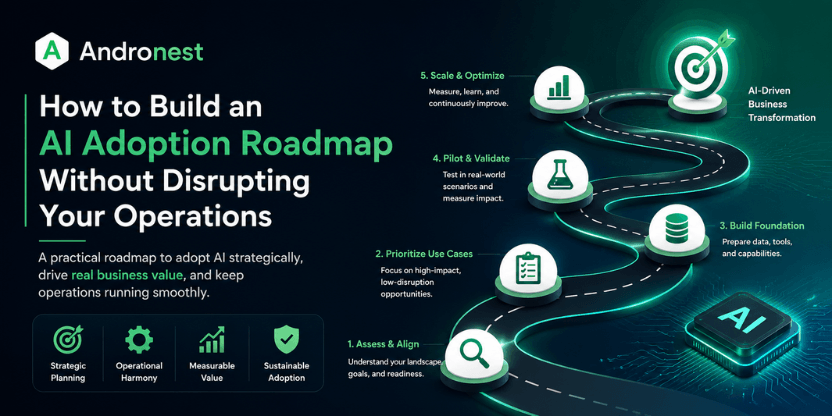
This guide gives you that roadmap. It covers every phase of a structured AI adoption plan — from the readiness assessment that must come before any tool selection, through to the governance, monitoring, and continuous improvement practices that keep AI delivering value long after the initial deployment excitement has faded.
The goal is not to adopt AI as fast as possible. The goal is to adopt AI in a way that compounds operational advantage — without disrupting the operations your business depends on today.
Why Most AI Adoption Efforts Stall — And What a Roadmap Changes
Before examining the roadmap itself, it is worth understanding precisely why so many AI initiatives fail to scale — because the failure patterns are remarkably consistent across industries, company sizes, and geographies.
According to Gartner, 30% of generative AI projects will be abandoned after proof of concept. The reasons behind these abandonments cluster around a set of recurring organizational failures.
No alignment between AI initiatives and business outcomes. Teams deploy AI tools because they are available and interesting — not because they are solving a specific, measurable business problem. When the tool fails to generate obvious value, it is quietly shelved.
Data foundations that cannot support AI. This is one of the most consistently underestimated challenges in AI adoption. Poor data hygiene, fragmented customer records, duplicate data, and unstructured processes mean that AI will only accelerate bad outcomes. AI is a multiplier — it scales what you already have. If your data foundation is weak, the priority must be fixing data infrastructure before expecting AI to deliver value.
Governance built after problems arise. Less than 20% of organizations have mature governance frameworks in place to manage AI responsibly. When governance is an afterthought, the first significant failure — a biased output, a compliance violation, a decision the business cannot explain — triggers a crisis of confidence that can set an AI programme back by years.
Change management treated as a communication exercise. AI adoption fails when organizations announce the technology and expect behaviour to change as a result. The skill gap is real: PwC’s 2026 survey found that 38% of respondents named skill gaps as a top-three barrier to scaling AI agents — ranking above funding and tooling.
Attempting to scale everything at once. Trying to implement AI across every function simultaneously leads to thin resources, slow progress, and widespread disillusionment. Concentrated execution on a small number of well-selected pilots produces faster learning and stronger business cases for expanded investment.
What a structured AI adoption roadmap changes is the sequencing. It forces clarity about what to build, why it matters, how it integrates, who owns it, and how it scales — before deployment begins. A roadmap shifts AI from a technology conversation to a business performance conversation. It ties AI initiatives directly to P&L impact — whether that is reducing operational costs, improving forecasting accuracy, automating decisions, or enhancing customer experience.
Phase 1: AI Readiness Assessment — Know Where You Stand Before You Move
Every successful AI adoption roadmap begins with an honest assessment of organizational readiness. This is not a box-checking exercise — it is a diagnostic that determines what you can deploy now, what you need to build before you can deploy, and what will realistically take 12–18 months to prepare for.
A comprehensive AI readiness assessment examines four critical dimensions.
Dimension 1: Data Readiness
AI systems are only as good as the data they run on. Assess the quality, completeness, accessibility, and governance of your current data across all relevant systems. Identify where data is siloed, where records are duplicated, and where data formats are inconsistent. Map the data flows between your CRM, ERP, HR systems, and operational platforms. Address structural data quality issues before any AI deployment touches production systems.
Dimension 2: Technology Infrastructure
Evaluate your current technology stack for AI compatibility. What APIs are available? What integration points exist between core systems? What is the current state of cloud infrastructure, and what additional capacity or architecture changes will AI workloads require? Which existing tools already include AI capabilities that are being underutilised?
Dimension 3: organizational Capability
Assess AI literacy across leadership, management, and frontline teams. Identify champions — people who are enthusiastic about AI and capable of supporting their peers through the learning curve. Map the roles that will change most significantly and begin workforce planning early. If data or integration capability is weak, prioritise quick wins that require less data or use pre-built APIs while strengthening foundations.
Dimension 4: Cultural Readiness
Before implementing any AI tools, make concerted efforts to understand your organization’s current workflows. Note where tasks get stuck, where decisions happen, and where people interact. Once patterns are identified, you can determine which AI programmes will help bridge those gaps. Assess whether leadership actively models AI adoption and whether there is a culture of experimentation and learning from failure — both prerequisites for successful AI programmes.
Readiness scoring:
Score each area on a 1–5 maturity scale. Aim for a minimum Level 3 maturity across all four dimensions before proceeding to pilot projects. organizations that skip this assessment and proceed directly to deployment consistently encounter avoidable failures at scale.
Phase 2: Define Business Outcomes — Start With Problems, Not Tools
The most common and costly sequencing error in AI adoption is selecting a tool and then searching for a problem it can solve. The productive direction runs the other way: identify your most significant business problems, then evaluate which AI capabilities address them most effectively.
Define business outcomes, not tech solutions. For each outcome, estimate expected benefit, implementation complexity, and time-to-value.
The four outcome categories that consistently deliver AI ROI are:
Cost reduction through automation: Repetitive, high-volume tasks where AI can achieve equivalent or better quality at significantly lower cost — invoice processing, customer service tier-1 resolution, HR query handling, IT ticket triage.
Revenue growth through personalization: AI’s ability to process customer data at scale and deliver individualised experiences enables conversion rate improvements, retention gains, and upsell identification that human-scale personalization cannot match.
Decision quality through predictive intelligence: AI models trained on operational data can surface patterns, forecast outcomes, and identify risks that manual analysis would miss — improving decision quality in demand forecasting, maintenance scheduling, credit risk assessment, and supply chain management.
Operational resilience through optimization: AI-driven scheduling, routing, resource allocation, and workflow optimization reduce waste, improve throughput, and increase adaptability to changing conditions.
For each outcome you identify, define a specific, measurable success metric before moving to use case selection. “Improve customer service” is not a success metric. “Reduce average handle time by 25% within 6 months of AI deployment” is. The specificity of your outcome definition determines whether you can measure success — and therefore whether you can justify continued investment.
Phase 3: Use Case Prioritization — The Impact-Complexity Matrix
With outcomes defined and readiness assessed, the next step is selecting the use cases that will form your initial AI deployment portfolio. The prioritization framework that consistently produces the best results is the impact-complexity matrix.
Plot each candidate AI use case on two axes:
Horizontal axis — Business Impact: How significantly does successful deployment of this use case contribute to the business outcomes defined in Phase 2? Consider revenue impact, cost reduction, customer experience improvement, and strategic competitive advantage.
Vertical axis — Implementation Complexity: How difficult is this use case to deploy successfully? Consider data availability and quality, integration requirements, regulatory constraints, change management requirements, and technical infrastructure needs.
The four quadrants:
High impact, low complexity — Quick Wins. These are your Phase 1 pilots: customer service chatbots, invoice processing automation, IT help desk deflection, scheduled report generation. Deploy these first to generate early ROI, build organizational confidence, and develop the team’s AI implementation capability.
High impact, high complexity — Strategic Investments. These are your 12–18 month deployments: predictive maintenance, AI-driven demand forecasting, personalised customer journey orchestration, autonomous supply chain optimization. Plan these carefully during early phases while quick wins are running.
Low impact, low complexity — Low Priority. Useful eventually but not worth distracting from higher-impact work in the early roadmap phases.
Low impact, high complexity — Avoid. These use cases consume resources disproportionate to their return. Revisit only when organizational AI maturity significantly increases.
Prioritize a use-case portfolio that mixes fast ROI pilots — customer chatbots, invoice automation — with medium-term bets like predictive maintenance, and strategic plays such as AI-enabled products.
The critical constraint: focus on two to three high-value use cases and deliver measurable results before expanding. Portfolio breadth is the enemy of early AI success. Concentrated execution on a small number of well-selected pilots produces faster learning, more confident teams, and stronger business cases for expanded investment than spreading effort across too many simultaneous initiatives.
Phase 4: Build the Data and Technology Foundation
Before any AI solution goes into production, the data and technology infrastructure that will support it must be validated and, where necessary, improved. This phase is unglamorous but non-negotiable. The most sophisticated AI model cannot overcome poor data. Investing in data quality, accessibility, and governance before — or at least in parallel with — AI development is not optional.
Data preparation essentials:
- Deduplicate and standardise records across all data sources that the AI system will access
- Define and enforce data quality standards — completeness, accuracy, consistency, and timeliness — for all fields the AI will use as inputs
- Establish data lineage tracking so that every data element used by the AI system can be traced to its source
- Implement access controls that restrict AI system access to the data it genuinely requires — principle of least privilege applied to AI data access
- Document data ownership: who is responsible for maintaining quality, who resolves disputes, and who authorises access changes
Technology infrastructure validation:
- Confirm that your cloud infrastructure can handle the additional compute and storage requirements of AI workloads at the planned volume
- Validate API connectivity between AI systems and the operational platforms they will integrate with — CRM, ERP, HRMS, customer service platforms
- Establish sandbox environments where AI systems can be tested against production-representative data without affecting live operations
- Implement logging and monitoring infrastructure before deployment — you need to see what the AI is doing from day one
Integration architecture: Plan the integration points between your AI systems and existing operational tools before deployment begins. Define the data flows — what goes in, what comes out, at what frequency, in what format. Determine whether integrations will be real-time, near-real-time, or batch based on business requirements. Document the fallback behaviour: what happens when the AI system is unavailable, produces an error, or returns a low-confidence result?
Phase 5: Pilot Deployment — Controlled, Measured, and Reversible
The pilot phase is where AI adoption either builds organizational momentum or loses it. The design of a pilot determines whether it produces actionable learnings or simply confirms that AI can technically work under controlled conditions.
A well-designed AI pilot has five characteristics:
- Defined scope: A single use case, a single team or department, a defined time period, and a specific set of success metrics. Scope creep in pilots is one of the most consistent causes of extended timelines and inconclusive results.
- A control group or baseline: AI impact can only be measured against something. Establish a clear baseline — current cost per transaction, current resolution time, current error rate — before deployment. Maintain a comparison group where possible to isolate the AI’s contribution from other operational changes occurring simultaneously.
- Reversibility: Design the pilot so that it can be rolled back without operational disruption if results are unsatisfactory. This means preserving existing workflows and systems during the pilot rather than replacing them — the AI system should augment or operate alongside existing processes, not replace them before validation is complete.
- Active monitoring: Every production AI deployment needs monitoring from day one — tracking model performance metrics, audit trails, detection of unexpected outputs, and controls for bias and misuse. Many organizations still lack sufficient monitoring for AI deployments, creating a real operational risk that can be avoided with early infrastructure investment.
- Regular review cadence: Weekly check-ins during the first month of a pilot, bi-weekly thereafter. Each review should assess technical performance, business performance against target metrics, and user experience — are the people affected by the pilot using it as intended, and what are they experiencing?
Pilot timeline guidance: Small businesses can often compress early phases into 6–8 weeks by focusing on a single, high-impact use case. Enterprise organizations should resist this temptation — thorough planning prevents costly mistakes at scale. For most mid-enterprise AI pilots, a 60–90 day pilot period provides sufficient data to make a confident scaling decision.
Phase 6: Governance — Build It Before You Need It
As AI moves from experimentation to deployment, governance is the difference between scaling successfully and stalling out. Enterprises where senior leadership actively shapes AI governance achieve significantly greater business value than those delegating the work to technical teams alone.
AI governance is not a compliance overhead — it is an operational enabler. organizations with mature governance frameworks scale faster, recover from failures more quickly, and maintain stakeholder trust more effectively than those that treat governance as a constraint on innovation.
The core components of an AI governance framework:
Model ownership and accountability: Every AI model in production must have a named owner — a business leader who is accountable for its performance, its outputs, and its alignment with organizational values and regulatory requirements. Technical teams manage the model; business owners are accountable for what it does.
Escalation logic and human oversight: Every AI system needs defined criteria for when it should escalate to human review — uncertainty thresholds, exception categories, high-stakes decision types. organizations need to define where humans should remain in control, how automated decisions are audited, and which records of system behaviour should be retained. The human review process must be operationally realistic, not aspirational.
Bias monitoring and fairness auditing: AI models trained on historical data can perpetuate and amplify historical biases. Regular auditing of model outputs across demographic segments, geographies, and customer groups is an operational requirement, not optional ethics compliance.
Data privacy and security controls: AI systems that access customer or employee data must comply with all applicable data protection regulations — GDPR, CCPA, and sector-specific requirements. Implement data minimization, access controls, encryption, and retention policies as standard components of every AI deployment.
Audit trails and explainability: Enterprises must align AI use with ethical guidelines and legal requirements. This means ensuring transparency in AI decision-making and maintaining records that allow every significant AI output to be traced, reviewed, and explained. For regulated industries, this is a legal requirement. For all industries, it is a customer trust requirement.
Change management for governance: True governance makes oversight everyone’s role, embedding it into performance standards so that as AI handles more tasks, humans take on active oversight responsibilities. Governance is not just a set of policies — it is a set of behaviours that must become part of day-to-day operations.
Phase 7: Change Management — The Dimension Most Roadmaps Miss
Of all the elements in an AI adoption roadmap, change management is the one most consistently underinvested and most consistently consequential. AI adoption is a business transformation, not a technology implementation — and every AI deployment changes how people work, what tasks they perform, what decisions they make, and what skills they need.
organizations that communicate this clearly, invest in skill development, and involve employees in the design and rollout of AI systems consistently achieve higher adoption rates and stronger business outcomes than those that treat the people dimension as secondary to the technology dimension.
The three-tier training model:
Structure AI training across three distinct levels:
- AI Awareness for all employees: what AI can and cannot do, how to interact with AI tools responsibly, and organizational AI policies
- AI User training for business users: hands-on training with specific AI tools, prompt engineering basics, and workflow-specific guidance
- AI Builder training for technical staff: AI development skills, platform training, architecture patterns, and responsible AI implementation practices
Addressing the fear of displacement:
One of the most significant barriers to AI adoption at the employee level is the perception that AI deployment is a prelude to job elimination. In Deloitte’s 2026 survey, education — not role or workflow redesign — was the number one way companies adjusted their talent strategies in response to AI. Address workforce concerns directly and honestly. Communicate which roles will change, how they will change, and what support the organization will provide to help individuals develop the skills their evolving role requires. organizations that invest genuinely in reskilling and redeployment build the internal AI champions who become the most effective advocates for expanded adoption.
Identifying and empowering AI champions:
In every team affected by an AI deployment, identify two or three individuals who are enthusiastic about the technology and capable of supporting their peers. Train them more deeply, involve them in pilot design, and give them visible roles in communicating benefits and addressing concerns. Peer-to-peer influence is more effective than top-down communication for driving behavioural change.
Communication cadence:
Establish a regular AI communication rhythm — weekly updates during deployment phases, monthly updates during steady-state operations — that keeps all stakeholders informed of progress, results, challenges, and plans. Transparency about what is working and what is not builds more durable trust than selective communication of positive news only.
Phase 8: Scale — From Pilot to Enterprise-Wide Deployment
A successful pilot answers the question: “Can this work?” Scale answers the question: “Can we make this work everywhere it needs to?” These are different questions with different operational challenges.
Once pilots prove effective, scaling requires additional infrastructure, resources, and continuous monitoring. A phased expansion reduces operational disruptions and ensures AI solutions remain sustainable and aligned with evolving enterprise goals.
The scaling sequence:
Move from one team or department to multiple teams within the same function — before expanding to other functions. This allows you to validate that the solution works in diverse sub-contexts, build operational expertise in deploying and supporting the system, and develop the playbook for onboarding new teams before the operational complexity of cross-functional rollout is added.
Standardization vs flexibility:
As AI solutions scale across the organization, define which elements should be standardised — governance frameworks, security controls, monitoring practices, data standards — and which elements should flex to accommodate different departmental contexts. Over-standardization kills adoption by making tools feel generic and irrelevant. Under-standardization creates a fragmented, unmaintainable AI estate.
Operating model for scaled AI:
A mature AI programme requires a clearly defined operating model: who owns the models, who manages pipelines, how teams collaborate, and which roles must evolve or be created. Consider establishing a Centre of Excellence — a cross-functional team responsible for AI strategy, governance, platform management, and best practice development — as the AI estate grows beyond a few isolated deployments.
Cost management at scale:
AI operating costs — model inference, data storage, monitoring infrastructure, and ongoing model maintenance — grow with scale and must be planned for. Establish FinOps practices for AI workloads that provide visibility into cost per use case, cost per transaction, and the relationship between AI investment and the business outcomes being generated.
Phase 9: Measuring ROI — The Metrics That Matter
A clear, practical AI adoption roadmap helps turn AI into predictable business value — faster revenue growth, higher productivity, better customer experiences, and more resilient operations. But predictable value requires predictable measurement.
Operational metrics (leading indicators):
- Automation rate: percentage of targeted transactions handled by AI without human intervention
- Error rate: frequency of AI outputs that require correction or produce incorrect outcomes
- Processing time: time from input to completed output, compared to pre-AI baseline
- System uptime and availability: percentage of time the AI system is available for use
Business outcome metrics (lagging indicators):
- Cost per transaction: total operational cost divided by volume of transactions processed
- Resolution time: average time from customer or employee request to resolution
- Customer satisfaction: NPS, CSAT, or equivalent satisfaction metrics for AI-affected processes
- Employee productivity: output per employee in AI-assisted roles, compared to baseline
- Revenue influence: pipeline generated, revenue attributed to, or retention improved by AI-enabled workflows
Financial metrics (ROI calculation): Calculate AI ROI as the sum of hard cost savings — headcount, error remediation, processing costs — and soft value gains — revenue influence, customer retention, productivity improvement — divided by total AI investment including implementation, licensing, infrastructure, maintenance, and training. Target a payback period of 12–18 months for most enterprise AI deployments.
Monitoring should encompass model performance metrics, business KPI tracking, user adoption rates, and ROI measurement. organizations should establish MLOps practices for sustainable AI operations. Regular reviews ensure AI solutions continue delivering value as business needs evolve, with budget allocated at 15–20% of the initial implementation cost annually for ongoing maintenance and optimization.
Benefits of a Strategic AI Adoption Roadmap
A well-planned roadmap helps organizations:
- Reduce operational risks
- Improve employee productivity
- Increase automation efficiency
- Accelerate decision-making
- Improve customer experiences
- Scale AI initiatives confidently
- Maximize ROI
- Ensure governance and compliance
Instead of disrupting operations, AI becomes a natural extension of existing business processes.
The 12-Month AI Adoption Roadmap: A Practical Timeline
For organizations ready to begin, the following timeline provides a structured path from assessment to scaled deployment:
Months 1–2: Foundation
- Complete AI readiness assessment across all four dimensions
- Define business outcomes and success metrics for initial use cases
- Conduct impact-complexity analysis and select 2–3 pilot use cases
- Begin data quality remediation for pilot use cases
- Establish AI governance framework — policies, ownership, escalation logic
Months 3–4: Preparation
- Build or configure AI solutions for selected pilot use cases
- Validate integrations in sandbox environments
- Design and deliver AI awareness training for all affected employees
- Deploy monitoring and logging infrastructure
- Communicate pilot plans, timelines, and expected outcomes to stakeholders
Months 5–7: Pilot Execution
- Deploy AI pilots in controlled, monitored environments
- Conduct weekly reviews for first month, bi-weekly thereafter
- Document learnings, exceptions, and model performance observations
- Refine models and workflows based on pilot data
- Begin workforce development for AI user and AI builder roles
Months 8–9: Evaluation and Planning
- Conduct formal pilot review against defined success metrics
- Make go/no-go decisions for scaling each pilot use case
- Develop scaling plans for successful pilots — timeline, resources, risk mitigation
- Identify next wave of use cases for Phase 2 roadmap planning
- Assess and refine governance framework based on pilot learnings
Months 10–12: Initial Scaling
- Begin controlled scaling of successful pilots to additional teams or departments
- Establish Centre of Excellence or dedicated AI operations function
- Implement FinOps practices for AI cost management
- Launch formal change management programme for scaled deployments
- Publish first AI adoption report: outcomes achieved, lessons learned, Phase 2 priorities
Common Pitfalls and How to Avoid Them
Pitfall 1: Starting without executive sponsorship
AI adoption requires cross-functional coordination, budget allocation, and the authority to change processes across departments. Without active executive sponsorship — not just budget approval, but visible championing — AI initiatives stall at the intersection of competing departmental priorities. Secure named executive sponsors before any roadmap work begins.
Pitfall 2: Confusing activity with progress
The number of AI tools deployed, models trained, or use cases piloted is not a measure of progress. Business outcomes are. Define outcome metrics early and review them relentlessly. Teams that track deployment activity rather than business impact consistently overestimate their AI programme’s maturity.
Pitfall 3: Underestimating the data preparation timeline
Data preparation consistently takes longer than planned — typically two to three times the initial estimate. Build generous data preparation timelines into your roadmap and begin data work as early as possible. This is the single most common cause of AI deployment delays in otherwise well-planned programmes.
Pitfall 4: Scaling before validating
The pressure to show AI results quickly leads many organizations to scale pilots before they have produced conclusive evidence of effectiveness. Scaling a pilot that has not proven its business case simply scales the uncertainty — at much greater cost and complexity. Define your go/no-go criteria for scaling before the pilot begins, and apply them objectively.
Pitfall 5: Treating governance as a one-time activity
AI governance is not a checklist to complete at deployment. It is an ongoing operational practice. As AI moves into decision-making roles across more functions, governance becomes progressively more critical — enterprises must manage fairness, transparency, data privacy, security, and model risk on an ongoing basis, especially in regulated industries. Review governance frameworks quarterly and update them as AI capabilities, regulatory requirements, and organizational needs evolve.

Best Practices for Successful AI Adoption
- Align AI with business strategy
- Start small and scale gradually
- Focus on measurable outcomes
- Keep humans in the loop
- Build strong data governance
- Continuously train employees
- Monitor performance regularly
- Update the roadmap as business needs evolve
AI Adoption Roadmap Checklist
Before launching an AI initiative, confirm you have:
- ✅ Defined business objectives
- ✅ Identified priority use cases
- ✅ Assessed organizational readiness
- ✅ Prepared high-quality data
- ✅ Established AI governance
- ✅ Planned employee training
- ✅ Selected pilot projects
- ✅ Defined success metrics
- ✅ Created a scaling strategy
The Future of AI Adoption
As AI capabilities continue to evolve, organizations will move beyond isolated automation projects toward enterprise-wide AI ecosystems.
Emerging trends include:
- AI agents
- Predictive decision-making
- Intelligent workflow orchestration
- Hyperautomation
- Multimodal AI
- Industry-specific AI platforms
Businesses that build a structured adoption roadmap today will be better prepared to capitalize on these innovations tomorrow.
Conclusion
AI has the power to transform businesses—but only when adopted strategically.
Rather than attempting large-scale transformations overnight, organizations should take a phased approach that prioritizes business goals, data readiness, governance, employee engagement, and continuous improvement.
A structured AI adoption roadmap minimizes disruption, reduces risk, and creates a strong foundation for sustainable innovation.
The organizations that succeed with AI won’t necessarily be the ones that adopt it first—they’ll be the ones that adopt it thoughtfully.
Frequently Asked Questions
- What is an AI adoption roadmap?
An AI adoption roadmap is a strategic plan that outlines how an organization will evaluate, implement, govern, and scale AI technologies while minimizing operational risks. - Why is an AI roadmap important?
It helps organizations align AI initiatives with business goals, reduce implementation risks, improve adoption, and maximize ROI. - How long does AI adoption take?
The timeline varies depending on business size and complexity, but most organizations begin with pilot projects before scaling AI over several months or years. - What is the first step in AI adoption?
The first step is identifying clear business objectives and selecting use cases that deliver measurable value. - Can small businesses create an AI roadmap?
Yes. AI adoption is valuable for businesses of all sizes. Small organizations can begin with focused automation projects and expand as they grow.