Artificial intelligence has moved from experimentation to enterprise priority.
Organizations are exploring generative AI, AI agents, copilots, intelligent automation, predictive analytics, and private AI to improve productivity, accelerate decision-making, reduce operational costs, and create new customer experiences.
But there is a major difference between using AI and building an enterprise capable of creating sustainable value from AI.
Many organizations start with tools.
One department subscribes to a generative AI platform. Another experiment with an AI assistant. Developers begin connecting large language models (LLMs) to internal applications. Business teams launch isolated proofs of concept.
Individually, these initiatives may deliver value. Collectively, however, they can create fragmented architecture, duplicated investments, security risks, inconsistent data practices, and AI projects that never move beyond experimentation.
That is why enterprises need an AI strategy before large-scale AI adoption.
An enterprise AI strategy defines where AI should be used, why it should be used, what business outcomes it should produce, which data and infrastructure it requires, and how it will be governed and scaled.
The question enterprises should ask is no longer:
“Where can we use AI?”
It should be:
“Where can AI create measurable business value—and how can we deploy it responsibly at scale?”
The Most Expensive Lesson in Enterprise Technology
The numbers from 2026 tell a story that should make every enterprise technology leader pause.
88% of organizations now use AI in at least one business function, according to McKinsey’s 2025 State of AI report. Yet only 39% of those organizations report any measurable impact on enterprise-wide EBIT — and of those, most describe the impact as less than 5%. 95% of generative AI pilots fail to reach production, according to MIT’s 2026 enterprise study published in Fortune. Gartner’s 2025 analysis puts the overall enterprise AI project failure rate at 70% to 90%. And 79% of organizations report facing challenges in adopting AI in 2026, a double-digit increase from 2025, according to Writer’s Enterprise AI Survey of senior executives.
The total financial commitment behind these underwhelming results is staggering. Enterprises spent $37 billion on generative AI in 2025. 59% of organizations are investing over $1 million annually in AI technology. And 48% of executives call their organization’s AI adoption a “massive disappointment.”
The comfortable explanation is that AI technology is overhyped. But the data does not support that conclusion. The same research that documents widespread AI disappointment also documents its inverse. Companies that moved early into generative AI with structured strategic approaches report $3.70 in value for every dollar invested. Top performers are achieving $10.30 per dollar invested. The contrast is not between organizations with access to good AI and organizations without it. The contrast is between organizations that deployed AI within a coherent strategy and organizations that deployed AI instead of one.
An AI strategy is not a software roadmap. It is not a list of tools the organization plans to purchase or a timeline of pilots planned for the next four quarters. A genuine enterprise AI strategy is a business operating decision — one that defines which outcomes AI is expected to move, what the organization needs to put in place before AI can move them, how success will be measured in financial rather than activity terms, and who is accountable for the result.
This guide makes the case for why that strategy must precede every AI deployment — and what it needs to contain.
Read: How Private AI Reduces Long-Term Operational Costs
What is an Enterprise AI Strategy?
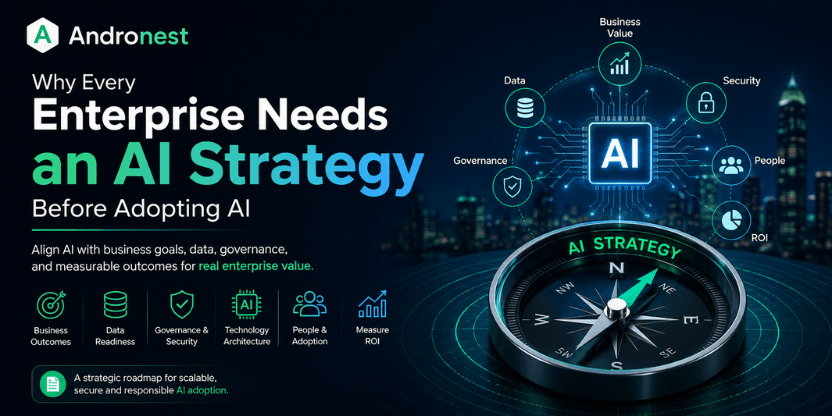
An enterprise AI strategy is a structured roadmap that connects artificial intelligence investments with business objectives, data capabilities, technology architecture, governance, security, workforce readiness, and measurable outcomes.
It helps answer fundamental questions such as:
- What business problems should AI solve?
- Which AI use cases should be prioritized?
- What data will AI systems require?
- Should AI be public, private, cloud-based, or hybrid?
- Which models and platforms should be used?
- Where should AI agents be allowed to take actions?
- Which decisions require human approval?
- How will sensitive information be protected?
- How will AI performance and ROI be measured?
- How can successful pilots scale across the enterprise?
An AI strategy therefore isn’t simply a list of AI tools the organization plans to purchase.
It connects:
Business Strategy → Use Cases → Data → AI Architecture → Governance → People → Measurement → Scale
Without these connections, AI adoption can easily become a collection of disconnected experiments.
Also read: How to Choose the Right AI Workflow Automation Platform for Your Business
The Adoption vs. Impact Gap: Understanding the Core Problem
The central problem in enterprise AI in 2026 is not adoption. Organizations are adopting AI at a pace that no other technology category has matched. The problem is the gap between adoption and impact — between the 88% using AI and the 39% seeing any financial return from it.
As phData’s 2026 enterprise AI analysis frames it directly: “Adoption is not ROI. Usage is not business value. Prompts are not profit. And worst of all: nobody ever defined, upfront, what financial outcome AI was actually supposed to drive.”
That statement captures the mechanism of failure precisely. The sequence that produces AI disappointment is consistent and recognizable:
An organization secures an AI budget. Enterprise licenses are signed and deployed. Employees onboard. Usage metrics climb. Weekly active users, prompt counts, and AI interactions become the dashboard of success. Leadership reviews these activity metrics quarterly and concludes the AI investment is working.
Twelve to eighteen months later, a different question gets asked. What business outcome has actually improved? Revenue per rep? Support resolution rates? Contract cycle time? Error rates in manual processes? Operating margin in any function that received AI investment?
The silence that follows is not a technology failure. The AI worked. Employees used it. The problem is that the organization never defined — before deployment — what financial outcome the AI was supposed to move. And without a prior definition, proving impact becomes impossible, and when leadership cannot see the business impact, budgets get cut.
This is the adoption vs. impact gap. And closing it requires a strategy that precedes adoption rather than follows it.
Check out: Can AI Replace Auditors? Understanding the Human Advantage
Top Reasons Every Enterprise Needs an AI Strategy Before Adopting AI
1. AI Investment Must Start With Business Problems
One of the easiest AI mistakes to make is starting with the technology.
A leadership team sees an impressive AI demonstration and immediately asks:
“How can we use this?”
A better question is:
“Which business problem are we trying to solve?”
For example, an enterprise might have challenges such as:
- Customer support costs are increasing.
- Sales teams spend too much time on administrative tasks.
- Employees cannot easily find internal knowledge.
- Contract review takes too long.
- Developers spend significant time on repetitive coding tasks.
- Finance teams manually reconcile information across systems.
- Operations teams struggle to predict equipment failures.
These are business problems.
AI becomes relevant when it can improve the underlying outcome.
A better approach
For every proposed AI initiative, define:
Problem → Current cost → AI opportunity → Expected outcome → KPI
For example:
- Problem: Support agents spend too much time searching knowledge bases.
- AI opportunity: AI-powered knowledge retrieval and response assistance.
- Outcome: Faster case handling.
- KPI: Average handling time and first-contact resolution.
This keeps AI investment connected to measurable business value.
2. Not Every Problem Requires AI
AI is powerful, but it isn’t automatically the best solution for every workflow.
Some business processes can be solved more reliably and economically using:
- Traditional software
- APIs
- Workflow automation
- Business rules
- Robotic process automation
- Database queries
- Standard analytics
Consider a workflow where invoices above a fixed amount must be routed to a manager.
That is deterministic.
You probably don’t need an LLM to decide what happens.
Now consider processing thousands of invoices where information arrives in different formats and requires interpreting unstructured text.
AI may provide considerably more value.
A good AI strategy prevents organizations from using AI where simpler automation would work better.
3. Enterprises Need to Prioritize AI Use Cases
Once organizations begin exploring AI, potential use cases appear everywhere.
Marketing wants content generation.
Sales wants prospect research.
Customer service wants AI agents.
HR wants employee assistants.
Finance wants document processing.
Engineering wants coding copilots.
Operations wants predictive analytics.
Trying to implement everything simultaneously is rarely practical.
Instead, organizations can evaluate opportunities against factors such as:
| Factor | Question |
| Business Value | How significant is the potential impact? |
| Feasibility | Can we realistically implement it? |
| Data Readiness | Is reliable data available? |
| Risk | What happens if AI gets it wrong? |
| Integration Complexity | How many systems are involved? |
| Adoption | Will employees/customers actually use it? |
| Scalability | Can it expand beyond the initial pilot? |
| Cost | Does the expected value justify the investment? |
This creates an AI use-case portfolio rather than a random collection of projects.
High-value, feasible, relatively low-risk use cases can become early priorities.
4. AI Is Only as Effective as the Data Behind It
Enterprises frequently focus on models before evaluating their data.
But enterprise AI depends heavily on whether the organization can provide accurate, accessible, relevant, governed, and appropriately permissioned data.
Typical problems include:
- Information trapped in silos
- Duplicate records
- Inconsistent schemas
- Outdated knowledge
- Missing metadata
- Unstructured documents
- Poor data ownership
- Unclear access permissions
- Legacy systems that are difficult to integrate
These weaknesses become particularly important for generative AI and AI agents.
Imagine an AI customer-service agent connected to outdated product documentation.
Or a sales assistant relying on incomplete CRM records.
The model might be sophisticated, but its output can still be unreliable.
AI strategy must therefore include data strategy.
Organizations need to determine:
- Which data does AI need?
- Where does that data live?
- Who owns it?
- Who can access it?
- How will its quality be maintained?
- How will AI retrieve it securely?
In many enterprises, preparing data for AI can be just as important as selecting the AI model itself.
5. AI Creates New Security and Privacy Risks
Enterprise AI can interact with highly sensitive information.
This may include:
- Customer records
- Financial information
- Source code
- Intellectual property
- Employee information
- Contracts
- Product roadmaps
- Internal communications
- Proprietary research
Allowing employees to send such information to unapproved AI tools can introduce significant security and privacy risks.
An enterprise AI strategy should establish clear policies around:
- Approved AI platforms
- Sensitive-data handling
- Model access
- Authentication
- Authorization
- Data retention
- Logging
- Third-party AI providers
- Model training policies
- AI application security
For organizations handling particularly sensitive workloads, the strategy may also need to evaluate private AI, self-hosted models, dedicated infrastructure, or hybrid architectures.
The goal isn’t to block AI adoption.
It is to make safe AI adoption easier than unsafe AI adoption.
6. AI Governance Cannot Be an Afterthought
As AI systems become more capable, governance becomes increasingly important.
Traditional enterprise software largely follows deterministic rules.
Generative AI systems can produce probabilistic outputs. AI agents may go further by selecting tools and performing actions.
That creates new questions.
Who is accountable when AI makes an incorrect recommendation?
Which actions can an AI agent perform autonomously?
When should a human approve an action?
How are AI decisions logged?
How are models evaluated?
What happens when performance deteriorates?
An AI governance framework should define areas such as:
- AI ownership
- Acceptable use
- Risk classification
- Model evaluation
- Data governance
- Security
- Human oversight
- Monitoring
- Auditability
- Incident response
Governance should scale with risk.
An internal AI assistant summarizing meeting notes doesn’t require exactly the same controls as an autonomous agent capable of modifying financial or customer records.
7. AI Agents Make Strategy Even More Important
Generative AI primarily expanded what machines could create and understand.
Agentic AI expands what AI systems may be able to do.
AI agents can potentially:
Understand a goal → Reason about next steps → Retrieve information → Use tools → Execute actions → Evaluate results → Continue or escalate
For example, a customer-service agent could potentially access customer information, inspect an order, check policy, initiate an approved action, update a CRM record, and communicate the result.
This is far more powerful than generating an answer.
It is also more consequential.
Enterprises therefore need to define agent boundaries.
For every AI agent, determine:
What can it read?
Which databases, documents, applications, and records?
What can it do?
Can it create, update, approve, delete, purchase, refund, or communicate?
When does it need approval?
Low-risk actions might run autonomously, while high-impact actions may require human authorization.
How will actions be audited?
Every important action should be traceable.
A useful principle is:
Give AI the minimum autonomy required to achieve the business outcome.
8. An AI Strategy Prevents Tool Sprawl
AI adoption can quickly become decentralized.
Marketing buys one AI platform.
Developers use another.
Customer support adopts a third.
Sales experiments with several copilots.
Different departments create independent integrations with multiple LLM providers.
Soon, the organization may have:
- Duplicate subscriptions
- Inconsistent security standards
- Multiple model providers
- Fragmented data integrations
- Unclear ownership
- Different governance policies
- Redundant AI applications
This creates AI tool sprawl.
An enterprise strategy can establish common architectural principles and reusable capabilities.
Instead of every team independently solving authentication, retrieval, monitoring, security, model access, and data integration, organizations can build shared AI foundations.
9. AI Architecture Determines Whether Pilots Can Scale
Creating an AI prototype can be relatively straightforward.
Running AI reliably across thousands of employees, millions of requests, or business-critical workflows is different.
Enterprise AI architecture may need to address:
- Model selection
- Model routing
- Retrieval-Augmented Generation (RAG)
- Vector databases
- Enterprise search
- APIs
- Identity and permissions
- Data pipelines
- Observability
- Guardrails
- Evaluation
- Caching
- Cost controls
- High availability
- Integration with enterprise applications
Organizations also need to decide between:
- Public AI APIs
- Private AI
- Cloud-hosted models
- On-premises models
- Hybrid AI architectures
There is no universally correct architecture.
The right approach depends on data sensitivity, performance requirements, cost, regulatory obligations, existing infrastructure, and the use case itself.
10. AI Costs Can Grow Faster Than Expected
A successful AI pilot can create an unexpected problem:
usage grows.
AI costs may include much more than model inference.
Enterprises should consider:
- API/token consumption
- GPU infrastructure
- Cloud compute
- Storage
- Data pipelines
- Vector databases
- Observability
- Integration
- Security
- Model evaluation
- Development
- Maintenance
- Human review
Agentic AI can further complicate economics because a single user request may trigger multiple model calls, retrieval operations, API interactions, and tool executions.
A mature AI strategy therefore measures more than:
Cost per token
It considers:
Cost per successful business outcome.
For example:
What does it cost AI to successfully resolve a support case?
That is more meaningful than simply tracking how many tokens the application consumed.
11. Employees Need an AI Adoption Strategy Too
Enterprise AI isn’t purely a technology transformation.
It changes how people work.
Employees may wonder:
- Will AI replace my job?
- Which tools am I allowed to use?
- Can I trust AI-generated information?
- What information can I share with AI?
- When should I verify an AI response?
- Who is responsible if AI makes a mistake?
Ignoring these questions can lead to resistance—or uncontrolled AI usage outside approved systems.
Successful organizations should invest in:
- AI literacy
- Role-specific training
- Acceptable-use policies
- Prompting skills
- Verification practices
- Security awareness
- Change management
Employees should understand AI as a capability that can augment their work while recognizing its limitations.
12. AI ROI Must Be Defined Before Deployment
Organizations often track AI adoption using metrics such as:
- Number of AI users
- Number of prompts
- Number of generated responses
- Number of deployed copilots
These metrics tell you that AI is being used.
They don’t necessarily tell you whether AI is creating value.
Instead, connect AI initiatives to business outcomes.
Customer Service
Measure:
- Resolution time
- First-contact resolution
- Cost per case
- Escalation rate
- Customer satisfaction
Sales
Measure:
- Lead response time
- Conversion rate
- Sales cycle
- Administrative time saved
- Revenue productivity
Engineering
Measure:
- Development cycle time
- Defect rates
- Deployment frequency
- Time spent on repetitive tasks
Operations
Measure:
- Processing time
- Error rate
- Automation rate
- Cost per transaction
The right metric depends on the original business problem.
Also check: AI Agents vs Traditional Automation – What’s the Difference and Which Should You Use?
What a Real Enterprise AI Strategy Includes
A genuine enterprise AI strategy is not a technology roadmap or a list of planned pilot projects. It is a business document that answers the following questions with specificity before any AI deployment begins:
Business objective alignment.
Which specific business outcomes — expressed in financial or operational metrics — is AI expected to move? Revenue per customer? Operating cost per transaction? Error rate in a defined process? Response time in a service function? The outcomes must be specific, measurable, and connected to the organization’s actual P&L.
Data foundation assessment.
What data does the organization have, where does it live, what quality standards does it meet, and what is missing? What investment is required in data infrastructure before AI can reliably operate on it? What data governance policies must be in place?
Use case prioritization.
Which specific applications of AI will move the defined business outcomes? Which of those applications have the highest impact, the best data readiness, the fastest path to measurable results, and the most reusable infrastructure? In what sequence should they be deployed?
Governance and risk framework.
What decisions will AI influence or make? What accountability model applies? What auditability is required? What regulatory obligations apply to each use case? What guardrails prevent AI from operating outside its intended scope?
Technology architecture.
What platforms, models, and integrations are required to execute the prioritized use cases? What does the data infrastructure need to look like? How does the AI architecture integrate with the existing enterprise technology stack?
People and change strategy.
How will employees be prepared for AI’s impact on their roles? What training is required? How will adoption be incentivized? What change management resources are allocated?
Success metrics and governance model.
What are the specific financial metrics that define success for each use case, measured at what interval? Who is accountable for the outcome? How is progress reviewed, and what triggers a strategic adjustment?
Read: AI Risk vs AI Reward – Finding the Right Balance
The Cost of Not Having an AI Strategy
Organizations that adopt AI without a strategy do not avoid the cost of strategy — they pay it differently, in the form of failed pilots, wasted investment, governance exposure, and the organizational cynicism that accumulates when expensive technology programs do not deliver.
The specific costs of strategy-free AI adoption include:
Wasted investment. 95% of generative AI pilots that fail to reach production represent the full cost of pilot development with no return. At the investment levels enterprises are committing — $37 billion in 2025, growing rapidly in 2026 — even a modest improvement in pilot success rates through strategic prioritization generates returns that dwarf the cost of strategy development.
Governance exposure. AI systems deployed without compliance review can create regulatory exposure that is significantly more expensive to remediate than to prevent. The EU AI Act, GDPR, sector-specific requirements, and emerging sovereignty regulations each carry enforcement teeth that make post-hoc compliance expensive.
Organizational trust erosion. When expensive AI programs do not deliver the promised outcomes, the resulting skepticism makes subsequent AI programs harder to fund, staff, and execute. The 48% of executives who describe their AI adoption as a “massive disappointment” are not just unhappy with current results — they are less willing to support future investment, and their teams are less willing to engage with AI initiatives that have so far delivered frustration.
Competitive disadvantage. The organizations achieving $3.70 to $10.30 per dollar invested in AI are compounding their advantage with every quarter of disciplined strategy execution. The organizations running disconnected pilots without strategic direction are not standing still — they are falling further behind competitors who started with a strategy.
The Strategy-First AI Maturity Path
Organizations that achieve sustained AI ROI share a recognizable maturity sequence:
Stage 1 — Foundation building.
Data readiness assessment, governance framework design, use case identification and prioritization, success metric definition. No AI deployment occurs during this stage, but the investment made here determines the success rate of every subsequent deployment.
Stage 2 — High-confidence first deployment.
The highest-ROI, best-data-ready, most governable use case from the prioritized list. A contained, measurable deployment with clear success criteria and a defined timeline for evaluation. Not a pilot in the sense of “we’re experimenting” — a production deployment in the sense of “we’re executing a plan.”
Stage 3 — Capability compounding.
Each successful deployment builds reusable infrastructure — data pipelines, integration architecture, governance documentation, organizational AI literacy — that reduces the cost and risk of subsequent deployments. The cadence accelerates as the foundation deepens.
Stage 4 — Enterprise-wide operationalization.
AI embedded in workflows across functions, governed by a mature framework, measured against financial outcomes at portfolio level, and continuously improved through structured feedback loops.
The organizations at Stage 4 in 2026 are the ones that started at Stage 1 — with strategy — while most of their competitors were running pilots.
Also read: AI Risk Management – What Every CIO Should Know
Enterprise AI Strategy Checklist
Before scaling AI, enterprises should be able to answer:
- Which business outcomes are we targeting?
- Have we prioritized AI use cases?
- Do we have the necessary data?
- Is our data reliable and governed?
- Have we defined an AI architecture?
- Have we evaluated public vs. private AI?
- Do we know what sensitive data AI can access?
- Have we established AI governance?
- Are AI-agent permissions clearly defined?
- Do high-risk actions require human approval?
- Can we monitor AI quality and actions?
- Have employees received appropriate AI training?
- Do we understand total AI costs?
- Have we defined business KPIs?
- Do we have a roadmap for scaling successful pilots?
If several answers are “no,” accelerating AI deployment may create more problems than value.
Common Enterprise AI Strategy Mistakes
Chasing AI Trends
Don’t implement technology simply because competitors are discussing it. Begin with business problems.
Trying to Automate Everything
Some processes need human judgment. Others are better suited to traditional automation.
Ignoring Data Readiness
Advanced models cannot compensate for fundamentally unreliable enterprise data.
Giving AI Agents Too Much Authority
Start with constrained permissions and expand them as reliability is demonstrated.
Running Endless Pilots
Experiments without production pathways create pilot purgatory—lots of demonstrations but little enterprise value.
Measuring AI Activity Instead of Business Value
More prompts and more AI users do not automatically mean better business performance.
Treating Governance as a Barrier
Good governance isn’t intended to prevent AI adoption. It creates the conditions for AI to scale safely.
Private AI as Part of an Enterprise AI Strategy
For some organizations, particularly those handling sensitive or regulated information, the AI strategy should also evaluate private AI deployment.
Private AI can give organizations greater control over:
- Data
- Models
- Infrastructure
- Security
- Access
- Compliance
- Intellectual property
It may be particularly relevant for sectors such as financial services, healthcare, legal services, government, defense, and enterprises handling proprietary information.
However, private AI isn’t automatically the right choice for every workload.
An enterprise may ultimately adopt a hybrid AI strategy:
Public AI for low-risk general-purpose workloads.
Private AI for sensitive or proprietary workloads.
Traditional automation for deterministic workflows.
AI agents for carefully governed multi-step processes.
The goal isn’t choosing one AI architecture.
It’s choosing the right architecture for each business problem and risk profile.
The Future: From AI Strategy to Agentic Enterprise
Enterprise AI is evolving from systems that primarily generate information toward systems capable of executing increasingly complex work.
That makes strategic planning even more important.
Future enterprise environments may contain multiple specialized agents:
Sales Agent → Service Agent → Finance Agent → IT Agent → Operations Agent
These agents may interact with enterprise data, applications, APIs, and potentially other agents.
Without common governance, identity, permissions, data architecture, monitoring, and orchestration, this environment could quickly become difficult to control.
The enterprises that succeed with agentic AI may therefore be those that build the foundation before autonomy becomes widespread.
How Andronest Can Help Enterprises Build an AI Strategy
AI transformation should begin with understanding the business—not selecting an LLM.
An effective AI initiative requires organizations to connect business objectives with data, architecture, infrastructure, governance, security, and implementation.
Andronest can help enterprises evaluate AI opportunities and develop technology foundations designed for scalable AI adoption.
Depending on organizational requirements, an AI transformation initiative may involve:
- AI strategy and consulting
- AI readiness assessment
- AI use-case identification
- Generative AI development
- AI prototype and MVP development
- Private and local AI deployment
- AI agent development
- Data engineering
- Cloud architecture
- Enterprise integrations
- AI governance planning
The objective isn’t to deploy the largest possible number of AI applications.
It’s to identify where AI creates genuine value and build the technical foundation needed to deliver that value securely and sustainably.
Frequently Asked Questions
What is an enterprise AI strategy?
An enterprise AI strategy is a structured plan that connects AI investments with business goals, use cases, data, technology architecture, governance, security, workforce readiness, and measurable outcomes.
Why do companies need an AI strategy?
Without an AI strategy, organizations risk fragmented tools, duplicated investments, poor data practices, security issues, uncontrolled AI usage, and pilots that never generate meaningful business value.
What should an AI strategy include?
It should generally address business objectives, prioritized use cases, data readiness, AI architecture, infrastructure, security, governance, human oversight, skills, implementation, measurement, and scaling.
Should businesses choose AI tools before developing their strategy?
Generally, no. Enterprises should first identify business requirements and use cases. Technology and model selection should follow those requirements.
What is the difference between AI strategy and AI implementation?
AI strategy determines why, where, and how AI should create business value. AI implementation involves building and deploying the technologies required to execute that strategy.
Should AI governance be created before AI deployment?
Governance should be established early and mature alongside adoption. Organizations need clear rules around data, security, approved tools, accountability, monitoring, and human oversight before high-risk AI applications are deployed.
Does every enterprise need private AI?
No. Private AI can be valuable when organizations require greater control over sensitive data, models, infrastructure, or regulatory requirements. Many enterprises may use a combination of public and private AI.
Conclusion: Strategy is Not Preparation for AI. Strategy Is the Investment.
The narrative that enterprise AI adoption requires bold action and fast movement has produced billions of dollars in failed pilots, disappointed executives, and organizational cynicism that will make the next round of AI investment harder to justify.
The data from 2026 is unambiguous: speed of adoption is not correlated with returns. Strategic discipline is.
The 39% of organizations seeing measurable EBIT impact from AI did not win by adopting AI faster. They won by defining what success looked like in financial terms before they deployed anything, by building the data foundations that AI requires to produce reliable output, by prioritizing the use cases that would generate the fastest and most reusable returns, and by governing AI deployment from the first system rather than after the first incident.
Every dollar invested in AI strategy before deployment is a dollar that increases the probability that the subsequent deployment investment will generate a return. For organizations that are currently part of the 61% seeing no measurable financial impact from AI, the path forward is not more AI tools. It is the strategy work that should have preceded the tools — done now, before more capital compounds into the same pattern.