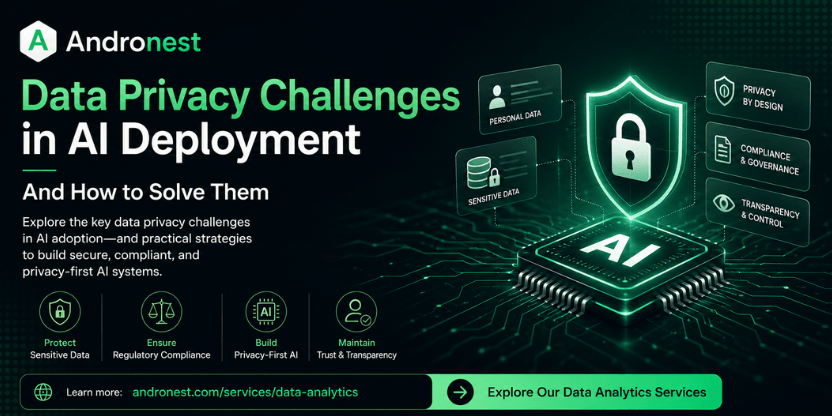
Artificial intelligence can transform how organizations analyze information, automate workflows, support employees, personalize customer experiences, and make business decisions. But as AI moves from experimentation into production, one challenge becomes increasingly important: how do you use AI without compromising data privacy?
AI systems often require access to large volumes of data. That data may include customer records, employee information, financial details, healthcare information, proprietary documents, communications, and other sensitive business information. When this information is processed by AI models, traditional privacy controls may no longer be sufficient on their own.
The challenge becomes even more complex with generative AI, large language models (LLMs), AI agents, retrieval-augmented generation (RAG), and third-party AI APIs.
A privacy failure can result in more than regulatory consequences. It can lead to data exposure, loss of customer trust, intellectual property leakage, security incidents, and reputational damage.
The solution is not to avoid AI.
Instead, organizations need to design privacy into the AI deployment lifecycle.
This guide explores the major data privacy challenges organizations face when deploying AI, why conventional data protection approaches may not be enough, and practical strategies for building privacy-aware AI systems.
What is Data Privacy in AI Deployment?
Data privacy in AI deployment refers to protecting personal, confidential, and sensitive information throughout the collection, processing, storage, training, inference, sharing, and disposal of data used by AI systems.
Traditional applications generally have clearly defined data flows.
For example:
User → Application → Database → Response
AI systems can introduce additional data paths:
User → Application → AI Model → External API → Model Output → Application → User
A production AI architecture may also include:
- Vector databases
- Knowledge bases
- Model providers
- AI agents
- Tool integrations
- Logs
- Monitoring platforms
- Analytics systems
- Human reviewers
Each additional component can create another place where sensitive information may be exposed or mishandled.
This is why privacy needs to be considered at the architecture level, not just through a privacy policy or access-control configuration.
Why AI Creates Unique Data Privacy Challenges
Traditional enterprise software collects data, stores it in defined locations, and exposes it through defined interfaces. The privacy challenges are primarily about access control, encryption, and retention — known problems with known solutions.
AI systems challenge all three of these assumptions simultaneously.
An AI model that has been trained on personal data does not store that data in a retrievable database field. It encodes patterns derived from that data in millions or billions of model parameters — a representation that is not human-readable, not easily audited, and not trivially erasable. When a user asks the model to complete a task, the model may reproduce fragments of its training data in its output without any retrieval step that data access controls could intercept.
An enterprise AI deployment that routes employee prompts to a commercial cloud AI provider exposes those prompts — which may contain sensitive customer data, proprietary business information, or personal details — to the provider’s infrastructure for processing. Standard data protection measures like field-level encryption do not apply to the content of natural language prompts.
And the regulatory frameworks governing these exposures were written before generative AI existed. Compliance teams attempting to apply GDPR’s right to erasure, right of access, or purpose limitation principles to large language model deployments are working at the frontier of regulatory interpretation, not in the territory of established compliance practice.
Understanding the specific mechanisms through which AI deployment creates privacy risk is the prerequisite for selecting the solutions that actually address those mechanisms.
Challenge 1: Personal Data in AI Training Sets
The problem: AI models require large, diverse datasets to learn the patterns that make them useful. In many enterprise AI use cases — customer service models, clinical AI systems, HR recommendation tools, financial advisory systems — the most valuable training data is the historical records of real people. These records contain personally identifiable information (PII), sensitive personal categories (health conditions, financial records, protected class characteristics), and behavioral data that individuals never consented to use for AI model training.
The consent problem is layered. The original consent collected when the data was first captured typically covers a specific, named purpose — a customer survey, a transaction record, a healthcare appointment — not the training of a machine learning model. Using that data to train an AI system without a separate legal basis may constitute a violation of the purpose limitation principle that sits at the core of GDPR, CCPA, and equivalent frameworks.
The solution: Several approaches address training data privacy simultaneously.
Synthetic data generation creates statistically realistic training data that mirrors the statistical properties of real datasets without containing real personal information. Synthetic data can be validated to preserve the predictive signal of the original data while providing demonstrably zero privacy exposure.
Data minimization ensures that only the data elements genuinely required for the model’s function are included in training — removing fields that are not analytically necessary even when they exist in the source dataset.
Federated learning enables model training without centralizing personal data at all: the model learns from data that remains on local devices or organization-controlled servers, with only aggregated model updates (not raw training data) shared with the central training system.
Differential privacy adds calibrated mathematical noise to training data or model outputs, ensuring that no individual’s data record is recoverable from the model’s learned parameters even through adversarial queries.
Challenge 2: Sensitive Data in AI Prompts and Inputs
The problem: Every interaction with a cloud-based AI system transmits a prompt — the text the user types or the data the application passes — to the provider’s infrastructure for processing. In enterprise contexts, these prompts routinely contain information that would require strict protection if transmitted in any other context: patient diagnoses in healthcare prompts, customer account details in service prompts, proprietary contract language in legal prompts, financial projections in strategic analysis prompts.
Jones Walker LLP’s 2026 Privacy Day analysis notes that “organizations should operate on the assumption that all employee interactions with public-tier AI systems are discoverable” — meaning that prompts sent to commercial AI providers may be subject to litigation discovery, regulatory investigation, or vendor data use policies that conflict with the organization’s own privacy obligations.
CIOs surveyed by Salesforce allocate an average of four times more budget to data infrastructure than to AI — a resource allocation that reflects how seriously technology leaders view this exposure. 99% of organizations expect to reallocate resources from privacy budgets to AI initiatives in the near term, creating capacity pressures that increase the risk of inadequately governed AI prompt exposure.
The solution: Multiple controls address prompt-time exposure.
Prompt filtering and redaction — implemented as a layer between the user and the AI provider — automatically detects and removes or pseudonymizes PII, sensitive business data, and regulated data categories from prompts before they are transmitted. Several commercial tools implement this as a transparent middleware layer.
Zero-retention modes offered by enterprise AI providers (including OpenAI’s enterprise tier and Microsoft Azure OpenAI Service’s data processing agreements) prevent inputs and outputs from being stored by the vendor or used for model improvement.
Private AI deployment — running AI models on organization-controlled infrastructure rather than on commercial cloud services — eliminates prompt exposure entirely by ensuring that inputs never leave the organization’s security perimeter.
Role-based prompt scope controls limit which employees can transmit which categories of data to AI systems, applying the same least-privilege principle that governs database access to AI query access.
Challenge 3: Re-identification of Anonymized Data
The problem: Anonymization has historically been the standard approach for enabling analytics on sensitive data — remove names, identifiers, and obvious PII, and the dataset is considered safe for broader use. This assumption has collapsed.
Modern AI tools can re-identify individuals from nominally anonymized datasets by correlating behavioral patterns, temporal signals, geographic data, and contextual information that are individually non-identifying but collectively unique. A dataset of anonymized hospital visits becomes re-identifiable when correlated with public social media data, local news coverage, and insurance claim records. A pseudonymized customer behavior dataset becomes re-identifiable when the behavioral pattern itself is unique enough to match an individual across systems.
Regulators have recognized this: the European Data Protection Board increasingly scrutinizes anonymization claims, particularly for large language model training data, under standards that few enterprises currently meet. The EU AI Act’s training data quality requirements for high-risk AI systems impose documentation and validation obligations that go significantly beyond traditional anonymization claims.
The solution: Genuine de-identification for AI training requires techniques that provide mathematical privacy guarantees rather than only removing obvious identifiers.
Differential privacy (described above) provides a formal mathematical guarantee that individual records cannot be recovered from the dataset or model outputs, regardless of what auxiliary information an adversary possesses.
k-anonymity, l-diversity, and t-closeness are progressively stronger data generalization techniques that ensure each record in a dataset is indistinguishable from a minimum number of other records across the quasi-identifier fields that enable re-identification.
Secure multi-party computation enables multiple organizations to perform joint analysis on their combined datasets without any party revealing its raw data to another — useful when the most valuable training data requires combining data from multiple organizations, each of which has privacy obligations to its own subjects.
Challenge 4: Cross-Border Data Transfer and Regulatory Jurisdiction
The problem: 71% of organizations cite cross-border data transfer compliance as their top regulatory challenge, according to SecurePrivacy’s 2026 Data Privacy Trends analysis. AI deployment compounds this challenge because the compute infrastructure that runs AI models — GPU clusters, inference endpoints, model training pipelines — is highly concentrated in a small number of geographic locations that may not correspond to the regulatory jurisdictions of the data being processed.
An organization that collects patient data from EU residents, processes it through a US-based AI cloud service, stores outputs in Singapore, and accesses those outputs from a development team in India has created a cross-jurisdictional exposure that each jurisdiction’s privacy law governs in different and potentially conflicting ways. GDPR requires that cross-border data transfers to non-adequate countries (including the US, absent specific safeguards) be covered by Standard Contractual Clauses or equivalent mechanisms. The US Department of Justice’s Bulk Data Transfer Rule, which took effect in 2025, imposes additional obligations on large-scale transfers of US sensitive personal data to countries of concern.
The solution:
Data residency architecture — explicitly designing AI infrastructure so that data is processed within the regulatory jurisdiction in which it was collected — is the most direct solution. Cloud providers including AWS, Azure, and GCP offer regional deployment options specifically designed to address data residency requirements.
Standard Contractual Clauses (SCCs) provide the contractual framework for GDPR-compliant cross-border transfers where regional deployment is not feasible.
Data flow mapping — documenting every system, vendor, and jurisdiction through which data travels during AI processing — is the prerequisite for identifying and closing jurisdictional compliance gaps.
Vendor privacy agreements that specify data processing locations, retention periods, and employee access restrictions bring commercial AI providers within the organization’s data governance framework rather than outside it.
Challenge 5: Model Output Privacy and Training Data Memorization
The problem: Large language models can memorize and reproduce verbatim fragments of their training data — including personal information, proprietary data, or confidential content that was present in the training set. This phenomenon, documented extensively in academic AI safety research, means that a model trained on data containing personal information may disclose that information in response to adversarial prompts designed to elicit memorized content.
This creates a specific challenge for the right to erasure under GDPR: if a model has memorized an individual’s personal data during training, deleting that data from the training database does not remove it from the model. Retraining the model without the individual’s data is technically possible but computationally expensive and may require discarding significant model capability developed from the broader training corpus.
The solution:
Machine unlearning — techniques for removing the influence of specific training examples from a trained model without full retraining — is an active research area with several practical implementations for smaller model deployments. For large foundation models, output filtering at the inference layer detects and blocks outputs that match patterns of personally identifiable information before they reach the user.
Minimum data collection from the outset — training models only on data with documented legal basis and privacy review — is significantly more cost-effective than attempting to remediate memorization after training.
Privacy auditing of model outputs — systematically probing the model for disclosure of sensitive training content during the evaluation phase — enables identification of memorization issues before production deployment.
Challenge 6: Third-Party AI Vendor Risk
The problem: Most enterprise AI deployments depend on third-party models, APIs, and infrastructure providers. Each vendor relationship creates a data privacy exposure that the organization’s internal controls cannot fully govern: the vendor may use input data for model training, store conversation history, expose data to subprocessors in additional jurisdictions, or experience a data breach that affects the organization’s data held on vendor infrastructure.
82% of organizations have developed plans to use generative AI in their data security programs, but the same AI integration that enhances security also extends the organization’s attack surface through the vendor relationships it creates. Standard Contractual Clauses and data processing agreements provide contractual protection but not technical protection against vendor-side breaches or misuse.
The solution:
Data Processing Agreements (DPAs) specifying the vendor’s data processing purposes, retention periods, subprocessor restrictions, and breach notification obligations are the contractual foundation.
Vendor privacy due diligence — assessing each AI vendor’s data handling practices, security certifications (SOC 2, ISO 27001), breach history, and regulatory compliance posture before contract execution — provides the selection-stage controls.
Zero-retention API configurations that prevent vendors from retaining inputs and outputs beyond the processing session eliminate the most significant ongoing exposure.
Prompt filtering and redaction (as described above) reduces the sensitivity of data transmitted to vendor systems.
On-premises model deployment eliminates vendor exposure entirely for the highest-sensitivity use cases.
Challenge 7: Right to Explanation and Algorithmic Transparency
The problem: GDPR Article 22 grants individuals the right not to be subject to decisions based solely on automated processing when those decisions produce legal or similarly significant effects — and the right to obtain meaningful information about the logic involved when such processing occurs. The EU AI Act imposes transparency and explainability requirements on high-risk AI systems used in employment, credit scoring, healthcare, insurance underwriting, and law enforcement contexts.
Most modern AI systems — particularly large language models and deep learning models — are not natively explainable. The relationship between inputs and outputs is mediated by millions of parameters whose individual contributions to a specific output cannot be straightforwardly articulated in terms that satisfy regulators or affected individuals.
The solution:
Explainable AI (XAI) techniques — including LIME (Local Interpretable Model-agnostic Explanations), SHAP (SHapley Additive exPlanations), and attention visualization — provide post-hoc explanations of model decisions in terms that human reviewers can evaluate and regulators can assess.
Human-in-the-loop controls for the highest-risk decision types ensure that AI recommendations are reviewed by qualified humans before they produce legal effects — satisfying the “not solely automated” requirement of Article 22.
Model cards and AI system documentation — standardized descriptions of model training data, intended use cases, known limitations, and performance characteristics across demographic groups — satisfy transparency obligations and support audit and investigation.
Challenge 8: Shadow AI and Unauthorized Data Exposure
The problem: Employees who discover that AI tools increase their productivity often adopt them before organizational AI governance policies address those specific tools. This shadow AI phenomenon — employees using publicly available AI services that the IT and privacy functions have not reviewed, assessed, or authorized — creates data exposures that no organizational control addresses because the organization does not know the exposure exists.
23% of surveyed leaders cite disparate tools with no centralized dashboard as a top data visibility and governance challenge, according to the 2026 Microsoft Data Security Index Report. AI proliferation accelerates this fragmentation: each employee-adopted AI tool is a potential channel for sensitive data to leave the organization without review.
The solution:
AI acceptable use policies — specifying which AI systems employees are authorized to use, which categories of data may be submitted to each system, and what constitutes prohibited use — provide the governance baseline.
Employee training on AI-specific privacy risks addresses the most consistent failure mode: employees who expose sensitive data not from malice but from unawareness of the risk.
AI system discovery and monitoring — tools that detect when organizational data is being transmitted to AI endpoints not on the approved list — provides the technical enforcement layer.
Approved AI tool programs — curating and providing access to reviewed, privacy-assessed AI tools — reduce the incentive for shadow AI adoption by ensuring that employees who want AI productivity benefits have access to tools the organization has validated.

The Regulatory Landscape: What Governs AI Data Privacy
The regulatory environment for AI data privacy in 2026 is the most complex, most actively enforced, and most financially consequential it has ever been.
EU AI Act (full enforcement August 2026). The world’s first comprehensive AI regulation classifies AI systems by risk level and imposes data governance requirements on high-risk systems used in employment, credit, healthcare, education, and public services. Non-compliance fines reach €35 million or 7% of global annual revenue — double the GDPR maximum. High-risk AI systems must meet training data quality standards, maintain technical documentation, implement human oversight mechanisms, and log their operations for post-market monitoring.
GDPR (2025 proposed amendments). GDPR’s core principles — lawful basis, purpose limitation, data minimization, accuracy, storage limitation, and security — apply fully to AI systems, regardless of whether the term “artificial intelligence” appears in the regulation. The European Commission’s Q4 2025 proposed amendments clarify AI obligations and expand the scope of data protection impact assessment requirements for AI deployments. Cumulative GDPR fines have now exceeded €7.1 billion, with regulators increasingly focusing enforcement on AI, adtech, and cross-border data transfers.
US State Privacy Laws. Twenty states now have comprehensive privacy legislation, creating a regulatory patchwork that multi-state organizations must navigate without the unified federal framework that remains stalled in Congress. California (CPRA), Virginia, Colorado, Connecticut, Texas, and fifteen additional states each impose distinct requirements for AI systems that process personal data of their residents — including new requirements for automated decision-making and data protection impact assessments.
DOJ Bulk Data Transfer Rule (effective 2025). Large-scale transfers of US sensitive personal data to countries of concern require due diligence, access controls, and ongoing monitoring obligations that apply directly to AI training data pipelines and inference infrastructure.
Privacy-Enhancing Technologies: The Technical Solutions at Scale
Privacy-enhancing technologies (PETs) are the technical category that enables AI systems to function on sensitive data while providing mathematical guarantees of privacy protection. The global PET market reached $3.12 to $4.40 billion in 2024 and is projected to reach $12.09 to $28.4 billion by 2030 to 2034 — reflecting the enterprise investment in moving from compliance checkbox approaches to genuine technical privacy protection.
Federated Learning enables model training across distributed data sources — hospital networks, retail chains, financial institutions — without centralizing the underlying personal data. Each participating organization trains on its local data and shares only model parameter updates with the central aggregation system. No raw training data leaves the organization that collected it.
Differential Privacy adds calibrated mathematical noise to training data, query outputs, or statistical analyses, providing a formal guarantee that an adversary with access to the model or its outputs cannot determine whether any specific individual’s data was present in the training set. Google and Apple have deployed differential privacy in production systems at scale; it is no longer an experimental technique.
Homomorphic Encryption enables computation on encrypted data — the AI system processes encrypted inputs and returns encrypted outputs, with the organization holding the only key that can decrypt the results. This enables outsourcing AI computation to untrusted infrastructure without exposing the underlying data. Computational overhead remains significant but is declining rapidly with hardware acceleration.
Secure Multi-Party Computation (SMPC) enables multiple organizations to jointly compute a function of their combined data — training a shared model, for example — without any party revealing its input data to another. This is particularly valuable for industry consortium AI use cases where the most predictive model would benefit from cross-organizational data but each organization has privacy obligations to its own subjects.
Synthetic Data Generation produces statistically realistic artificial datasets that preserve the distributional characteristics of real data without containing any real personal records. Synthetic data can be used for model training, testing, and development without creating privacy exposure. Organizations treating “privacy debt like technical debt” — a recommendation from ComplyJet’s 2026 GDPR compliance analysis — use synthetic data from the beginning of AI development rather than attempting to retrofit privacy compliance to systems built on real personal data.

The AI Data Privacy Lifecycle
A practical framework can be organized into seven stages.
1. Collect
Determine what information the AI system needs.
2. Classify
Identify:
- Public data
- Internal data
- Confidential data
- Personal data
- Highly sensitive data
3. Minimize
Only provide the AI system with the information necessary for its task.
4. Protect
Use:
- Encryption
- Access control
- Tokenization
- Anonymization
- Pseudonymization
5. Process
Control where and how AI systems can use the data.
6. Monitor
Track:
- Access
- Prompts
- Outputs
- Data transfers
- Agent actions
- Policy violations
7. Delete
Apply defined retention and deletion policies.
This creates a lifecycle rather than treating privacy as a one-time security configuration.
Data Minimization: One of the Most Important AI Privacy Principles
A powerful privacy strategy is simply:
Give the model less data.
Suppose an AI assistant needs to answer:
“What is the status of my order?”
It may only need:
- Order ID
- Product
- Status
- Estimated delivery date
It probably doesn’t need:
- Full payment information
- Complete customer history
- Internal financial records
- Unrelated customer data
Reducing the model’s context reduces potential exposure.
AI Privacy Testing
Privacy shouldn’t be assumed.
It should be tested.
Organizations can create test scenarios such as:
Unauthorized retrieval
Can User A access User B’s information?
Prompt injection
Can malicious input cause the system to reveal restricted information?
Data leakage
Can sensitive information appear in model responses?
Cross-user contamination
Can one user’s conversation influence another user’s response?
RAG permission failure
Can the retrieval system return documents the user shouldn’t access?
Agent authorization failure
Can an AI agent perform an action beyond its permissions?
Testing should occur before production and continue after deployment.
AI Governance and Privacy Policies
Technology controls need organizational governance behind them.
Organizations should establish policies covering:
- Approved AI systems
- Prohibited data
- Data retention
- Model usage
- Third-party providers
- Employee responsibilities
- Incident reporting
- Human oversight
- Model evaluation
- Data ownership
An AI governance committee may include representatives from:
- IT
- Security
- Legal
- Compliance
- Data
- Product
- Business units
The exact structure should match the organization’s size and regulatory environment.
Regulatory Compliance and AI Privacy
AI privacy requirements vary by jurisdiction and industry.
Depending on where an organization operates and what information it processes, relevant privacy and AI regulations may include:
- GDPR
- CCPA/CPRA
- HIPAA
- GLBA
- State privacy laws
- Industry-specific requirements
- Emerging AI regulations
Organizations should not assume that using a third-party AI provider automatically makes the application compliant.
Compliance depends on the complete system:
Data + Model + Infrastructure + Vendor + Application + People + Processes
For high-risk or highly regulated AI applications, organizations should involve qualified legal and compliance professionals when determining specific obligations.
How to Build a Privacy-First AI Deployment Strategy
A practical approach can follow these steps.
Step 1: Inventory AI Use Cases
Identify every AI application currently being used or planned.
Include:
- Official AI projects
- Third-party AI tools
- Employee experimentation
- Embedded AI features
- AI agents
Step 2: Map Data Flows
Document:
What data → Which system → Which model → Which provider → Where processed → Where stored
This often reveals privacy gaps that aren’t obvious from the application architecture.
Step 3: Classify Data
Create categories based on sensitivity.
For example:
Public
Internal
Confidential
Sensitive
Highly Restricted
Step 4: Define Approved AI Environments
Not every AI service should be approved for every type of data.
Create clear rules around:
- Public AI tools
- Enterprise AI platforms
- Private models
- On-premises AI
- Private cloud AI
Step 5: Implement Least Privilege
Give AI systems only the access they require.
Step 6: Add Privacy Controls
Consider:
- PII detection
- Redaction
- DLP
- Encryption
- Access control
- Data minimization
- Retention management
Step 7: Test for Privacy Failures
Conduct adversarial and functional privacy testing.
Step 8: Monitor Production
Track:
- Sensitive-data exposure
- Unauthorized retrieval
- Policy violations
- AI agent actions
- Third-party data transfers
- User behavior
Step 9: Review Continuously
AI systems evolve.
Models change.
Data sources change.
New tools are added.
Privacy assessments therefore need to be continuous.
Turn AI opportunities into a practical strategy for growth, efficiency, and innovation with Andronest’s AI consulting services.
On-Premises and Private AI Deployment
For particularly sensitive workloads, organizations may consider private or locally deployed AI.
Depending on the use case, private AI deployment can provide greater control over:
- Data location
- Network access
- Model hosting
- Data retention
- Security policies
- Integration with internal systems
However, private deployment doesn’t automatically guarantee privacy.
Organizations still need:
- Identity controls
- Encryption
- Secure infrastructure
- Monitoring
- Model governance
- Data classification
- Access management
The right deployment model depends on the organization’s security, privacy, performance, cost, and regulatory requirements.
How to Choose the Right AI Deployment Model
Organizations can broadly evaluate three approaches.
| Deployment Model | Privacy Control | Operational Complexity | Typical Use |
| Public AI service | Lower control | Low | General, non-sensitive tasks |
| Enterprise-managed AI | Moderate to high | Moderate | Business applications |
| Private/local AI | Highest infrastructure control | Higher | Highly sensitive workloads |
This isn’t an absolute ranking.
A well-configured managed enterprise AI environment can provide strong privacy controls, while a poorly secured private deployment can still expose sensitive data.
The architecture and governance matter as much as the hosting model.
Common Mistakes in AI Data Privacy
- Assuming the AI Provider Handles Everything
Vendor security doesn’t replace customer-side governance. - Giving the Model Too Much Data
More context isn’t always better. - Ignoring AI Logs
Logs can contain the same sensitive information as prompts. - Treating RAG as Automatically Secure
RAG must enforce source permissions. - Giving AI Agents Excessive Permissions
Agents should operate with the minimum access necessary. - Using Production Data Without Assessment
Sensitive production data should not automatically become AI training data. - Treating Privacy as a Compliance-Only Problem
Privacy affects architecture, security, UX, data management, and customer trust. - Failing to Test Privacy
A system can appear secure until it encounters an unexpected request.
Build intelligent AI agents that automate workflows, take action, connect with business systems, and help your teams work more efficiently. Learn more.
AI Data Privacy Checklist
Before deploying an AI application, ask:
Data
- What data does the AI need?
- Is personal or confidential data involved?
- Can unnecessary data be removed?
Model
- Where is the model hosted?
- Is data used for training?
- What retention policies apply?
Access
- Who can access the AI?
- What data can each user access?
- Does RAG enforce source permissions?
Security
- Is data encrypted?
- Are APIs secured?
- Are secrets protected?
Agents
- What actions can AI perform?
- Which actions require approval?
- Are agent activities logged?
Monitoring
- Are prompts and outputs monitored appropriately?
- Is sensitive information redacted from logs?
- Are privacy violations detected?
Governance
- Is there an AI usage policy?
- Are vendors assessed?
- Are privacy impact assessments required?
Compliance
- Which privacy and industry regulations apply?
- Where is data processed?
- Are cross-border transfers involved?
If these questions cannot be answered clearly, the AI system may not be ready for production.
The Future of AI Data Privacy
AI privacy will increasingly become an engineering discipline rather than a policy document.
Organizations are likely to invest more heavily in:
- AI security gateways
- Privacy-aware RAG
- Automated PII detection
- Policy enforcement
- Confidential computing
- Private AI infrastructure
- AI-specific DLP
- Agent authorization
- Model privacy testing
- Automated compliance monitoring
As AI agents become more capable, privacy controls will need to evolve from protecting data at rest and in transit to controlling what AI systems can see, infer, remember, and do.
This creates a broader security principle:
An AI system should have only the data, context, tools, and authority required to perform its assigned task.
Frequently Asked Questions
What are the biggest data privacy challenges in AI deployment?
The biggest challenges include sensitive data exposure, third-party AI providers, training-data privacy, RAG permissions, AI agent access, logging, data retention, cross-border processing, and unintended information disclosure.
How can organizations protect personal data when using AI?
Organizations can use data minimization, access controls, encryption, anonymization or pseudonymization, DLP, secure AI gateways, privacy-aware RAG, monitoring, and clear data-retention policies.
Is it safe to send sensitive data to an AI model?
It depends on the AI environment, provider, contractual terms, architecture, security controls, and type of data. Organizations should assess these factors before sending sensitive information to an AI system.
How does RAG affect data privacy?
RAG can introduce privacy risks if retrieval doesn’t enforce the user’s existing permissions. A secure RAG architecture should ensure users can retrieve only information they are authorized to access.
Are AI agents a privacy risk?
AI agents can create additional privacy and security risks because they may have access to multiple systems and tools. Least-privilege permissions, action boundaries, monitoring, and human approval for sensitive actions can reduce those risks.
Should businesses use private AI for sensitive data?
Private AI can provide greater control over data location, infrastructure, and access, but it isn’t automatically more secure. Organizations must still implement strong security, privacy, governance, and monitoring controls.
Can AI models leak training data?
AI models can potentially reproduce or expose information contained in training data under certain circumstances. Organizations should carefully evaluate training datasets, minimize sensitive information, and test models for unintended disclosure.
How important is data minimization for AI?
Data minimization is fundamental because reducing the amount of sensitive information available to an AI system reduces potential exposure and limits unnecessary access.
Final Thoughts
AI can deliver significant business value, but organizations shouldn’t treat data privacy as something to address after deployment.
The privacy architecture needs to be designed before the AI system starts processing sensitive information.
The most effective strategy combines:
Data minimization + Strong identity + Least privilege + Secure architecture + Privacy-aware retrieval + Controlled AI access + Monitoring + Governance
For organizations deploying generative AI, RAG applications, or AI agents, the challenge goes beyond protecting databases.
They must control what AI systems can access, what information they receive as context, what they retain, what they can infer, what tools they can use, and what actions they can take.
The goal isn’t to prevent AI from accessing business data.
The goal is to ensure that AI has the right data, for the right purpose, under the right controls.
Organizations that build privacy into AI architecture from the beginning will be better positioned to scale AI responsibly while maintaining customer trust, protecting sensitive information, and meeting their regulatory and business obligations.