Artificial Intelligence (AI) has rapidly evolved from an emerging technology to a strategic business necessity. Organizations across industries are leveraging AI to automate workflows, improve customer experiences, enhance decision-making, and drive innovation at unprecedented speeds.
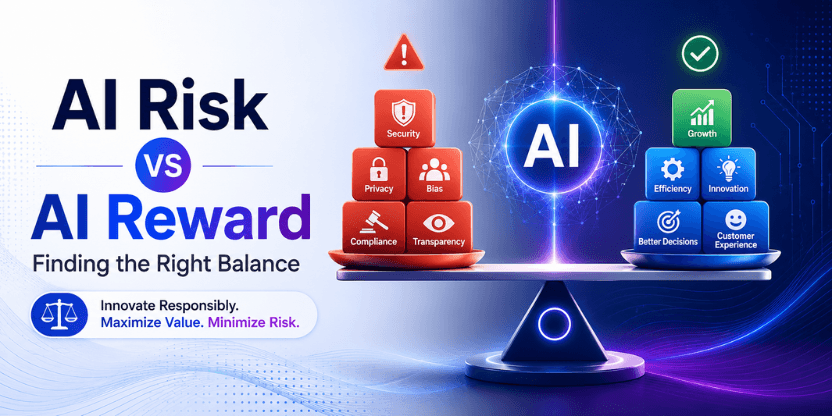
However, as AI adoption accelerates, so do concerns around security, compliance, bias, transparency, privacy, and operational risks. While AI offers significant rewards, businesses must carefully evaluate and manage the associated risks to ensure sustainable success.
The question is no longer whether organizations should adopt AI—it is how they can maximize AI’s benefits while minimizing potential risks.
In this guide, we’ll explore the rewards and risks of AI, the challenges organizations face, and practical strategies for achieving the right balance.
Why AI Adoption is Accelerating
Businesses are investing heavily in AI because of its ability to:
- Automate repetitive tasks
- Improve operational efficiency
- Reduce costs
- Enhance customer engagement
- Accelerate innovation
- Generate actionable insights
- Improve decision-making
- Increase competitiveness
According to industry reports, AI is becoming a core component of digital transformation strategies across sectors including healthcare, finance, retail, manufacturing, education, and technology.
Organizations that effectively leverage AI often gain significant competitive advantages over slower-moving competitors.
Read: AI Risk Management – What Every CIO Should Know
Understanding the Rewards of AI
Increased Productivity and Efficiency
One of the most immediate benefits of AI is automation.
AI-powered systems can handle:
- Data processing
- Customer support
- Document analysis
- Report generation
- Lead qualification
- Workflow management
This reduces manual effort and allows employees to focus on higher-value strategic tasks.
Example
Customer service teams using AI chatbots can resolve routine inquiries 24/7 while human agents focus on complex cases.
Better Decision-Making
AI can analyze vast amounts of data in real time and uncover insights that humans may miss.
Benefits include:
- Predictive analytics
- Demand forecasting
- Risk assessment
- Market trend analysis
- Customer behavior insights
Organizations can make faster, more informed decisions using AI-generated recommendations.
Enhanced Customer Experience
Modern consumers expect personalized experiences.
AI enables:
- Personalized recommendations
- Intelligent search
- Virtual assistants
- Predictive support
- Automated communication
These capabilities improve customer satisfaction and loyalty.
Innovation and Competitive Advantage
AI allows organizations to create entirely new products, services, and business models.
Examples include:
- AI-powered healthcare diagnostics
- Intelligent financial advisory platforms
- Autonomous manufacturing systems
- AI-driven software development tools
Businesses that innovate successfully with AI often gain substantial market advantages.
Cost Reduction
AI helps organizations optimize resources and reduce operational costs through:
- Process automation
- Reduced manual labor
- Faster issue resolution
- Improved resource allocation
- Predictive maintenance
These efficiencies often generate measurable ROI.
Understanding the Risks of AI
While AI offers significant opportunities, organizations must also recognize the associated risks.
Data Privacy and Security Risks
AI systems rely heavily on data.
Potential risks include:
- Data breaches
- Unauthorized access
- Sensitive information exposure
- Regulatory violations
Organizations handling customer or confidential data must implement strong security controls.
- Common Concerns
- GDPR compliance
- CCPA compliance
- Data residency requirements
- Cross-border data transfers
AI Bias and Fairness Issues
AI models learn from existing data.
If training data contains biases, AI systems may produce biased outcomes.
Examples include:
- Hiring discrimination
- Loan approval bias
- Healthcare disparities
- Customer segmentation inaccuracies
Organizations must continuously monitor AI outputs to ensure fairness.
Lack of Transparency
Many AI systems function as “black boxes.”
Decision-making processes may not always be fully explainable.
This creates challenges for:
- Compliance
- Auditing
- Customer trust
- Regulatory reporting
Explainable AI is becoming increasingly important:
Regulatory and Compliance Challenges
Governments worldwide are introducing AI regulations.
Organizations must prepare for:
- AI governance requirements
- Industry-specific regulations
- Accountability standards
- Transparency mandates
Failure to comply can result in legal and financial consequences.
Operational Dependency Risks
Over-reliance on AI can create vulnerabilities.
Potential issues include:
- System failures
- Model inaccuracies
- Service outages
- Poor business decisions
Human oversight remains critical.
Intellectual Property and Copyright Concerns
Generative AI introduces questions around:
- Content ownership
- Copyright infringement
- Training data usage
- Brand reputation
Organizations should establish clear policies governing AI-generated content.
The AI Risk vs Reward Matrix
| AI Initiative | Potential Reward | Potential Risk |
| Customer Support Chatbots | High | Low |
| Predictive Analytics | High | Medium |
| AI Content Generation | Medium | Medium |
| Automated Decision-Making | High | High |
| Autonomous Operations | Very High | Very High |
This framework helps prioritize AI investments based on business value and risk exposure.
How to Balance AI Risks and Rewards
Start with Business Objectives
AI should solve real business problems.
Avoid implementing AI simply because it’s trending.
Ask:
- What problem are we solving?
- What outcomes are we expecting?
- How will success be measured?
Clear objectives reduce unnecessary risk.
Implement Strong AI Governance
AI governance provides oversight and accountability.
Key components include:
- AI policies
- Risk assessments
- Ethical guidelines
- Security controls
- Compliance frameworks
Governance ensures responsible AI adoption.
Keep Humans in the Loop
Human oversight remains essential.
Employees should:
- Review critical AI decisions
- Validate outputs
- Handle exceptions
- Monitor system performance
The best results often come from AI-human collaboration.
Prioritize Data Quality
AI is only as effective as the data it uses.
Organizations should:
- Clean data regularly
- Eliminate duplicates
- Validate inputs
- Monitor data integrity
High-quality data improves AI performance and reduces errors.
Invest in Security and Compliance
AI security should be integrated from the beginning.
Recommended measures include:
- Encryption
- Access controls
- Data masking
- Audit trails
- Compliance monitoring
Security should not be an afterthought.
Conduct Continuous Monitoring
AI systems evolve over time.
Organizations should continuously monitor:
- Model performance
- Bias indicators
- Accuracy levels
- Compliance metrics
- Security events
Regular reviews help identify risks early.
Building Your AI Risk-Reward Strategy
Step 1: Audit Your Current AI Portfolio
Before making any new AI investments, map every AI system currently in operation — including AI-enabled SaaS features and employee-adopted tools.
For each system, assess:
- What business outcome is it designed to improve?
- What is its measured performance against that outcome?
- What data does it process, and what governance is in place?
- What are the consequences of an error, and is human oversight proportional to those consequences?
This audit typically reveals: some high-performing, well-governed systems generating real value; some systems generating activity but not outcomes; some systems operating without governance; and some systems that should be retired.
Step 2: Categorize Applications by Risk-Reward Profile
Using the quadrant framework above, place each current and proposed AI application in its appropriate risk-reward category. Priority applications (high reward, low risk) should receive fast-tracked deployment resources. Strategic applications (high reward, high risk) should receive governance infrastructure investment before expansion. Low reward applications should be deprioritized. High risk, low reward applications should be exited.
Step 3: Build Governance Proportional to Risk
Not every AI system needs the same governance overhead. A tiered governance framework — intensive controls for high-risk systems, standard monitoring for medium-risk, lightweight audits for low-risk — enables governance without creating bureaucratic friction that slows all AI deployment to the pace of the most conservative review.
Step 4: Invest in AI Literacy Across the Organization
AI super-users were 3x more likely to have received both a promotion and a pay raise in the past year. They are 4.5x more productive than AI laggards. The organization’s average AI capability is the sum of its individual AI capabilities — and building those capabilities through deliberate training and knowledge sharing is one of the highest-return AI investments available.
Step 5: Create Feedback Loops Between Risk and Reward
The organizations that find and maintain the right balance treat risk and reward as a continuous feedback loop — not a one-time decision. As AI systems generate more outcome data, risk assessments should be updated. As the regulatory environment evolves, governance should adapt. As the competitive landscape changes, reward calculations should be refreshed.
AI Governance Best Practices
Successful organizations typically follow these practices:
Create an AI Governance Committee
Establish oversight across:
- IT
- Security
- Legal
- Compliance
- Business Operations
Define AI Usage Policies
Clearly document:
- Approved AI tools
- Data handling requirements
- Security expectations
- Employee responsibilities
Perform Regular Audits
Review:
- AI outputs
- Decision quality
- Compliance adherence
- Risk exposure
Educate Employees
Training helps users understand:
- AI capabilities
- Limitations
- Security responsibilities
- Ethical considerations
Future Outlook: Responsible AI Will Win
The future belongs to organizations that embrace AI responsibly.
Businesses that focus solely on innovation may expose themselves to unnecessary risks.
Conversely, organizations that avoid AI entirely risk losing competitiveness.
The winning strategy is finding the balance:
- Innovate aggressively
- Govern responsibly
- Monitor continuously
- Keep humans involved
- Prioritize transparency and trust
Responsible AI adoption will become a defining characteristic of successful organizations over the next decade.
Conclusion
AI presents one of the greatest opportunities in modern business history. From productivity gains and enhanced customer experiences to innovation and competitive advantage, the rewards are significant.
However, AI also introduces challenges related to privacy, security, bias, compliance, transparency, and operational risk.
Organizations that thrive will be those that balance innovation with governance, automation with oversight, and efficiency with accountability.
The goal is not to eliminate AI risks entirely—it’s to manage them effectively while maximizing the rewards. By adopting a thoughtful, strategic approach to AI implementation, businesses can unlock transformative value while building trust, resilience, and long-term success.