Artificial intelligence is only as reliable as the data behind it.
Organizations may have large volumes of customer records, documents, transactions, application logs, sensor data, emails, and other information, but raw data is rarely ready to support AI applications. It often contains duplicates, missing values, inconsistent formats, outdated records, irrelevant information, and disconnected sources.
This is where data processing services become critical.
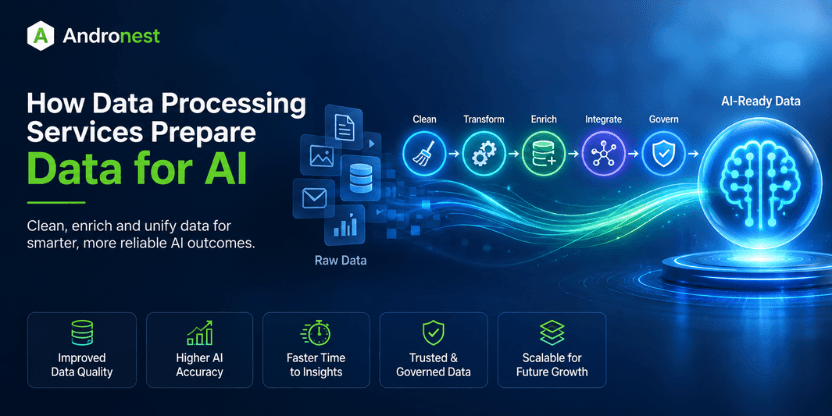
Data processing services transform raw, fragmented information into structured, validated, enriched, and accessible data that AI systems can use effectively. Whether an organization is building predictive models, generative AI applications, RAG systems, or AI agents, data processing provides an important foundation for reliable AI outcomes.
This guide explains how data processing services prepare enterprise data for AI, the key stages involved, common challenges, and best practices for building an AI-ready data foundation.
Key Takeaways
- AI systems require data that is accurate, consistent, relevant, accessible, and properly governed.
- Data processing converts raw information from multiple sources into AI-ready datasets.
- Important processing activities include data ingestion, cleaning, validation, transformation, enrichment, integration, and governance.
- Unstructured data such as documents, emails, images, and audio requires specialized processing before it can be effectively used by many AI applications.
- AI-ready data pipelines should support both batch and real-time processing, depending on the use case.
- Data quality directly affects AI accuracy, reliability, and business value.
- Organizations should treat data processing as an ongoing capability rather than a one-time preparation exercise.
Why Data Preparation is the Most Critical Phase of Any AI Project
The relationship between data quality and AI performance is not linear — it is multiplicative. An AI model trained on high-quality, diverse, well-labeled data produces significantly more accurate and reliable output than the same model architecture trained on poor-quality data. And unlike traditional software systems, which can sometimes compensate for poor data through better logic, AI models cannot compensate for the data they were trained on. The patterns they learn are the patterns the training data contained — including the patterns of error, bias, incompleteness, and inconsistency.
Data scientists and ML engineers consistently report that data preparation consumes 60% to 80% of the total time spent on AI projects. This figure is frequently cited as a productivity problem — time that could be spent on model development is spent on data cleaning. But this framing misses the more important point: data preparation is not overhead. It is the determinative work. A project that invests its time well in data preparation and modestly in model selection will outperform a project that invests modestly in data preparation and heavily in model selection, in almost every production context.
Gartner’s analysis of AI-ready data makes an important clarification that most data preparation frameworks overlook: there is no way to make data AI-ready in general or in advance. The readiness of data for AI depends entirely on how that data will be used. The dataset required to build a predictive maintenance algorithm is fundamentally different from the dataset required to ground a generative AI system in enterprise context. The dataset required to train a demand forecasting model is different from the dataset required to classify customer support tickets. Data processing services that prepare data for AI must therefore be use-case specific — beginning with a clear understanding of what the AI is being asked to do, and working backward to the specific data preparation requirements that use case demands.
By 2026, most organizations have recognized that AI success depends far more on data engineering than on model selection, according to Trigyn’s Data Engineering Trends 2026 analysis. High-performing AI systems require consistent data pipelines, reliable metadata, and strong governance across the entire data lifecycle. Data processing is not preparation for the real work — it is the real work.
Need secure and reliable infrastructure for your data? Explore Andronest’s Data Center & Colocation Services.
What AI-Ready Data Actually Means: The Six Dimensions
AI-ready data is data that has been cleansed, labeled, validated, and transformed into a high-quality format suitable for training or deployment by an AI system. But readiness is not a binary state — it exists across six dimensions that data processing services assess and address systematically.
Accuracy. The data must faithfully represent the real-world entities, events, and relationships it describes. Errors in source data — incorrect values, misattributed records, corrupted fields — propagate directly into AI model behavior. An accuracy problem in training data becomes a reliability problem in AI output.
Completeness. The dataset must contain the information the AI needs to learn the patterns it is expected to apply. Systematically missing data — records with empty fields, gaps in time series, source systems that were offline during certain periods — creates gaps in the model’s understanding of the patterns it needs to represent.
Consistency. The same entity must be represented in the same way across all systems and time periods. A customer whose name is spelled three different ways across the CRM, the ERP, and the support system is three entities to any AI system that has not been told they are one. Consistency requires data normalization, entity resolution, and master data management across the full data environment.
Diversity. The dataset must represent the full range of scenarios, populations, and patterns the AI is expected to handle — not just the patterns that are most common in the training data. A model trained on data that systematically underrepresents certain customer segments, geographic regions, or edge case scenarios will perform poorly precisely in those underrepresented contexts. This is the mechanism through which AI bias is embedded: not through intentional design, but through unrepresentative training data.
Timeliness. The data must be current enough to reflect the patterns the AI is expected to apply in production. A fraud detection model trained on transaction patterns from two years ago may not recognize the patterns of current fraud. A demand forecasting model trained on pre-pandemic purchasing behavior may not accurately forecast post-pandemic demand. Timeliness requires both data recency and continuous refresh as the real world evolves.
Discoverability and Governance. The data must be accessible to the AI systems and teams that need it, with appropriate controls on who can access what, full lineage tracing that establishes where the data came from and how it was transformed, and documentation that makes the data’s content and quality standards understandable to the teams using it.
The Seven Stages of Data Processing for AI
Data processing services prepare data for AI through a pipeline of seven sequential stages. Each stage addresses a specific category of readiness gap, and the output of each stage becomes the input for the next.
Stage 1: Data Discovery and Profiling
Before any data preparation work begins, data processing services conduct a systematic assessment of the data landscape: what data exists, where it lives, what format it is in, what quality issues it contains, and whether it is relevant to the specific AI use case being pursued.
Data profiling involves automated analysis of every candidate dataset — row counts, field completeness rates, value distributions, format patterns, cardinality, null rates, and the presence of outliers or anomalous values. This profiling produces a data quality baseline: a quantitative picture of the current state that defines the gap between where the data is and where it needs to be to support the intended AI application.
Discovery also identifies data that does not yet exist — the gaps between what the AI needs and what the organization currently collects. Addressing these gaps may require implementing new data collection mechanisms, integrating external data sources, or using data augmentation techniques to artificially expand the available training data.
The profiling output determines the scope and sequencing of all subsequent preparation work. Data that is 97% complete and format-consistent requires different preparation investment than data that is 60% complete with significant format variation across source systems.
Stage 2: Data Collection and Ingestion
Once the required data sources are identified, data processing services implement the ingestion pipelines that collect data from those sources on a scheduled or continuous basis. For AI applications, this ingestion must address the full diversity of source formats and delivery mechanisms that enterprise data environments contain.
Structured data — relational databases, ERP systems, CRM platforms, financial systems — is extracted through database connectors, API integrations, and CDC (Change Data Capture) patterns that capture every insert, update, and delete as it occurs in the source system.
Unstructured data — documents, emails, PDFs, images, audio, video, and code — requires format-specific ingestion patterns that extract the content in a form that downstream processing stages can work with. For generative AI applications that will reason over enterprise documents, this means OCR for scanned documents, audio transcription for recorded communications, and document parsing for structured content in unstructured formats.
Streaming data — IoT sensor readings, clickstream events, transaction records, and real-time operational signals — requires streaming ingestion infrastructure (Apache Kafka, Amazon Kinesis, Azure Event Hubs) that can capture events as they occur and make them available to AI systems with the low latency that real-time AI applications require.
The ingestion stage establishes the data refresh cadence — how frequently the AI’s input data is updated — which is a direct determinant of the AI system’s ability to operate on current information rather than stale representations of the world.
Stage 3: Data Cleaning and Validation
Raw data from enterprise source systems contains errors, inconsistencies, and anomalies that AI models cannot compensate for through better architecture. Data cleaning is the process of identifying and resolving these issues before the data enters AI training or inference pipelines.
Deduplication identifies and resolves records that represent the same real-world entity through different identifiers or with slight variations in key fields. A customer who appears in the CRM as “Acme Corp” and in the ERP as “Acme Corporation” is one entity — and treating them as two in AI training data creates false patterns about customer behavior.
Missing value handling resolves the incompleteness that almost every enterprise dataset contains. Depending on the AI use case and the pattern of missingness, appropriate approaches include imputation (replacing missing values with statistically derived estimates), deletion (removing records with missing values in critical fields), or flagging (preserving missing values as a meaningful signal rather than treating them as errors).
Outlier detection and handling identifies values that fall outside the expected range for a field — extreme transaction amounts, impossible timestamps, implausible measurement values — and determines whether they represent real events the model should learn from or data errors that should be corrected before training.
Format standardization ensures that the same type of value is represented in a consistent format across the full dataset: dates in a uniform format, addresses in a standard structure, categorical values using a consistent controlled vocabulary. Format inconsistency is one of the most common sources of silent errors in AI training data — the model treats “New York,” “New York City,” and “NYC” as three different locations rather than one.
Stage 4: Data Transformation and Normalization
Cleaned data is converted into the specific format, scale, and structure that the AI system requires. Transformation requirements vary significantly by AI application type, which is why use-case clarity at the beginning of the data processing pipeline is essential.
Numerical scaling ensures that features with different natural scales do not create artificial weighting in model training. A machine learning model that receives both annual salary (range: $30,000–$500,000) and age (range: 18–80) as features without normalization will treat salary as exponentially more important than age simply due to scale. Min-max normalization and z-score standardization are the standard approaches.
Categorical encoding converts categorical variables — country, product category, customer segment — into numerical representations that machine learning algorithms can process. One-hot encoding, ordinal encoding, and target encoding each have appropriate use cases depending on the cardinality of the categorical variable and the model architecture.
Time series alignment ensures that temporal data is aligned consistently across all features — that the values used to predict an outcome all come from the appropriate time window relative to the outcome being predicted.
Text preprocessing for NLP and language model applications includes tokenization, stop word removal, stemming or lemmatization, and the creation of embeddings that represent text as dense numerical vectors that capture semantic relationships between concepts.
Stage 5: Feature Engineering and Selection
Feature engineering is the process of creating new, more informative representations of the raw data that better capture the patterns the AI is expected to learn. It is one of the highest-leverage investments in AI data preparation — the quality of features is often more determinative of model performance than the choice of model architecture.
Feature creation derives new variables from existing ones: calculating the ratio between two metrics, extracting day-of-week and time-of-day from timestamps, creating rolling average windows that capture trend rather than point values, or computing distance between geographic coordinates from raw latitude and longitude values.
Feature selection identifies which of the available features actually contain useful signal for the specific prediction task and eliminates those that add noise, redundancy, or computational cost without improving prediction accuracy. Irrelevant features increase model complexity and training time without improving performance — and in some cases actively degrade it.
Feature stores — managed repositories that store computed features in a form that can be served to both model training and production inference — address one of the most persistent sources of AI production failure: the discrepancy between the features a model was trained on and the features available at inference time. Feast, Tecton, AWS SageMaker Feature Store, and similar platforms maintain this consistency, ensuring that the model in production sees the same feature representations it was trained on.
Stage 6: Data Labeling and Annotation
Supervised learning models — the most widely deployed category of machine learning in enterprise applications — require labeled training data: examples paired with the correct answer the model is expected to learn to produce. Data labeling is the process of creating these labels at the scale supervised learning requires.
For structured prediction tasks — classifying loan applications as approved or denied based on historical decisions, categorizing customer support tickets by type, identifying fraudulent transactions based on labeled fraud reports — labels often exist in historical records that can be extracted and aligned with the corresponding input data.
For computer vision tasks — detecting defects in manufactured products, identifying objects in satellite imagery, classifying medical images — human annotators review and label images according to task-specific guidelines, using annotation tools that enable efficient, consistent labeling across large image datasets.
For NLP tasks — sentiment classification, named entity recognition, intent detection in customer communications — annotators read and label text samples according to the classification scheme the model is being trained to apply.
Label quality is as important as label quantity. Inconsistent labels — where different annotators would classify the same example differently — create noise that degrades model learning. Data processing services address this through inter-annotator agreement measurement, clear annotation guidelines, calibration exercises, and quality review processes that identify and resolve labeling inconsistencies before training.
Stage 7: Data Governance, Lineage, and AI-Specific Packaging
The final stage prepares data for the operational realities of AI systems in production: versioning, documentation, lineage tracking, access control, and the packaging formats that specific AI frameworks require.
Data versioning creates immutable, timestamped snapshots of training datasets so that model behavior can be traced to the specific data it was trained on — an essential capability for debugging model performance issues, reproducing experiments, and maintaining compliance with AI governance requirements.
Data lineage establishes the full provenance of every data element in the training set: the source system it originated from, every transformation it passed through, and the processing decisions that produced the final form used in training. Lineage is the foundation of AI explainability — the ability to answer, for any AI output, what data produced it and how.
Access controls and privacy compliance ensure that sensitive data is appropriately protected throughout the AI data pipeline. Personally identifiable information (PII) that the AI does not need should be removed or pseudonymized before it enters training data. Data subject to regulatory constraints (GDPR, HIPAA, CCPA) must be handled in ways that comply with those constraints even when used in AI training.
AI-specific packaging prepares data in the formats specific AI frameworks and platforms require: TFRecord format for TensorFlow, Parquet or Delta Lake format for Spark-based training, JSONL for fine-tuning language models, or vector embeddings stored in a vector database (Pinecone, Weaviate, Chroma, pgvector) for retrieval-augmented generation applications.
Turn processed data into actionable business insights with Andronest’s Data Analytics & Classification Services.
Data Processing by AI Application Type
Different AI applications require meaningfully different data preparation approaches. Data processing services calibrate their preparation pipeline to the specific requirements of the AI being deployed.
Predictive machine learning models require structured, labeled, normalized training data with sufficient historical depth to capture the patterns being predicted. Feature engineering quality is typically the highest-leverage investment for predictive model performance.
Large language model fine-tuning requires curated, domain-specific text data in the format the base model was pre-trained on. The quality of the instruction-response pairs or domain text used for fine-tuning has a disproportionate effect on how well the fine-tuned model performs on the specific tasks it is being trained for.
Retrieval-augmented generation (RAG) requires enterprise documents to be chunked, embedded as dense vectors, and stored in a vector database that the language model can query at inference time. The chunking strategy — how documents are divided into retrievable segments — and the embedding model used to represent those chunks determine how effectively the RAG system surfaces relevant context.
Computer vision models require labeled image datasets with sufficient variation to represent the range of conditions the deployed model will encounter. Data augmentation — artificial expansion of the training set through rotations, flips, crops, color adjustments, and synthetic additions — is frequently the most cost-effective path to the data volume and diversity these models require.
Real-time AI agents require continuous data feeds from operational systems — current inventory levels, live customer interaction history, real-time pricing signals — delivered through low-latency streaming pipelines that update the agent’s context as the world changes.
The Technical Architecture: Modern Data Processing Stack for AI
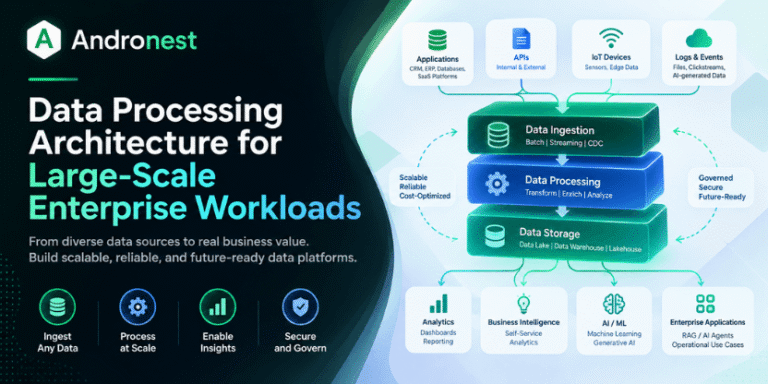
Data processing services deploy a layered technical architecture to execute the seven stages at enterprise scale.
Ingestion layer: Apache Kafka and cloud-native event streaming services (Amazon Kinesis, Azure Event Hubs) for streaming data. Fivetran, Airbyte, or custom CDC implementations for batch extraction from structured source systems. Document and unstructured data parsers for text, image, and audio content.
Processing and transformation layer: Apache Spark for large-scale distributed data processing. dbt (data build tool) for SQL-based transformation with built-in testing and documentation. Python-based processing frameworks (Pandas, Polars, Ray) for feature engineering and data manipulation at various scales.
Orchestration layer: Apache Airflow, Prefect, or Dagster for workflow scheduling, dependency management, monitoring, and failure handling across complex multi-stage processing pipelines.
Quality and validation layer: Great Expectations, Soda, or dbt tests for automated data quality validation at each pipeline stage. Statistical validation frameworks that detect distribution shift between training data and production data — the early warning signal that model performance is degrading.
Storage layer: Delta Lake or Apache Iceberg for the data lakehouse storage format that enables ACID transactions, time travel (data versioning), and efficient query performance across raw, processed, and feature data. Vector databases (Pinecone, Weaviate, Chroma, pgvector) for embedding storage and semantic retrieval in RAG applications.
Governance and catalog layer: DataHub, Atlan, or Collibra for data catalog and lineage tracking. Unity Catalog (Databricks) or Snowflake’s native governance features for access control and metadata management. OpenLineage for cross-platform lineage tracking across the full processing stack.
Feature serving layer: Feast, Tecton, or cloud-native feature stores for managing computed features across training and inference environments, ensuring consistency between what the model was trained on and what it receives in production.
Data Processing Failures That Kill AI Projects
Understanding the common failures in AI data preparation explains much of the gap between AI investment and AI impact that the 7% AI-readiness statistic represents.
Training-serving skew. The most costly production AI failure occurs when the data a model is served in production differs from the data it was trained on. A model trained on cleaned, normalized, engineering-processed data but deployed on raw, unprocessed production data will perform dramatically worse in production than it did in testing. Eliminating training-serving skew requires that exactly the same processing pipeline serves both training data and inference data — which is what feature stores are designed to ensure.
Label leakage. Features in the training data that were created using information about the target outcome — information that would not be available at the time a production prediction needs to be made — create models that appear to perform well in testing but fail in production. A fraud detection model that accidentally includes post-transaction labels as features will appear extremely accurate during training but will have no signal at inference time when those labels don’t exist yet.
Distribution shift. When the real world changes in ways not reflected in training data, model performance degrades — often silently, without triggering any explicit error. Detecting and responding to distribution shift requires continuous monitoring that compares the statistical characteristics of current production data against the training data baseline, alerting teams when meaningful divergence is detected.
Data silo isolation. 68% of organizations cite data silos as their top data management concern, according to DATAVERSITY’s 2026 research. AI models built on siloed data — trained only on CRM data without access to ERP or operational data, for example — miss the cross-system correlations that often contain the most predictive signal. Organizations with strong data integration achieve 10.3× ROI from AI versus 3.7× for organizations with poor connectivity, according to Integrate.io’s 2026 data.
Governance gaps that block production deployment. Many AI projects complete successful technical development but stall at production deployment because the data used in development did not comply with the privacy, consent, or regulatory requirements that govern production use. Data governance requirements must be applied from the beginning of the data preparation pipeline — not discovered at the deployment gate.
Read: The True Cost of Poor Cloud Governance – Risks, Challenges, and Solutions
Batch vs. Real-Time Data Processing for AI
Not every AI application needs real-time data.
The appropriate processing architecture depends on business requirements.
| Processing Type | Best For |
| Batch processing | Reporting, historical analysis, model training |
| Micro-batch processing | Frequent analytics updates |
| Real-time processing | Fraud detection, recommendations, monitoring |
| Streaming processing | IoT, financial transactions, event-driven AI |
For example, an AI demand forecasting system may work with daily or hourly data.
A fraud detection system may require processing within milliseconds or seconds.
Choosing the right architecture helps balance latency, cost, complexity, and business requirements.
Data Processing for Different AI Use Cases
Machine Learning
Machine learning requires historical datasets that are clean, representative, and properly structured.
Data processing supports:
- Data preparation
- Feature engineering
- Training datasets
- Validation datasets
- Data labeling
- Data quality checks
Generative AI
Generative AI applications often require processed documents, knowledge bases, metadata, and embeddings.
Data processing supports:
- Document extraction
- Content cleaning
- Chunking
- Metadata creation
- Embedding generation
- Retrieval
AI Agents
AI agents require current and contextual enterprise data.
Data processing supports:
- System integration
- Data synchronization
- Context aggregation
- Event processing
- Knowledge retrieval
- Workflow data
Predictive Analytics
Predictive systems depend on historical patterns.
Processing pipelines can consolidate and transform data into consistent analytical datasets.
Also read: AWS vs Azure vs Google Cloud – How to Choose the Right Platform for Your Business
What Makes Data “AI-Ready”?
AI-ready data generally has several characteristics.
Accurate
The information should correctly represent the underlying business reality.
Complete
Important fields and records should not be unnecessarily missing.
Consistent
Data should follow consistent definitions and formats across systems.
Relevant
The data should actually support the AI application’s intended task.
Timely
Information should be updated frequently enough for the use case.
Accessible
Authorized AI applications should be able to retrieve the required data.
Governed
Data should have appropriate ownership, security, privacy, lineage, and access controls.
Contextual
The AI should have sufficient context to interpret the information correctly.
How to Assess Your Organization’s AI Data Readiness
A practical AI data readiness assessment evaluates five dimensions:
Data inventory. What data does the organization have? Where does it live? What formats is it in? What quality issues does profiling reveal? The inventory establishes the starting point and identifies the gap between what exists and what the target AI application requires.
Integration maturity. Can data from different systems be joined, correlated, and unified? Do common entity identifiers exist across CRM, ERP, and operational systems? Organizations with unified data platforms achieve significantly better AI outcomes than those operating on isolated system data.
Governance readiness. Are access controls in place? Is PII identified and managed? Is lineage tracking implemented? These are not preparation investments — they are prerequisites. AI systems that cannot demonstrate data governance compliance cannot be deployed in regulated industries and cannot be trusted in any industry.
Processing infrastructure. Does the organization have the pipeline infrastructure to prepare, version, and serve AI data at the required scale and latency? Organizations without modern data processing infrastructure typically require infrastructure investment before AI data preparation can proceed at a meaningful scale.
Use case specificity. Is the AI use case defined clearly enough to specify what data is needed, in what form, at what quality level, and at what latency? Without use case specificity, data readiness is an indefinitely deferred target rather than an assessable, achievable condition.
Common Data Processing Challenges for AI
Data Silos
Information remains trapped inside separate business systems.
Solution: Build integration pipelines and establish shared data models where appropriate.
Poor Data Quality
Duplicate, incomplete, or inaccurate records reduce AI reliability.
Solution: Introduce automated data-quality validation and monitoring.
Unstructured Data
Important information exists in documents, emails, images, or other difficult-to-process formats.
Solution: Use document processing, OCR, classification, extraction, and other appropriate techniques.
Legacy Systems
Older applications may lack modern APIs or reliable data interfaces.
Solution: Use incremental integration and modernization strategies rather than attempting to replace everything at once.
Data Volume
AI applications can require processing very large datasets.
Solution: Use scalable cloud data platforms and distributed processing technologies where appropriate.
Data Privacy
AI applications may process sensitive customer, employee, financial, or operational information.
Solution: Apply appropriate access controls, encryption, masking, retention policies, and governance mechanisms.
Best Practices for Building AI-Ready Data Processing Pipelines
1. Start With the AI Use Case
Don’t process every piece of enterprise data simply because it exists.
Identify what data the AI application actually needs.
2. Define Data Quality Requirements
Establish measurable standards for accuracy, completeness, freshness, and consistency.
3. Automate Data Validation
Automated validation reduces the risk of poor-quality data reaching AI applications.
4. Build Reusable Pipelines
Reusable ingestion and transformation patterns reduce development effort and technical debt.
5. Design for Observability
Monitor pipeline health, data freshness, failures, volume changes, and quality metrics.
6. Separate Raw and Curated Data
Maintaining raw data alongside processed versions can make recovery, auditing, and future processing easier.
7. Apply Governance From the Beginning
Security and governance should be incorporated into the architecture rather than added after deployment.
8. Design for Change
AI applications evolve quickly. Data pipelines should therefore be flexible enough to support changing models, data sources, and business requirements.
How Data Processing Services Support AI Transformation
Organizations often have the data required for AI but lack the infrastructure or engineering capabilities to make that data usable.
Data processing services can help bridge that gap.
A data processing partner can support areas such as:
- Data ingestion
- Data cleaning
- Data transformation
- Data integration
- Data migration
- Real-time processing
- Batch processing
- Data quality
- Data governance
- Unstructured data processing
- AI data preparation
- RAG data pipelines
- AI-ready data platforms
The goal is not simply to process more data.
The goal is to make the right data available in the right format, at the right time, with the right controls.
How Andronest Helps Prepare Data for AI
Building reliable AI applications requires more than selecting an AI model. The underlying data infrastructure must be designed to support the application’s requirements.
Andronest helps businesses build and modernize data processing workflows that prepare enterprise information for AI, analytics, automation, and intelligent applications.
Our capabilities can support:
- Data processing and transformation
- Data pipeline development
- Data integration
- Cloud data platforms
- AI-ready data architecture
- Unstructured data processing
- RAG data preparation
- Real-time data processing
- Data quality and governance
- AI and machine learning data preparation
Whether you are preparing enterprise data for a new AI application or modernizing an existing data environment, the right processing architecture can create a stronger foundation for long-term AI adoption.
Final Thoughts
AI transformation does not begin with the AI model.
It begins with the data.
Enterprise data is often fragmented, inconsistent, outdated, and distributed across structured and unstructured sources. Data processing services help turn that raw information into a reliable foundation for machine learning, generative AI, RAG applications, predictive analytics, and AI agents.
The most successful AI initiatives therefore treat data processing as a strategic capability rather than a background technical task.
Clean data improves reliability. Connected data improves context. Governed data improves trust. And well-processed data gives AI the foundation it needs to deliver business value.
Frequently Asked Questions
What are data processing services for AI?
Data processing services prepare raw enterprise data for AI through ingestion, cleaning, transformation, integration, validation, enrichment, and governance.
Why is data processing important for AI?
AI systems depend on accurate, relevant, consistent, and accessible data. Data processing helps transform raw information into usable AI inputs.
How do you prepare data for generative AI?
Data is typically extracted, cleaned, structured, chunked, enriched with metadata, and converted into formats that AI applications can retrieve and use.
Can data processing support AI agents?
Yes. Data processing can connect and synchronize information from CRM, ERP, databases, knowledge bases, and other systems so AI agents have reliable business context.
What is AI-ready data?
AI-ready data is accurate, relevant, consistent, timely, accessible, and governed for the specific AI application that will use it.
What is the difference between batch and real-time data processing?
Batch processing handles data at scheduled intervals, while real-time processing handles information continuously or with very low latency. The right approach depends on the AI use case.
How does poor data quality affect AI?
Poor data quality can lead to inaccurate predictions, unreliable recommendations, incorrect AI responses, and weaker business outcomes.