Artificial Intelligence has become a strategic investment for enterprises looking to automate workflows, improve decision-making, and enhance customer experiences. However, as AI adoption accelerates, organizations are beginning to recognize a growing challenge: the long-term cost of relying solely on cloud-based AI services.
Every API request, inference, and token processed through public AI platforms contributes to ongoing operational expenses. For businesses running AI-powered applications at scale, these recurring costs can quickly surpass initial development investments.
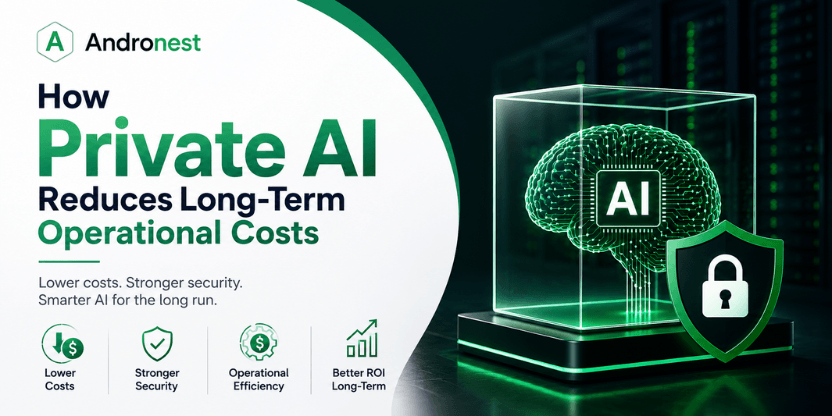
This is why many enterprises are exploring Private AI — deploying AI models within their own infrastructure, whether on-premises, in a private cloud, or in a secure hybrid environment. Beyond offering greater control over sensitive data, Private AI can significantly reduce long-term operational costs while improving performance, compliance, and scalability.
In this guide, we’ll explore how Private AI helps organizations optimize costs, where the savings come from, and why it is becoming a preferred strategy for enterprises building sustainable AI capabilities.
What is Private AI?
Private AI (also referred to as Sovereign AI or On-Premises AI) is artificial intelligence deployed and operated entirely within an organization’s own infrastructure — on-premises servers, private cloud environments, or dedicated cloud tenancies — rather than accessed through third-party API endpoints.
The defining characteristic is data sovereignty: data processed by private AI never leaves the organization’s controlled environment. The model runs on the organization’s own hardware or dedicated infrastructure, processes data inside the organization’s own security perimeter, and produces outputs that are never exposed to external providers for training, improvement, or analytics.
In practice, private AI encompasses several deployment architectures:
On-premises deployment runs AI models on the organization’s own hardware — typically GPU-equipped servers. All compute, storage, and inference happen within the physical facility. Appropriate for organizations with the highest data sensitivity requirements: defence contractors, healthcare systems processing PHI, financial institutions with strict regulatory obligations.
Private cloud deployment runs AI models on dedicated cloud infrastructure — a cloud environment provisioned exclusively for one organization, with no shared compute, storage, or network resources. Provides hardware flexibility while maintaining the data isolation and governance characteristics of on-premises.
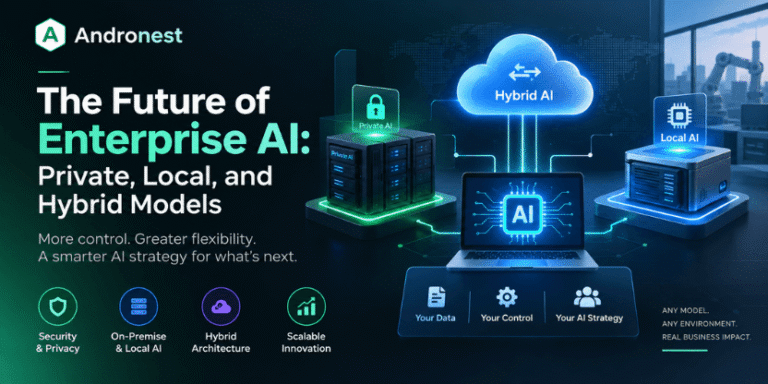
Hybrid private AI combines private AI for sensitive workloads — where confidential data or regulated information is processed — with public AI for non-sensitive functions. This model allows organizations to optimise cost across their AI portfolio rather than applying a single architecture across all use cases.
Fine-tuned and self-hosted open models deploy open-weight models — Llama, Mistral, Falcon, or domain-specific fine-tuned variants — on the organization’s own infrastructure, eliminating API costs entirely while enabling customization to the organization’s own data and domain vocabulary.
Understanding private AI’s full cost impact requires examining each of the cost dimensions where it differs from public AI.
Read: How to Choose the Right AI Workflow Automation Platform for Your Business
Understanding The Public AI Cost Structure — and Why It Escalates
Before examining how private AI reduces costs, understanding the full cost structure of public AI is essential — because several components of that structure are systematically underestimated at the outset.
Per-token inference costs are the visible cost: every API call to a large language model consumes tokens — input tokens (the prompt and context) and output tokens (the generated response). Enterprise-grade models charge between $2 and $60 per million tokens depending on model tier. At scale, these costs are enormous: a moderately active enterprise team running 10,000 AI-assisted tasks per day consumes hundreds of millions of tokens monthly.
Context window costs amplify inference costs significantly for RAG (Retrieval-Augmented Generation) and agentic workflows. A customer service agent that retrieves customer history before responding may process 10,000 tokens of context for a 200-token output. The context costs — not the answer costs — drive the bill.
Egress and data transfer fees apply every time data moves from the organization’s systems to the AI provider’s endpoint and back. VMware’s Private Cloud Outlook 2026 found that 97% of IT leaders believe some portion of their public cloud spend is wasted, with more than half estimating waste exceeds 25% of their total cloud budget. Egress fees are one of the primary components of that waste — easy to overlook on cloud billing dashboards and impossible to eliminate without architectural change.
Compliance overhead is the cost that most organizations fail to account for at all. Using public AI for business processes that involve regulated data — patient records, financial data, legal documents, personally identifiable information — requires ongoing compliance monitoring, legal review of vendor data processing agreements, employee training on what data may and may not be submitted to public AI tools, and audit preparation. Deloitte’s 2026 research found that 55% of enterprises avoid certain AI use cases entirely because of cloud data security concerns — not because the technology fails, but because they cannot demonstrate sufficient control to regulators. The AI capability is not captured. Its value is simply lost.
Breach risk exposure is the cost that materialises when public AI usage goes wrong. The average cost of a data breach is $4.4 million. HIPAA fines reach $2 million per year. GDPR fines have totalled $5.65 billion globally. Shadow AI — employees using public AI tools without authorization — was present in 20% of 2025 enterprise security incidents, costing on average $670,000 more per incident than standard data breaches. 77% of employees admit to pasting corporate information into public AI tools.
Vendor dependency costs are the cost of being subject to a provider’s pricing, policy, and availability decisions. An AI provider that raises prices by 20% controls a business-critical operational cost with no notice and no alternative.
Also read: AI Risk Management – What Every CIO Should Know
How Private AI Reduces Long-Term Operational Costs
1. Eliminates Per-Token API Costs
One of the biggest advantages of Private AI is eliminating recurring API and token-based pricing. Public AI platforms charge for every request, making costs increase as usage grows. In contrast, Private AI runs on your own infrastructure, replacing variable API expenses with predictable infrastructure costs.
For high-volume use cases like customer support, document processing, AI agents, and software development, Private AI often reaches its return on investment within 12–18 months. Beyond that point, organizations continue to benefit from lower operational costs as AI adoption scales.
2. Reduces Data Transfer and Cloud Costs
Public AI services often involve hidden expenses such as data transfer, bandwidth, and cloud egress fees, especially when processing large documents, images, or enterprise datasets.
Private AI keeps data within your infrastructure, eliminating these additional costs while reducing network latency and improving overall efficiency. This is particularly valuable for organizations handling data-intensive AI workloads.
3. Lower Compliance Costs
Organizations in regulated industries face significant costs to ensure compliance when using public AI services. Vendor audits, legal reviews, data governance, and ongoing monitoring all add to operational expenses.
With Private AI, sensitive information remains within your controlled environment, simplifying compliance with regulations such as GDPR, HIPAA, and SOC 2. It also minimizes the risk of costly data breaches and regulatory penalties.
4. Reduce Vendor Lock-In
Depending on a single AI provider exposes businesses to changing pricing models, service limitations, and vendor lock-in. Unexpected API price increases can significantly impact operational budgets.
Private AI gives organizations full ownership of their AI infrastructure, enabling them to choose open-source models, switch technologies when needed, and maintain predictable long-term costs without relying on external providers.
5. Improve Accuracy with Custom Models
Private AI allows businesses to fine-tune AI models using their own data, terminology, and workflows. This leads to more accurate outputs than generic public models.
Higher accuracy reduces manual reviews, minimizes rework, and improves productivity. Fine-tuned models also require less prompt engineering and smaller context windows, resulting in faster and more efficient AI performance.
6. Automate Operations at Lower Cost
AI-powered automation reduces repetitive work across customer service, operations, finance, HR, and software development. With public AI, every automated task still incurs API costs.
Private AI removes this limitation by enabling organizations to automate large volumes of work without increasing per-task expenses. As AI adoption grows, businesses continue to realize greater cost savings and operational efficiency.
7. Improve Performance and Productivity
Private AI processes requests within an organization’s own infrastructure, reducing latency and delivering faster response times compared to cloud-based AI services.
Lower latency improves employee productivity, enhances user experiences, and reduces dependency on external service availability. Organizations can also optimize AI workloads through intelligent routing and infrastructure management, further lowering operational costs.
Check out: AI Risk vs AI Reward – Finding the Right Balance
Additional Business Benefits Beyond Cost Savings
Private AI provides advantages that extend beyond operational efficiency.
Enhanced Data Privacy
Sensitive business information never leaves controlled infrastructure.
Stronger Security
Organizations maintain complete control over:
- Access management
- Encryption
- Monitoring
- Audit trails
Regulatory Compliance
Private AI simplifies adherence to regulations including:
- GDPR
- HIPAA
- SOC 2
- ISO 27001
- Industry-specific governance frameworks
Better Customization
Organizations can fine-tune AI models using proprietary business knowledge without exposing confidential data to external providers.
Higher Performance
Local deployments reduce latency while improving response times for mission-critical applications.
Also check: AI Agents vs Traditional Automation – What’s the Difference and Which Should You Use?
Industries Where Private AI Delivers the Greatest Cost Savings
Healthcare
Private AI helps healthcare organizations automate clinical documentation, patient record analysis, and administrative workflows while keeping sensitive patient data secure. It also simplifies compliance with regulations like HIPAA, reducing both operational costs and compliance risks.
Financial Services
Banks and financial institutions use Private AI for fraud detection, risk analysis, document processing, and customer support. By keeping financial data within a secure environment, organizations reduce compliance overhead while improving operational efficiency.
Legal Services
Law firms can securely automate contract analysis, legal research, document review, and drafting assistance using Private AI. This reduces manual effort, improves productivity, and protects confidential client information.
Manufacturing
Private AI enables predictive maintenance, quality inspection, supply chain optimization, and production monitoring. Running AI locally lowers inference costs while safeguarding proprietary manufacturing data and trade secrets.
Government and Public Sector
Government agencies benefit from Private AI by processing sensitive data within secure, sovereign environments. It supports compliance with data residency requirements while reducing long-term operational costs and enhancing security.
Enterprise SaaS
Reduce API expenses for AI-powered customer features.
Implementing Private AI: What to Consider Before You Start
Private AI delivers significant long-term cost benefits but requires a deliberate implementation approach. The organizations that succeed in private AI deployment share several common practices.
Start with a realistic total cost model. Infrastructure hardware, implementation engineering, ongoing maintenance, energy costs, and model update cycles all need to be modelled against current and projected public AI costs over a three-to-five-year horizon. The business case requires honest accounting of both sides.
Identify the highest-value use cases first. The private AI investment generates the fastest return when applied to the highest-volume, highest-sensitivity AI use cases — those where public AI is most expensive, most risky, or most limited. Start with the two to three use cases where private AI delivers the most immediate benefit and build from there.
Plan for model governance. Private AI ownership includes responsibility for model updates, performance monitoring, and quality assurance. Build the governance model before deployment, not after. Define who is responsible for model performance, how degradation is detected and addressed, and how model updates are managed across production environments.
Choose the right model for each use case. Frontier public models are not always the most appropriate model for every task. Open-weight models fine-tuned on domain-specific data frequently outperform generic frontier models on domain-specific tasks at a fraction of the cost. The reduction in enterprise token costs — down 67% year-on-year as organizations route workloads to appropriately-sized models — demonstrates the value of task-appropriate model selection.
Consider hybrid architecture. Not all AI workloads justify private infrastructure. A hybrid model — private AI for sensitive, high-volume, and regulated workloads; public AI for low-volume, non-sensitive, or exploratory use cases — optimises cost across the full AI portfolio rather than applying a single architecture universally.
Check: Can AI Replace Auditors? Understanding the Human Advantage
Is Private AI Right for Every Business?
Not necessarily.
Public AI remains a practical option for:
- Small businesses
- Early-stage startups
- Low-volume AI applications
- Rapid prototyping
Private AI becomes increasingly attractive when organizations:
- Process large volumes of AI requests
- Handle sensitive or regulated data
- Require predictable operating costs
- Need greater control over AI infrastructure
- Plan to scale AI across multiple business functions
Best Practices for Maximizing Cost Savings with Private AI
To achieve the greatest return on investment:
- Assess current AI usage and recurring costs.
- Select AI models aligned with business requirements.
- Optimize infrastructure for inference workloads.
- Implement intelligent workload scheduling.
- Monitor GPU and CPU utilization.
- Automate infrastructure scaling.
- Continuously evaluate model performance and efficiency.
- Adopt a hybrid approach where appropriate, using public AI for experimentation and Private AI for production workloads.
Ready to build AI tailored to your business? Explore our Custom AI Solutions and discover how we help organizations design, develop, and deploy scalable AI applications that deliver measurable business outcomes.
Why Choose Andronest for Private AI Deployment?
At Andronest, we help enterprises design, deploy, and optimize secure Private AI environments tailored to their operational and compliance requirements.
Our expertise includes:
- Private AI strategy and consulting
- Local AI deployment
- Self-hosted LLM implementation
- Enterprise AI infrastructure
- AI agent deployment
- Secure RAG architectures
- AI integration services
- Performance optimization
- AI governance and compliance
Whether you’re evaluating Private AI for cost optimization, security, or scalability, our team helps you build future-ready AI solutions that align with your business goals.
Frequently Asked Questions
What is Private AI?
Private AI refers to deploying AI models within an organization’s own infrastructure, such as on-premises servers, private clouds, or hybrid environments, rather than relying exclusively on third-party AI services.
Is Private AI cheaper than cloud AI?
For organizations with high AI usage, Private AI often becomes more cost-effective over time by eliminating recurring API fees and making better use of existing infrastructure. The break-even point depends on usage volume, hardware investment, and operational requirements.
Does Private AI improve security?
Yes. Because data remains within your controlled environment, Private AI offers stronger data privacy, tighter access controls, and greater visibility into security operations.
Which industries benefit most from Private AI?
Industries handling sensitive or regulated data—such as healthcare, finance, government, legal services, and manufacturing—often see the greatest benefits from Private AI due to improved compliance, security, and cost predictability.
Can businesses use both Public AI and Private AI?
Absolutely. Many organizations adopt a hybrid strategy, using public AI for experimentation and rapid prototyping while deploying Private AI for production workloads that require stronger security, lower long-term costs, or greater control.
Final Thoughts
As AI becomes embedded across enterprise operations, organizations must look beyond the convenience of public AI services and consider the long-term economics of their AI strategy.
While cloud-based AI is ideal for experimentation and rapid deployment, recurring API charges, growing inference volumes, and compliance requirements can significantly increase operational expenses over time. Private AI addresses these challenges by offering predictable costs, greater infrastructure efficiency, enhanced data security, and reduced dependence on external providers.
For businesses planning large-scale AI adoption, Private AI is more than a technology decision—it’s a strategic investment in sustainable growth, operational resilience, and long-term cost optimization. By carefully assessing workloads, infrastructure, and business objectives, enterprises can build AI capabilities that deliver measurable value while keeping operational costs under control.