The Risk That Moved From Footnote to Front Page
Two years ago, AI risk appeared in enterprise risk registers as a footnote — something risk teams acknowledged, wrapped in a few policies, and moved past. The real risks were cyber, operational, and financial.
In 2026, that has changed completely.
Artificial intelligence has surged into the top tier of global business concerns, rising to #2 in 2026 from #10 in 2025 — the biggest single-year jump in the Allianz Risk Barometer’s history. Both cyber and AI now rank as top five concerns for companies in almost every industry sector.
The reason for this elevation is straightforward: AI is no longer experimental. It is operational. It is running in customer-facing workflows, making autonomous decisions, processing regulated data, and operating at a scale and speed that traditional risk oversight was not designed to manage.
And the governance reality has not kept up with the deployment reality. Only 8% of organizations globally have a comprehensive AI governance framework, yet 88% are actively using AI across business functions. 87% of organizations claim they have clear AI governance frameworks — but fewer than 25% have fully implemented the controls needed to manage bias, transparency, and security risks. Claiming governance and running governance are two entirely different things.
For CIOs, this gap is both a risk and a responsibility. The technology deployments running across the enterprise — the AI agents resolving customer queries, the models recommending credit decisions, the automation workflows updating records — are running under the CIO’s infrastructure. The risk that emerges from those deployments sits on the CIO’s desk, whether the governance framework exists to manage it or not.
This guide covers everything a CIO needs to know in 2026: the specific AI risk categories that matter most, the regulatory frameworks that are defining the compliance baseline, a practical governance architecture, and the implementation roadmap for organizations that need to close the governance gap before it closes them.
Why AI Risk Management Has Become a CIO Priority
Historically, CIOs focused on managing risks related to:
- Infrastructure
- Applications
- Cybersecurity
- Cloud environments
- Data management
AI introduces a fundamentally different category of risk.
Unlike traditional software systems, AI models can:
- Generate unpredictable outputs
- Learn from data
- Make recommendations
- Influence business decisions
- Perform autonomous actions
This creates new governance challenges.
As AI becomes embedded into business-critical workflows, organizations need clear strategies for managing:
- Operational risk
- Security risk
- Regulatory risk
- Ethical risk
- Reputational risk
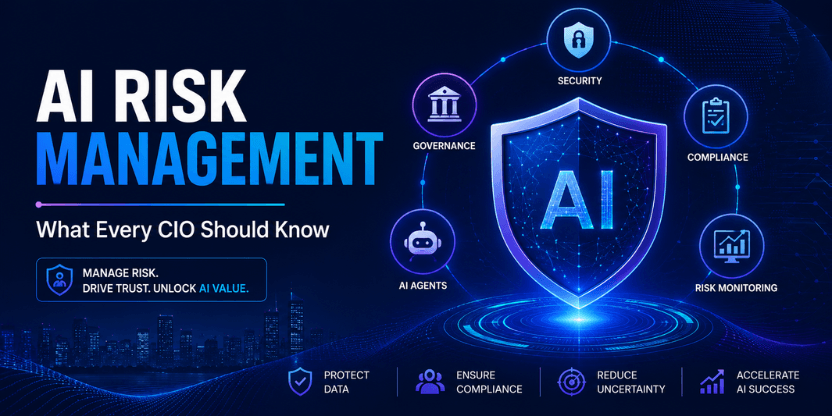
AI risk management is no longer just an IT responsibility—it is a business imperative.
What is AI Risk Management?
AI risk management is the process of identifying, assessing, monitoring, and mitigating risks associated with artificial intelligence systems.
Its objective is to ensure AI solutions remain:
- Secure
- Compliant
- Transparent
- Reliable
- Ethical
- Aligned with business goals
A strong AI risk management framework helps organizations maximize the benefits of AI while minimizing potential harm.
Effective AI risk management includes:
- Governance policies
- Security controls
- Data protection measures
- Model monitoring
- Human oversight
- Compliance processes
The Seven Categories of AI Risk Every CIO Must Understand
AI risk is not a single category — it is a constellation of risk types that interact with and amplify each other. Managing AI risk requires understanding each category specifically.
1. Model Accuracy and Bias Risk
AI systems produce outputs based on the data they were trained on and the objective functions they were optimized for. When training data reflects historical biases, AI models perpetuate those biases at scale — and at machine speed.
Why it matters for CIOs: Model outputs used in hiring decisions, credit assessments, insurance underwriting, or customer service routing can violate anti-discrimination regulations without any individual making a discriminatory decision. The AI made the decision. The organization bears the liability.
What governance looks like:
- Pre-deployment bias testing across demographic groups before any model touches production data
- Ongoing monitoring of output distributions for evidence of disparate impact
- Defined remediation procedures when bias is detected
- Documentation of training data provenance and known limitations
The regulatory exposure: Under the EU AI Act, AI systems used in hiring, credit, education, and access to essential services are classified as high-risk and require bias testing, transparency documentation, and human oversight mechanisms before deployment. Non-compliance carries fines up to €35 million or 7% of global annual turnover.
2. Security and Adversarial Risk
AI systems introduce new attack surfaces that traditional security frameworks were not designed to address. AI accelerates the speed and scale of attacks, increases the complexity of operational failure, and amplifies the consequences of security failures.
AI-enabled attacks against your organization:
- Advanced phishing campaigns personalized at scale using AI language models
- Deepfake-based social engineering targeting executives and financial teams
- AI-powered vulnerability scanning that identifies and exploits weaknesses faster than security teams can patch
- Voice cloning attacks impersonating executives in financial authorization workflows
AI system vulnerabilities within your organization:
- Prompt injection attacks that redirect AI agent behavior through malicious instructions embedded in processed data
- Training data poisoning that corrupts model behavior by introducing adversarial examples during training
- Model inversion attacks that extract sensitive training data from deployed models
- Adversarial examples that cause AI classification models to produce incorrect outputs through specifically crafted inputs
AI-related attack activity accelerated dramatically throughout 2025 and into 2026. The attack surface is shifting away from infrastructure and toward identity-driven access paths. Modern AI governance failures increasingly emerge through integrations and permissions rather than direct system compromise.
The OAuth risk specific to AI tools:
OAuth remains one of the least understood governance risks in enterprise AI environments. Many AI tools request broad delegated permissions to access enterprise data and systems. These permissions can persist long after users forget approvals exist — creating a shadow access layer that traditional IAM monitoring does not track.
3. Data Privacy and Compliance Risk
AI systems consume data at scale — and the data governance obligations that attach to that consumption do not relax because AI is doing the consuming.
The core data risks in enterprise AI:
Training data compliance: AI models trained on customer data may violate data minimization requirements under GDPR if that data was collected for a different purpose. The legal basis for using personal data in AI training is one of the least resolved compliance questions in enterprise AI.
Inference-time data exposure: AI models used in customer-facing applications process personal data in real time. Every AI interaction that involves personal data is subject to the same data subject rights as any other processing activity — including the right to explanation, the right to erasure, and breach notification obligations.
Cross-border AI processing: Cloud-hosted AI models may process data in jurisdictions with different regulatory frameworks. An organization using a US-hosted AI model to process EU customer data may have inadvertent cross-border transfer obligations.
RAG pipeline exposure: Retrieval-Augmented Generation systems that connect AI models to enterprise knowledge bases can inadvertently surface information that individual users should not have access to — creating data access violations that no traditional access control prevents.
4. Operational and Continuity Risk
AI systems that run in production workflows create operational dependencies that most organizations have not adequately planned for. When an AI system fails, is compromised, or produces incorrect outputs at scale, the operational impact can cascade across every process that depends on it.
Failure modes specific to AI systems:
Model drift: AI model accuracy degrades over time as the real-world environment diverges from the training data environment. A fraud detection model trained on 2024 transaction patterns may miss fraud patterns that emerged in 2025. Without continuous monitoring, model drift is invisible until it manifests as a meaningful failure.
Dependency failures: AI systems that depend on external APIs, foundation model providers, or cloud inference infrastructure inherit those systems’ availability risks. The AI agent that resolves customer queries is only as available as the LLM provider’s API.
Cascading errors in autonomous workflows: An AI agent that writes incorrect data to one system can propagate that error across downstream systems before any human detects it. Unlike traditional software bugs that typically produce visible errors, AI errors can produce plausible-but-incorrect outputs that propagate silently.
Human skill atrophy: When AI automates tasks that humans previously performed, the human capability to perform those tasks manually degrades. If the AI system fails, the fallback capability may no longer exist at the required quality level.
5. Regulatory and Legal Compliance Risk
The regulatory environment for AI is evolving rapidly — and in 2026, several major frameworks have moved from proposed to enforced.
Multinationals operating across both markets now face dual compliance obligations with overlapping but distinct requirements. Framework adoption rates lag behind regulatory expectations.
The EU AI Act (in force from 2025, with high-risk system obligations phasing through 2026) classifies AI systems into four risk tiers — unacceptable risk (prohibited), high risk (stringent requirements), limited risk (transparency obligations), and minimal risk (no specific obligations). Any organization serving EU customers, employing EU staff, or using EU-based AI systems must assess and categorize every AI system against this framework.
High-risk AI systems under the EU Act — including those used in hiring, credit decisions, education, law enforcement, critical infrastructure, and healthcare — require:
- Pre-deployment conformity assessments
- Bias testing and ongoing monitoring
- Human oversight mechanisms
- Transparent documentation of model purpose, limitations, and training data
- Registration with EU regulatory authorities
GDPR and AI continue to evolve through regulatory guidance and enforcement actions. The French CNIL, the UK ICO, and the Irish DPC have each issued guidance on AI and personal data that extends GDPR obligations to AI-specific scenarios.
Sector-specific AI regulations are emerging across financial services (model risk management requirements), healthcare (FDA AI/ML guidance), and defence and government procurement. CIOs in regulated industries face layered compliance obligations that require dedicated tracking.
6. Reputational and Brand Risk
AI failures are public events in 2026 in a way they were not in 2022. When an AI system produces a harmful output, makes a discriminatory decision, or is revealed to have been operating without adequate oversight, the reputational consequences arrive faster and are more durable than most organizations anticipate.
The mechanisms of AI reputational risk:
Viral AI failures: Screenshots of AI chatbot responses, AI-generated content errors, and AI system failures spread across social media within hours. A single significant AI failure can reach millions of people before the organization has drafted a response.
Regulatory investigations as reputational events: Regulatory investigations into AI system compliance are public. Being the subject of an EU AI Act enforcement action or an FTC investigation into AI-based discrimination is a reputational event independent of the ultimate legal outcome.
Employee and talent implications: Organizations with visible AI governance failures struggle to attract AI talent — the professionals most needed to build responsible systems are the most attentive to how organizations govern the ones they already have.
7. Third-Party and Supply Chain AI Risk
Enterprise AI risk does not stop at the organization’s own systems. Every AI-enabled SaaS application, every foundation model API, every AI consulting engagement introduces third-party risk that extends the organization’s AI risk surface.
Enterprise SaaS ecosystems continue expanding rapidly. AI functionality compounds this growth because AI capabilities are increasingly introduced through existing SaaS vendors rather than new standalone platforms. Most AI governance frameworks were designed around centralized AI initiatives. Modern enterprise AI adoption is decentralized and distributed across SaaS ecosystems, making traditional governance approaches difficult to enforce consistently.
The shadow AI dimension: employees adopting AI tools independently — either through personal accounts or shadow procurement — create third-party AI exposure that the organization has no visibility into and cannot govern. Security teams cannot govern what they cannot inventory.
Building an AI Risk Management Program: The CIO’s Implementation Framework
Pillar 1: Visibility — You Cannot Govern What You Cannot See
The foundation of any AI risk management program is complete visibility into the AI systems operating across the organization. Without an accurate inventory, governance is theoretical.
AI inventory requirements:
- All AI systems deployed in production, including models, agents, and AI-enabled SaaS features
- All AI systems in development or pilot stage
- All third-party AI tools with access to organizational data (including OAuth-granted tools)
- All AI systems inherited through M&A activity
- All shadow AI tools identified through network traffic analysis and expense reports
For each identified system, capture: the AI system’s purpose and scope, the data it processes (including personal data categories), the decisions it influences or makes, the organizational owner, and the risk tier (high/limited/minimal under EU AI Act).
Governance complexity scales alongside SaaS complexity. Organizations now manage AI functionality across hundreds of SaaS applications, many of which are adopted outside centralized security review processes. Achieving visibility in this environment requires both technical discovery (monitoring tools that identify AI-enabled applications) and process controls (procurement governance that prevents unsanctioned AI adoption).
Pillar 2: Risk Assessment — Calibrated, Not Uniform
Not every AI system presents the same risk profile. Risk assessment should be calibrated to the AI system’s purpose, the data it touches, the decisions it influences, and the population it affects — not applied uniformly across all systems regardless of risk.
Risk assessment dimensions for each AI system:
| Dimension | Assessment Questions |
| Impact severity | What is the maximum harm this system could cause if it fails or produces incorrect outputs? |
| Affected population | How many people could be affected? Does it affect protected groups? |
| Decision autonomy | Does the AI make final decisions, or does a human review AI recommendations? |
| Data sensitivity | Does the system process personal, regulated, or confidential data? |
| Reversibility | Can incorrect outputs be identified and reversed, or do they cause irreversible harm? |
| Regulatory exposure | Does this system fall within high-risk categories under the EU AI Act or sector regulations? |
The output of risk assessment is a risk-tiered AI portfolio — high-risk systems requiring the most intensive governance controls, limited-risk systems requiring transparency obligations, and minimal-risk systems requiring standard operational monitoring.
Pillar 3: Governance Architecture — Structure That Enables Action
A generative AI governance framework has five pillars: policy (what is allowed), roles and responsibilities, risk assessment per use case, ongoing monitoring, and incident response.
Policy: The AI governance policy defines what is permitted, what is prohibited, and what requires explicit approval. A practical governance policy covers: permitted AI tools and platforms, prohibited use cases (automated decisions about individuals without human oversight, where prohibited), data handling requirements for AI systems, approval processes for new AI deployments, and employee responsibilities regarding AI use.
Roles and Responsibilities: Typically a cross-functional committee chaired by the CIO or CTO, with representation from legal, compliance, HR, security, and business leaders. A dedicated AI governance lead reports to the chair.
Every production AI system should have a named business owner — not an IT owner, but the business stakeholder accountable for the outcomes the system produces. This is the single most important accountability mechanism for AI risk management: when a named human is accountable for an AI system’s decisions, the incentive to maintain governance controls is direct and personal.
Risk Assessment Per Use Case: Rather than applying a blanket governance process to all AI, assess each use case individually against the risk framework. High-risk use cases receive intensive review. Low-risk use cases receive streamlined approval. The speed of governance should be proportional to the risk level — well-designed governance accelerates innovation by clearing the path: teams know what is approved, which tools are sanctioned, and where to go for quick reviews.
Ongoing Monitoring: Production AI systems require continuous monitoring, not point-in-time audits. Monitoring components include: model performance tracking (accuracy, drift, bias indicators), security monitoring (anomalous access patterns, adversarial input detection), compliance monitoring (data handling compliance, output fairness metrics), and cost monitoring (token consumption, API costs, infrastructure spend).
Incident Response: Developing contingency and incident-response plans for AI-related failures or misuse, such as misinformation incidents, model malfunctions, or rapid rollback needs.
Every AI system that runs in production should have a documented incident response procedure including: detection (how is an AI failure identified), assessment (how is the severity determined), containment (how is the affected system isolated), remediation (how is the failure resolved), and post-mortem (what process change prevents recurrence).
Pillar 4: Human Oversight — The Control That Cannot Be Automated Away
Upgrading AI governance frameworks, including model-risk management, monitoring, and human-in-the-loop oversight is one of the three core actions organizations are taking to address AI risk.
Human oversight is not simply having humans in the loop for every AI decision — that would negate the efficiency benefits of AI deployment. It is having clearly defined points at which human judgment is required, and ensuring those points are operationally real rather than documented but bypassed in practice.
Human oversight design principles:
- High-stakes decisions (employment, credit, healthcare, law enforcement) require meaningful human review — not a rubber stamp on AI recommendations, but genuine evaluation of the AI’s output against the specific case context
- Agentic systems require defined escalation triggers — the conditions under which an AI agent must pause and involve a human, rather than proceeding autonomously
- Monitoring must be performed by humans with the expertise to recognize meaningful anomalies — not delegated to dashboards that nobody regularly reviews
- Override mechanisms must be tested — if humans can theoretically override an AI decision but never do so in practice, the oversight mechanism is performative rather than functional
Deploying autonomous systems without shutdown capability is not a theoretical risk — it is an operational liability. Every production AI system needs a tested, documented procedure for immediate suspension.
Pillar 5: Regulatory Compliance — Aligned, Not Parallel
Rather than building a separate compliance framework for each regulation, align AI governance architecture to the major frameworks (NIST AI RMF, ISO 42001, EU AI Act) and map specific regulatory requirements to that aligned framework.
The advantage of this approach: compliance with one well-designed framework provides substantial coverage across multiple regulatory obligations, reducing the total compliance burden and creating consistency that auditors can verify.
Common AI Risk Management Mistakes CIOs Should Avoid
Treating AI Governance as an IT Function
AI risk is not an IT risk. It is an enterprise risk with legal, regulatory, ethical, and operational dimensions that IT alone cannot manage. CIOs who position AI governance as an IT compliance activity rather than an enterprise risk management discipline will be unable to get the cross-functional engagement and board-level visibility the challenge requires.
Governing Internally Developed AI While Ignoring SaaS AI
Most AI risk discussions focus on models the organization builds or trains. The majority of enterprise AI exposure in 2026 comes through AI-enabled SaaS applications, foundation model APIs, and shadow AI tools — none of which appear in a traditional AI inventory if the inventory is limited to internally developed systems.
Documentation Without Implementation
87% of organizations claim they have clear AI governance frameworks. Fewer than 25% have fully implemented the controls needed to manage bias, transparency, and security risks. The governance document is not the governance program. The policies, monitoring tools, accountability structures, and training that make the document operational are the governance program.
Point-in-Time Compliance Rather Than Continuous Governance
AI systems do not stay the same after they are deployed. Model drift, new training data, changed use cases, and evolving regulatory requirements all require ongoing governance attention. A compliance assessment at deployment that is never revisited is a deteriorating asset.
Governance That Slows Everything Down
The number one complaint about AI governance is that it slows down innovation. That is a symptom of bad implementation, not a fundamental trade-off. A well-designed governance framework has tiered review processes — high-risk use cases get intensive review, low-risk ones get fast-tracked approval — and clear guidance so teams know in advance what is and is not permitted. Governance that is too slow generates the shadow AI it is trying to prevent.
Best Practices for CIOs Managing AI Risk
Establish an AI Governance Committee
Create a cross-functional team involving:
- IT
- Security
- Legal
- Compliance
- Business leaders
Develop Responsible AI Policies
Define acceptable AI usage standards.
Prioritize Security by Design
Integrate security throughout the AI lifecycle.
Maintain Human-in-the-Loop Processes
Ensure critical decisions receive human oversight.
Monitor AI Continuously
Track model performance and business outcomes.
Educate Employees
Provide AI literacy and risk-awareness training.
Future Trends in AI Risk Management
As enterprise AI adoption grows, several trends will shape the future.
Increased Regulation
Governments will continue introducing AI governance requirements.
AI Auditing
Independent AI audits will become more common.
Agent Governance
Organizations will establish formal governance models for AI agents.
Automated Risk Monitoring
AI systems will increasingly monitor other AI systems.
Trust and Transparency
Explainability and accountability will become critical business requirements.
AI Risk Management Checklist for CIOs
Before scaling AI initiatives, ask:
- Do we have an AI governance framework?
- Are AI systems aligned with security policies?
- Have we assessed compliance requirements?
- Is sensitive data adequately protected?
- Are AI outputs monitored and validated?
- Do we have human oversight mechanisms?
- Have we defined acceptable AI use cases?
- Are employees trained on AI policies?
- Are AI agents operating within approved permissions?
- Do we continuously monitor AI performance?
If the answer to any of these questions is “no,” additional governance measures may be required.
Conclusion
Artificial Intelligence offers transformative opportunities for organizations seeking to improve efficiency, innovation, customer experiences, and business performance.
However, AI also introduces new risks that traditional governance frameworks were never designed to address.
For CIOs, successful AI adoption requires more than technology implementation. It requires a comprehensive approach to security, compliance, governance, data management, and human oversight.
Organizations that proactively manage AI risks will be better positioned to build trust, meet regulatory requirements, and unlock the full value of AI technologies.
As AI agents, generative AI platforms, and autonomous systems become increasingly integrated into enterprise operations, AI risk management will become one of the most important responsibilities of modern technology leadership.
The question is no longer whether organizations should adopt AI.
The question is whether they are prepared to govern it responsibly.