Two years ago, “automation” meant one thing: rules, scripts, and bots that followed a fixed sequence of steps without deviation.
In 2026, it means something fundamentally different.
AI agents — autonomous systems that interpret goals, plan multi-step workflows, use tools, evaluate results, and course-correct without human intervention — have crossed from research labs into enterprise production. Gartner forecasts that 40% of enterprise applications will embed task-specific AI agents by the end of 2026, up from less than 5% in 2024. The global AI agents market has reached $10.9–12.1 billion this year, growing at a 44–46% compound annual rate.
But here’s what the headlines miss: traditional automation isn’t dead. It isn’t even declining. It’s specializing — and for large categories of enterprise work, it remains the faster, cheaper, and more reliable choice.
The real question for any business leader or technology team in 2026 isn’t “AI agents or traditional automation?” It’s “which technology fits which process — and what does a smart hybrid strategy look like for our specific situation?”
This guide answers that question completely.
What is Traditional Automation?
Traditional automation refers to rule-based, deterministic systems that execute predefined sequences of actions on structured data. The category includes:
Robotic Process Automation (RPA) — software bots that interact with digital systems exactly as a human would: clicking, copying, pasting, logging in, and moving data between applications. Tools like UiPath, Blue Prism, and Automation Anywhere lead this space.
Workflow Automation — rule-based orchestration tools (Zapier, Make, Microsoft Power Automate) that trigger actions when defined conditions are met: “if a new lead is created in Salesforce, send a welcome email and create a task.”
Business Process Management (BPM) — structured process engines that route work through defined stages with defined rules, approvals, and escalation paths.
Integration Platforms (iPaaS) — middleware solutions like MuleSoft and Boomi that connect systems and automate data flows according to fixed mapping rules.
How Traditional Automation Works
The core logic is explicit and deterministic: a developer or process designer defines every decision point in advance. The system executes that logic consistently, at scale, without deviation. If input A arrives, output B results — every time, reliably.
This predictability is both the greatest strength and the defining limitation of traditional automation. It excels when processes are stable, inputs are structured, and rules are clear. It breaks when any of those conditions change.
Where Traditional Automation Excels
- High-volume, structured, repetitive tasks — invoice processing with consistent fields, employee onboarding checklists, password resets, order status lookups
- Regulated environments requiring perfect auditability — every action is logged, every decision is traceable to a rule
- Cost-sensitive, high-frequency transactions — a well-built rules engine resolves Tier-0 support queries (FAQ retrieval, order status, password resets) at roughly $0.001 per resolution
- Stable processes with predictable inputs — when the process won’t change and the data format is fixed, traditional automation delivers unmatched cost-efficiency
What are AI Agents?
AI agents are autonomous software systems that can interpret a goal expressed in natural language, create a plan to achieve it, call tools and APIs, evaluate intermediate results, adapt their approach based on what they learn, and iterate until the task is complete — often with optional human approval gates at critical junctures.
Unlike single-shot large language model (LLM) prompts that produce text outputs, AI agents are built for multi-step execution. They combine an LLM reasoning layer with memory, retrieval systems (RAG), policy constraints, and connectors to enterprise systems — creating a system that can “think through” complex, variable workflows rather than simply execute a fixed script.
How AI Agents Work
A typical enterprise AI agent deployment in 2026 combines:
A Planner — the LLM reasoning layer that interprets the goal and determines what steps are needed to achieve it
A Tool Layer — connectors to APIs, databases, search systems, browsers, code executors, and other enterprise systems that the agent can call to take real-world actions
Memory — short-term working memory for the current task plus optional long-term memory for context across sessions
An Orchestration Layer — the framework (LangChain, LlamaIndex, Microsoft AutoGen, Salesforce Agentforce, etc.) that coordinates the planner, tools, and memory into a coherent workflow
Human-in-the-Loop Gates — optional approval checkpoints where a human reviews and confirms before the agent proceeds with high-stakes actions
Where AI Agents Excel
AI agents win decisively for:
- Unstructured data processing — interpreting emails, contracts, PDFs, support tickets, and documents where the format varies and the meaning requires contextual understanding
- Exception handling — the cases that fall outside predefined rules and currently require a human to make a judgment call
- Multi-step, context-dependent workflows — research tasks, lead qualification, complex customer service escalations, and processes that require synthesizing information from multiple sources
- Dynamic environments — workflows that change frequently, making the maintenance cost of traditional automation’s rigid rule sets prohibitive
- Goals expressed in natural language — when the desired outcome is clear but the path to get there is variable
Read: AI Risk Management – What Every CIO Should Know
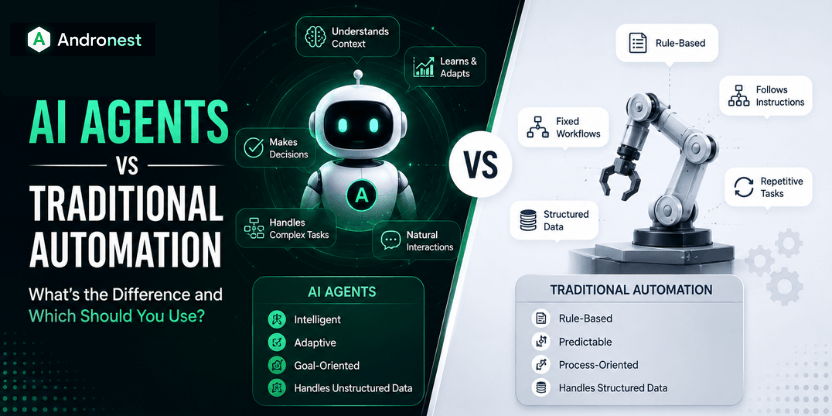
AI Agents vs. Traditional Automation: The Key Differences
| Dimension | Traditional Automation | AI Agents |
| Core Logic | Rules and scripts (deterministic) | LLM reasoning (probabilistic) |
| Input Requirements | Structured, formatted data | Structured or unstructured data |
| Adaptability | Breaks when process or UI changes | Adapts to achieve the goal |
| Decision-Making | Pre-programmed if/then/else | Contextual, multi-step reasoning |
| Setup Complexity | Moderate — requires process mapping | Higher — requires prompt engineering, tool design, safety testing |
| Per-Transaction Cost | Very low ($0.001–$0.01) | Higher (50–500× per transaction) |
| Auditability | Perfect — every action traced to a rule | Requires deliberate logging architecture |
| Failure Mode | Breaks silently when inputs change | May hallucinate or take unexpected actions |
| Maintenance Overhead | High when source systems change | Lower for stable goal, but governance is ongoing |
| Best For | Stable, high-volume, structured processes | Variable, complex, judgment-intensive tasks |
| Time to Value | Weeks to months | Months (median 5.1 months to positive ROI) |
| Risk Profile | Low for stable processes; high during change | Moderate to high without governance framework |
The Architecture Difference That Changes Everything
The most important conceptual distinction between traditional automation and AI agents isn’t about features or capabilities — it’s about the operating model.
Traditional automation is managed like a script. You define it, test it, deploy it, and maintain it. When something breaks, you fix the rule. Outcomes are deterministic: the same input always produces the same output.
AI agents are managed like a learning system. You define the goal, the guardrails, and the tools available. The agent determines the path. Outcomes are probabilistic: the same input may produce different (but hopefully equivalent) outputs depending on context.
This distinction has profound implications for governance, risk management, and organizational design — not just technology selection.
As one enterprise research framework puts it: traditional automation is predictable; AI agents are probabilistic. That doesn’t mean agents are unreliable. It means you manage them differently — with ongoing monitoring, output validation, and governance infrastructure that doesn’t exist in traditional automation programs.
Where Each Technology Wins: Real-World Use Cases
Traditional Automation Wins
Finance and accounting: Invoice processing with consistent formats, accounts payable reconciliation, bank statement processing, expense report routing. The inputs are structured, the rules are clear, and volume is high.
IT service management: Password resets, user provisioning, software license allocation, routine monitoring alerts. Tier-0 support — FAQ retrieval, order status, standard account queries — can be handled at $0.001 per resolution.
HR operations: Standard employee onboarding checklists, payroll processing, benefits enrollment workflows, leave request routing. Process stability makes these ideal for RPA.
Compliance reporting: Scheduled report generation, regulatory filing preparation from structured data sources, audit log compilation. Deterministic outputs are a requirement, not a preference.
AI Agents Win
Customer service escalations (Tier-1 and above): Queries that require synthesizing purchase history, account status, policy information, and sentiment — then determining the right resolution path. AI agents handle this; traditional bots cannot.
Sales qualification and outreach: Researching prospects across multiple sources, personalizing outreach based on firmographic and behavioral signals, qualifying inbound leads against complex criteria. The variable inputs and judgment requirements make this an AI agent use case.
Contract and document review: Extracting key terms from variable-format contracts, flagging non-standard clauses, summarizing due diligence materials. Unstructured inputs eliminate traditional automation as a viable option.
Incident response and root cause analysis: Synthesizing logs, alerts, deployment history, and documentation to identify probable root causes and recommend remediation steps. Context synthesis across multiple unstructured sources is an AI agent strength.
Content and research workflows: Competitive intelligence gathering, market research synthesis, technical documentation generation from code or requirements. Multi-step research with variable sources suits AI agents well.
Also read: AI Risk vs AI Reward – Finding the Right Balance
The Hybrid Reality: Why It’s Not Either/Or
The most important finding from enterprise automation research in 2026 is that the most successful organizations aren’t choosing between AI agents and traditional automation — they’re deploying them as complementary layers in a single process architecture.
Traditional automation handles structured, deterministic, high-volume execution. AI agents handle the variable inputs, unstructured data, and exception reasoning that sit at the edges of those structured processes.
A real-world example: a financial services firm’s invoice processing workflow uses RPA to extract and process 95% of invoices that arrive in standard formats at $0.001 per transaction. The 5% that arrive in non-standard formats, are missing fields, or contain discrepancies are routed to an AI agent that interprets the document, matches it against purchase order data, and either resolves the discrepancy autonomously or escalates with a clear summary for human review. The combination delivers outcomes that neither technology achieves alone — at a cost structure that makes economic sense.
This orchestration pattern — where traditional automation handles deterministic execution and AI agents handle reasoning and exception management — is becoming the standard enterprise automation architecture for 2026 and beyond.
A Decision Framework: Which Should You Use?
Work through these five questions to identify the right technology for any specific automation initiative:
1. How structured is the input?
If your process inputs are consistently formatted, database-stored, or arrive through defined API contracts, traditional automation is likely sufficient. If inputs are unstructured — emails, documents, natural language requests, images — AI agents are required.
2. How stable is the process?
If the workflow has been stable for two or more years and is unlikely to change significantly, the maintenance overhead of traditional automation is manageable. If the process evolves frequently — because of regulatory changes, product updates, or business model shifts — traditional automation’s rigidity makes it expensive to maintain, and AI agents’ adaptability becomes a meaningful advantage.
3. What is the exception rate?
If fewer than 5% of cases fall outside defined rules, traditional automation handles the mainstream efficiently and exceptions can be routed to humans. If more than 20% of cases require judgment or contextual reasoning, the exception handling cost of traditional automation erodes its economic advantage.
4. What are the auditability requirements?
If your regulatory or compliance environment requires perfect traceability of every decision to a documented rule, traditional automation’s deterministic audit trail is difficult to replace. AI agents can be built with robust logging, but the governance architecture requires deliberate design investment.
5. What is the transaction volume?
For very high-volume processes (10,000+ transactions per day), the per-transaction cost premium of AI agents becomes material. For lower volumes of complex, high-value transactions, the premium is easily justified by labor cost reduction.
The Risk Landscape: What to Watch For
Traditional Automation Risks
Brittleness: The most cited failure mode. When a source application updates its interface, a form field moves, or a data format changes, bots break — often silently, creating downstream errors that aren’t caught until significant damage is done.
Scope creep: RPA programs frequently expand beyond their original governance frameworks as individual business units add bots without central oversight, creating a bot estate that nobody fully understands or maintains.
Maintenance debt: Every bot added to an enterprise estate is a future maintenance commitment. Organizations with large RPA estates often find that 30–50% of their automation team’s capacity is consumed by maintaining existing bots rather than building new ones.
AI Agent Risks
Hallucination and unexpected actions: AI agents can take actions that are plausible but wrong — misinterpreting a goal, selecting the wrong tool, or producing confident but inaccurate outputs. Without robust output validation and human-in-the-loop gates for high-stakes actions, this risk is material.
Governance gaps: Only 23% of organizations report significant ROI from AI agents, and Gartner expects more than 40% of agentic AI projects to be cancelled by 2027 — primarily due to unclear business value, cost overruns, and inadequate risk controls. Governance is the primary differentiator between successful and failed deployments.
Data quality dependency: Agents are only as good as the data they can access. 52% of businesses cite data quality and availability as their biggest barrier to AI adoption. Poor data infrastructure produces poor agent performance regardless of model quality.
Identity and security: 68% of organizations say they lack identity security controls for AI agents. An agent with broad tool access and inadequate access controls is a significant security risk.
Ready to move beyond traditional automation? Explore Andronest’s AI Agent Development Services to build intelligent AI agents tailored to your business goals.
Common Mistakes Organizations Make
Choosing technology before defining the process. The first question is always “what is the process?” not “which tool should we use?” Organizations that start with technology selection consistently overbuild or underbuild.
Treating AI agents as a universal replacement for RPA. They are not. For stable, high-volume, structured processes, RPA remains the more cost-effective and reliable choice. Replacing working RPA with AI agents because agents are newer creates cost and risk without business value.
Underinvesting in governance for AI agents. The 40% cancellation rate Gartner projects for agentic AI projects by 2027 is almost entirely attributable to governance failure — not technology failure. Define the agent’s scope, tool access, escalation rules, and monitoring framework before deployment, not after.
Ignoring the maintenance cost of traditional automation. Organizations that evaluate automation ROI only on implementation cost consistently underestimate the total cost of ownership. A bot that costs $50,000 to build and requires $15,000–$25,000 annually to maintain has a very different economics profile than the initial number suggests.
Moving too fast without a baseline. Without measuring the current process — cost, time, error rate, exception volume — it’s impossible to demonstrate the value of any automation initiative, traditional or AI-driven.
Benefits of Traditional Automation
- Lower implementation cost
- Predictable outcomes
- Easy compliance
- Stable performance
- Mature technology
- Ideal for repetitive work
Benefits of AI Agents
- Greater flexibility
- Faster decision-making
- Higher employee productivity
- Improved customer experiences
- Intelligent recommendations
- Cross-system automation
- Continuous learning
- Supports complex workflows
Challenges of Traditional Automation
- Limited flexibility
- High maintenance when rules change
- Cannot understand context
- Poor handling of exceptions
- Difficult to scale across dynamic processes
Challenges of AI Agents
- Higher implementation complexity
- Strong governance required
- Data privacy considerations
- Model monitoring
- Integration planning
- Human oversight remains essential
Can Businesses Use Both?
Absolutely.
In fact, the most successful organizations combine both approaches.
Traditional automation handles:
- Structured processes
- High-volume repetitive work
- Fixed business rules
AI agents manage:
- Customer interactions
- Decision support
- Knowledge work
- Workflow orchestration
- Intelligent recommendations
Together, they create a powerful automation ecosystem.
Ready to move beyond traditional automation? Explore our Custom AI Solutions to build intelligent applications tailored to your business processes and long-term growth goals.
Choosing the Right Approach
Ask these questions:
1. Is the process repetitive?
Traditional automation may be sufficient.
2. Does the process require reasoning?
Choose AI agents.
3. Does it involve unstructured information?
AI agents perform better.
4. Are decisions based on changing conditions?
AI agents provide greater flexibility.
5. Is compliance critical with fixed rules?
Traditional automation often remains the safer choice.
Best Practices for AI Agent Adoption
- Start with clearly defined business problems.
- Identify high-impact automation opportunities.
- Integrate AI agents with existing enterprise systems.
- Maintain human oversight for sensitive decisions.
- Establish AI governance policies.
- Monitor performance continuously.
- Measure ROI using productivity, cost savings, and customer satisfaction metrics.
The Future of Enterprise Automation
The future isn’t AI agents replacing traditional automation—it is intelligent collaboration between the two.
Businesses are moving toward Agentic AI, where AI agents orchestrate workflows, coordinate with multiple applications, and work alongside employees to improve productivity.
Organizations that embrace this hybrid approach will gain:
- Lower operational costs
- Faster business processes
- Better customer experiences
- Improved scalability
- Stronger competitive advantage
How Andronest Can Help
Successfully adopting AI agents requires more than selecting the right technology—it requires a clear strategy, seamless integration, and a focus on measurable business outcomes.
At Andronest, we help organizations evaluate automation opportunities, design AI-first workflows, and implement intelligent business solutions that improve efficiency, reduce operational costs, and accelerate digital transformation. Whether you’re exploring AI agents for customer service, operations, or enterprise automation, our experts can help you build a scalable roadmap for long-term success.
Conclusion
Traditional automation and AI agents both have important roles in modern enterprises—but they solve different problems.
Traditional automation is ideal for structured, rule-based tasks that require consistency and predictability.
AI agents are designed for dynamic, knowledge-intensive work that demands reasoning, adaptability, and intelligent decision-making.
Rather than choosing one over the other, organizations should build an automation strategy that combines the reliability of traditional automation with the intelligence of AI agents.
The result is a smarter, more efficient business that’s ready for the future.
Frequently Asked Questions
1. What is the difference between AI agents and traditional automation?
Traditional automation follows predefined rules, while AI agents understand context, make decisions, and execute complex workflows using AI and machine learning.
2. Are AI agents replacing RPA?
No. AI agents complement RPA by handling unstructured tasks and intelligent decision-making, while RPA remains effective for repetitive rule-based processes.
3. Which industries benefit most from AI agents?
Healthcare, finance, retail, manufacturing, logistics, customer service, and professional services all benefit from AI-powered automation.
4. Can AI agents integrate with Salesforce and ERP systems?
Yes. Modern AI agents can integrate with CRM, ERP, cloud platforms, helpdesk systems, and other enterprise applications using APIs.
5. Should small businesses invest in AI agents?
Yes, provided they start with high-impact use cases such as customer support, sales automation, or internal knowledge management.