Enterprise AI is entering a new phase.
Early AI adoption often focused on experimenting with public cloud AI services, generative AI assistants, and externally hosted large language models (LLMs). Organizations could move quickly because the infrastructure and models were already available.
But as AI becomes embedded in customer service, software development, financial operations, healthcare workflows, legal processes, internal knowledge management, and enterprise decision-making, a different question is becoming increasingly important:
Where should enterprise AI actually run?
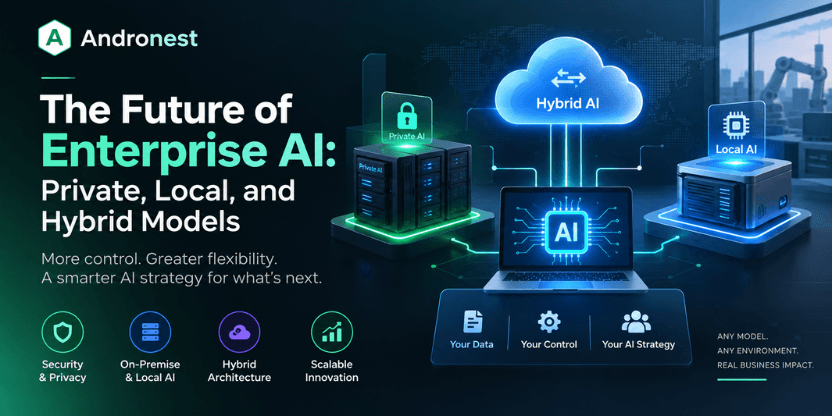
For some organizations, public cloud AI will remain the most practical option. Others may require private AI deployments because of sensitive data, regulatory requirements, intellectual property concerns, or internal security policies. Some will run models locally or at the edge. Many enterprises will adopt a hybrid AI architecture, combining public cloud, private infrastructure, and local models according to the workload.
The future of enterprise AI is therefore unlikely to be defined by a single deployment model.
Instead, organizations are moving toward flexible AI architectures in which the model, data, inference environment, and governance controls can be selected according to business requirements.
This article explores private, local, and hybrid AI models, their advantages and limitations, architectural considerations, enterprise use cases, and how organizations can prepare for the next phase of AI adoption.
Read: How Private AI Reduces Long-Term Operational Costs
What is Enterprise AI?
Enterprise AI refers to the use of artificial intelligence technologies within business processes, applications, data platforms, and operational workflows.
Unlike consumer AI applications, enterprise AI typically needs to operate within established requirements for:
- Data security
- Privacy
- Compliance
- Identity and access control
- Integration
- Reliability
- Observability
- Governance
- Cost management
- Business continuity
Enterprise AI can include traditional machine learning, predictive analytics, generative AI, large language models, retrieval-augmented generation (RAG), AI agents, computer vision, speech processing, and domain-specific AI applications.
As organizations move from AI experimentation toward production deployment, infrastructure decisions become increasingly important.
The question is no longer simply:
“Which AI model should we use?”
It becomes:
“Which model should run where, using which data, under which controls, and for which business process?”
Also read: How to build an AI adoption roadmap without disrupting your operations
Why Enterprise AI is Moving Beyond Public Cloud Models
Public cloud AI platforms have made advanced AI capabilities accessible without requiring organizations to build and maintain their own model infrastructure.
They can provide:
- Foundation models
- Managed inference
- GPU infrastructure
- AI APIs
- Model customization
- Vector databases
- AI development platforms
- Monitoring capabilities
- Scalable compute
For many workloads, this model is highly effective.
However, enterprises increasingly need to consider situations where sending data to an external AI service may create additional security, privacy, compliance, latency, or governance considerations.
For example, consider an organization processing:
- Proprietary engineering documents
- Financial records
- Patient information
- Legal documents
- Customer data
- Source code
- Intellectual property
- Internal research
- Government or regulated data
The organization may not want every AI request to leave its controlled environment.
This is one reason private and hybrid AI architectures are becoming increasingly important.
Check out: How to Choose the Right AI Workflow Automation Platform for Your Business
The Three Deployment Models Defined
Before examining why enterprises are diversifying their AI deployment, the three deployment models require clear definition, because the terminology is frequently conflated in vendor marketing.
Private AI
Private AI refers to AI models and infrastructure that operate entirely within the organization’s security and governance perimeter — on hardware the organization controls, whether that is an on-premises data center, a colocation facility, or a private cloud environment. The defining characteristic of private AI is data sovereignty: no data leaves the organization’s controlled environment during AI processing, inference, or storage. Private AI is not synonymous with on-premises — a private cloud hosted in a third-party data center but managed exclusively for one organization qualifies as private AI if the data isolation is genuine.
Typical private AI architecture
A simplified architecture might look like this:
Enterprise Data → Private Data Platform → AI Gateway → Private Model → Enterprise Application
The AI gateway can provide centralized controls for:
- Authentication
- Authorization
- Model routing
- Logging
- Policy enforcement
- Rate limiting
- Data filtering
- Monitoring
This architecture can be particularly useful when AI needs access to sensitive enterprise information.
Local AI
Local AI refers specifically to AI inference that runs on hardware at the point of use — an individual server, a workstation, an edge device, or a factory floor system. Local AI extends the private AI principle to the operational edge, bringing model inference directly to the data rather than routing data to centralized infrastructure. The model runs where the data is generated: on the production line, in the branch office, in the hospital room, on the trading floor. Local AI is increasingly practical in 2026 because smaller, quantized open-source models now run on commodity hardware that did not require data center-class GPUs two years ago.
Hybrid AI
Hybrid AI combines cloud and non-cloud infrastructure under a single management and orchestration layer, routing each AI workload to the deployment environment where the requirements of cost, latency, data sensitivity, and regulatory compliance are best met. Hybrid AI is not a compromise architecture — it is the architecturally correct answer for most enterprise workload portfolios, because different workloads have genuinely different optimal deployment environments.
A hybrid architecture might look like:
Enterprise Applications
↓
AI Gateway / Orchestration Layer
↓
Public Cloud Models | Private Models | Local Models
↓
Enterprise Data Sources
This approach allows organizations to select the appropriate AI environment based on the workload.
Keep your data in your control with private and local AI deployment services. Learn more.
Private AI vs. Local AI
The terms private AI and local AI are related but not identical.
| Factor | Private AI | Local AI |
| Primary focus | Control and isolation | Proximity to users/data |
| Deployment | Private cloud, dedicated infrastructure, on-premises | Device, server, edge, or local infrastructure |
| Data control | High | High |
| Latency | Can be low | Often very low |
| Scalability | Generally higher | Depends on infrastructure |
| Management | Centralized | Can be distributed |
| Typical use | Enterprise applications | Edge, offline, sensitive or latency-sensitive workloads |
A private AI platform can therefore be centralized, while local AI can be distributed across many locations.
Why Hybrid AI Could Become the Dominant Enterprise Architecture
Different AI workloads have different requirements.
A marketing team generating social media ideas may not need the same infrastructure as a financial institution processing confidential customer documents.
Similarly, an industrial AI system operating on a factory floor may have very different latency requirements from an internal knowledge assistant.
A hybrid model allows organizations to make these decisions independently.
Example
A company might use:
Public AI
For:
- Marketing content
- General summarization
- Low-risk productivity tasks
Private AI
For:
- Internal knowledge
- Financial analysis
- Customer information
- Proprietary documents
Local AI
For:
- Edge applications
- Offline environments
- Low-latency inference
- Sensitive operational data
This workload-based approach can prevent organizations from forcing every AI use case into the same infrastructure model.
Also check: How to Deploy AI Agents Securely in Enterprise Environments
Private AI: Key Enterprise Benefits
1. Greater Data Control
Sensitive information can remain within controlled environments.
This can be particularly valuable for organizations handling regulated or proprietary data.
2. Stronger Privacy Controls
Private infrastructure can provide additional control over how data enters, moves through, and leaves an AI system.
However, private deployment does not automatically guarantee compliance or privacy.
Organizations still need appropriate technical and organizational controls.
3. Reduced Dependency on External Services
Private AI can reduce reliance on external AI APIs for selected workloads.
This can provide greater control over:
- Model lifecycle
- Infrastructure
- Availability
- Configuration
- Data handling
4. Customization
Organizations can potentially customize models for specific business domains.
Examples include:
- Financial terminology
- Healthcare terminology
- Legal language
- Engineering documentation
- Internal product knowledge
5. Predictable Data Boundaries
A private deployment can make it easier to define explicit boundaries around sensitive information.
This can be useful for organizations with strict internal security policies.
Private AI Challenges
Private AI also introduces significant responsibilities.
Organizations may need to manage:
- GPU infrastructure
- Model deployment
- Model upgrades
- Security patches
- Scaling
- Monitoring
- Availability
- Hardware capacity
- Model evaluation
- AI talent
The total cost is therefore not limited to the model itself.
A private AI strategy must consider the full operational lifecycle.
Read: How to Deploy AI Securely Without Sending Data to the Cloud
Local AI: Where It Makes Sense
Local AI becomes especially interesting when latency, connectivity, or data locality are important.
Potential use cases include:
Manufacturing
AI can analyze sensor data close to machines.
Healthcare
Local processing can support applications where data locality is important, subject to applicable privacy and regulatory requirements.
Retail
Edge AI can support real-time computer vision and store analytics.
Field Services
Technicians could use local AI assistants even when connectivity is unreliable.
Automotive
AI inference can occur directly on vehicles or edge devices.
Defense and critical infrastructure
Local or isolated AI environments may be relevant where connectivity and data-handling constraints are significant.
NIST’s current work on trustworthy AI for critical infrastructure specifically highlights the need for lifecycle-oriented risk management when deploying AI in high-stakes environments.
Hybrid AI: The Best of Multiple Environments?
Hybrid AI can provide flexibility, but it also increases architectural complexity.
An enterprise may have to manage:
- Multiple models
- Multiple infrastructure environments
- Different security controls
- Different APIs
- Multiple monitoring systems
- Model versioning
- Data movement
- Identity management
- Cost allocation
Therefore, hybrid AI should not simply mean “use everything.”
It should mean:
Use the appropriate environment for each workload while maintaining centralized governance.
Also read: How Data Processing Services Prepare Data for AI
Private vs. Public vs. Hybrid AI
| Factor | Public AI | Private AI | Hybrid AI |
| Infrastructure control | Lower | Higher | Flexible |
| Scalability | High | Depends on infrastructure | High |
| Data control | Depends on provider and configuration | High | Workload-dependent |
| Customization | Provider-dependent | High | High |
| Initial complexity | Lower | Higher | Higher |
| Operational responsibility | Lower | Higher | Higher |
| Local inference | Limited | Possible | Possible |
Best fit | General workloads | Sensitive workloads | Diverse enterprise environments |
The right choice depends on the organization’s data, risk profile, workloads, existing infrastructure, and operating model.
The Technical Enablers Making Private and Local AI Practical
The argument for private and local AI is not new — regulated industries have always wanted on-premises AI. What has changed in 2026 is that the technical and economic prerequisites have been met.
Open-source frontier models. The open-source model ecosystem has matured to where models approaching the capability of frontier commercial models are available for self-hosting. Llama 4, DeepSeek-V4, and Qwen3 series models provide enterprise-grade reasoning, code generation, and language understanding capability that organizations can deploy on their own infrastructure. ERNIE 5.1 achieved comparable results with 6% of industry-standard pretraining costs.
Quantization and efficiency techniques. 4-bit quantization compresses model weights to a quarter of their standard size with minimal capability degradation, enabling models that previously required 80GB or more of GPU memory to run on much smaller hardware. Techniques like speculative decoding and continuous batching enable single GPU instances to serve inference for hundreds of concurrent users — changing the hardware economics of on-premises AI deployment fundamentally.
Purpose-built inference hardware. NVIDIA’s H200 and its inference-optimized descendants, together with AMD Instinct MI300-series accelerators and emerging purpose-built inference ASICs, provide significantly better inference throughput per watt per dollar than the GPU generations on which the “on-premises is too expensive” assumption was formed. New-generation GPUs and specialized inference accelerators from NVIDIA and AMD increase throughput while reducing power consumption, pushing the breakeven point between API and self-hosting lower every quarter.
MicroVMs and container-native deployment. Model serving infrastructure — NVIDIA NIM microservices, vLLM, Ollama, llama.cpp — has matured to where deploying a large language model for enterprise inference no longer requires a specialized MLOps team. An AI model can be packaged as a container image and deployed to existing Kubernetes infrastructure on the same operational model as any other enterprise containerized workload.
Ready to Get Started with RAG & Knowledge Base AI?
Check this out.
How RAG Fits Into Private and Hybrid AI
Retrieval-augmented generation (RAG) is particularly important for enterprise AI because organizations often want models to answer questions using current internal information without retraining the underlying model for every change.
A simplified architecture is:
Enterprise Data
↓
Document Processing
↓
Embedding Model
↓
Vector Database
↓
Retriever
↓
LLM
↓
Enterprise Application
With private or hybrid AI, different components can potentially operate in different environments.
For example, an organization could keep sensitive documents and retrieval infrastructure private while using an external model for selected workloads, subject to its security and data-processing requirements.
Alternatively, the entire RAG pipeline could operate within a private environment.
Enterprise AI Security Considerations
Moving AI into private or hybrid environments does not eliminate security risk.
Organizations still need to address:
- Prompt injection
- Data leakage
- Model abuse
- Unauthorized access
- Insecure APIs
- Supply-chain risks
- Model theft
- Sensitive information exposure
- Excessive agent permissions
- Poor logging
- Uncontrolled model deployment
NIST’s Generative AI Profile recommends managing generative AI risks across the lifecycle and organizing risk management around governance, mapping, measurement, and management.
NIST also identifies security and resilience as important characteristics of trustworthy AI and continues to develop guidance for securing AI systems, including agent systems.
AI Governance Must Span the Entire Stack
Enterprise AI governance should not stop at the model.
A mature governance strategy should cover:
Data
Who can access the information?
Models
Which models are approved?
Applications
Where can AI be used?
Agents
What actions can an AI system perform?
Infrastructure
Where can AI workloads run?
Users
Who can access AI capabilities?
Outputs
How are AI-generated results validated?
This creates a broader governance model:
Data Governance + Model Governance + Application Governance + Agent Governance
Observability Becomes Essential
Traditional application monitoring is not enough for complex AI systems.
Enterprise AI observability may need to track:
- Model latency
- Token consumption
- Infrastructure utilization
- Cost
- Response quality
- Retrieval quality
- Hallucination indicators
- Prompt patterns
- Failed requests
- Agent actions
- Tool usage
- Security events
For hybrid architectures, observability becomes even more important because the AI stack may span multiple environments.
The Economics of Private and Hybrid AI
Cost is one of the most important factors in architecture decisions.
Organizations should consider:
Infrastructure costs
- GPUs
- CPUs
- Memory
- Storage
- Networking
Software costs
- Model licenses
- AI platforms
- Databases
- Monitoring
- Security tools
Operational costs
- AI engineering
- MLOps
- DevOps
- Security
- Infrastructure management
Cloud costs
- Compute
- Storage
- Network transfer
- Managed AI services
A private model may appear cheaper based on API usage alone but become more expensive when infrastructure and operational costs are included.
Therefore, enterprises should calculate total cost of ownership (TCO) rather than comparing model API prices alone.
How Enterprises Should Choose Between Public, Private, Local, and Hybrid AI
A practical evaluation framework can use seven questions.
1. How sensitive is the data?
Classify the information involved.
2. Does the workload require local processing?
Consider latency, connectivity, and geographic requirements.
3. What level of customization is required?
Determine whether an existing model is sufficient or whether customization is necessary.
4. What compliance requirements apply?
Evaluate the relevant regulatory and contractual requirements for the business and geography.
5. What level of operational responsibility can the organization support?
Private AI can require substantial infrastructure and AI engineering expertise.
6. What is the expected workload?
Evaluate:
- Requests per second
- Peak workloads
- Average usage
- Model size
- Context length
- Inference frequency
7. What is the business value?
Not every AI workload needs a private deployment.
The architecture should be proportional to the value and risk of the use case.
A Practical Enterprise AI Adoption Roadmap
Organizations don’t need to move directly from public AI to a fully private AI environment.
A phased approach can reduce risk.
Phase 1: Identify AI Workloads
Catalog existing and planned AI use cases.
Classify them according to:
- Data sensitivity
- Business criticality
- Latency
- Volume
- Cost
- Compliance
Phase 2: Establish AI Governance
Define:
- Approved models
- Data policies
- Access controls
- Security requirements
- Evaluation standards
- Monitoring requirements
NIST’s AI RMF can provide a useful voluntary framework for structuring these activities.
Phase 3: Build an AI Gateway
Introduce a common layer for:
- Authentication
- Model access
- Policy enforcement
- Logging
- Routing
- Monitoring
This reduces direct dependencies between applications and individual model providers.
Phase 4: Introduce Private Models
Move selected sensitive or high-value workloads into private environments.
Start with clearly defined use cases.
Phase 5: Add Local or Edge AI
Where latency or connectivity requires it, deploy models closer to users or data sources.
Phase 6: Implement Hybrid Model Routing
Use workload characteristics to dynamically determine where requests should run.
Phase 7: Continuously Evaluate
AI systems change rapidly.
Organizations should periodically reassess:
- Model quality
- Security
- Cost
- Infrastructure
- Compliance
- User experience
- Business outcomes
How to Choose the Right Deployment Model
The decision between private, local, and hybrid deployment is determined by workload characteristics rather than by a general organizational preference for one model over another. A structured evaluation framework covers five dimensions:
Data sensitivity: Does the workload process regulated data (PHI, PII, financial records, classified information, privileged communications)? If yes, private deployment is the baseline requirement. If no, cloud deployment is viable.
Latency requirement: Does the use case require sub-100ms response time? If yes, edge or local deployment may be necessary. If latency tolerance is in the seconds range, cloud or private infrastructure both work.
Usage volume and consistency: Is the AI workload consistent and high-volume (thousands of requests daily at predictable rates) or variable and bursty? Consistent, high-volume workloads benefit from private infrastructure’s fixed cost model. Variable workloads benefit from cloud’s variable cost model.
Jurisdictional requirements: Does the data have cross-border transfer restrictions? If yes, private or sovereign AI deployment in the applicable jurisdiction is necessary. If no, deployment location is an economic and operational decision.
Operational maturity: Does the organization have the MLOps capability to operate, monitor, update, and secure self-hosted AI models? If yes, private deployment is viable. If not, managed private cloud or third-party private AI services address the capability gap.
The recommended approach: start with use cases and a readiness assessment. Evaluate hybrid and local options against business outcomes, not vendor narratives. Engage IT, security, data science, and business stakeholders early. The decisions made in the first few months shape everything that follows, and they are far harder to reverse than they look at the time.
10 Enterprise AI Trends to Watch
1. Hybrid AI architectures
Organizations will increasingly combine multiple AI environments.
2. Smaller specialized models
Smaller models will become useful for targeted enterprise workloads.
3. AI gateways
Centralized AI access and policy layers will become more common.
4. Model routing
Applications will dynamically select models based on workload requirements.
5. AI agents
AI systems will increasingly move from generating information to executing workflows.
6. Private RAG
Organizations will build retrieval systems around proprietary data.
7. AI observability
Monitoring AI quality, cost, security, and behavior will become a core operational requirement.
8. AI-specific identity
As agents gain the ability to perform actions, identity and authorization will become increasingly important.
9. Edge AI
Local inference will expand where latency, connectivity, and data locality matter.
10. AI infrastructure abstraction
Organizations will increasingly want applications to consume AI capabilities without being tightly coupled to one model provider.

Common Questions About Private, Local, and Hybrid AI
Is private AI the same as on-premises AI?
No. On-premises AI is one form of private AI. Private AI can also operate in dedicated or isolated cloud environments.
Is hybrid AI more secure than public AI?
Not automatically. Hybrid AI can provide additional control over where data and workloads operate, but security depends on architecture, configuration, identity, governance, and operational practices.
Does private AI require an organization to train its own LLM?
No. Organizations can deploy existing models privately without training a foundation model from scratch.
Is local AI better for sensitive data?
Local processing can reduce the need to move certain data to remote services, but it does not automatically make a system secure or compliant. Security controls are still required.
What is hybrid AI?
Hybrid AI combines multiple AI deployment environments, such as public cloud models, private models, and local or edge models, within a broader enterprise architecture.
Why are enterprises considering private AI?
Common considerations include data control, privacy, security, customization, latency, compliance requirements, and reduced dependency on external AI services.
What is the difference between private AI and hybrid AI?
Private AI focuses on controlled AI deployment, while hybrid AI focuses on combining different AI environments according to workload requirements.
Can hybrid AI use multiple LLMs?
Yes. A hybrid architecture can route workloads across multiple models based on factors such as sensitivity, cost, latency, capability, and availability.
Does RAG work with private AI?
Yes. RAG can be implemented entirely within a private environment or across a hybrid architecture, depending on data and model requirements.
Will enterprises still use public AI?
Yes. Public AI can remain valuable for workloads where its capabilities, scalability, and economics make sense. The future is likely to involve choosing the right deployment model for each workload rather than eliminating public AI altogether.
Conclusion: Enterprise AI Is Becoming an Architecture Decision
The next phase of enterprise AI will not be defined solely by which model produces the best response.
It will also be defined by where AI runs, what data it can access, what actions it can take, and how the organization controls it.
Public cloud AI will continue to play an important role. Private AI will become increasingly relevant for sensitive workloads. Local AI can address latency, connectivity, and data-locality requirements. Hybrid AI can bring these environments together.
The strategic opportunity is therefore not simply to choose between public, private, or local AI.
It is to build an AI architecture that can use all three appropriately.
For enterprises, the winning architecture may ultimately be the one that provides the right balance of:
Security + Privacy + Performance + Cost + Flexibility + Governance
Organizations that begin designing this architecture now can create a foundation that adapts as models, infrastructure, regulations, and AI applications continue to evolve.
Build a Future-Ready Enterprise AI Architecture
Andronest helps organizations evaluate and implement AI architectures across private AI, local AI, hybrid AI, AI agents, RAG, AI model evaluation, data platforms, and enterprise application environments.
Whether your organization is evaluating private LLM deployment, building a secure RAG platform, introducing AI agents, or designing a hybrid AI strategy, the architecture should start with your data, business requirements, security model, and long-term operating strategy.