Modern enterprises generate enormous amounts of data every day.
Customer interactions, application events, transactions, IoT devices, business applications, logs, documents, APIs, and AI systems continuously produce information that organizations need to process and analyze.
As data volumes increase, traditional data processing architectures can struggle with performance, scalability, reliability, and cost. Enterprise organizations therefore need a data processing architecture that can handle large workloads while remaining flexible enough to support analytics, applications, machine learning, and AI.
A well-designed data processing architecture for large-scale enterprise workloads provides the foundation for collecting, transforming, storing, analyzing, and governing data across the organization.
The architecture should not only answer how much data can be processed, but also:
- How quickly can data be processed?
- Can the platform scale as workloads grow?
- How are batch and real-time workloads handled?
- How is data quality maintained?
- How are failures detected and recovered?
- How is sensitive data protected?
- How can AI and machine learning workloads consume trusted data?
- How can infrastructure costs be controlled?
This guide explains the key components, architectural patterns, technologies, challenges, and best practices for designing scalable enterprise data processing systems.
Read: Data Privacy Challenges in AI Deployment and How to Solve Them
What is Data Processing Architecture?
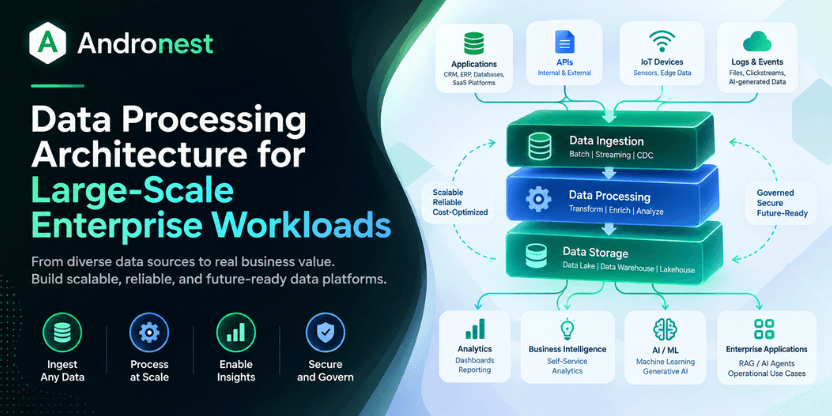
Data processing architecture is the structured design of technologies, components, workflows, and processes used to collect, ingest, transform, store, process, govern, and analyze data.
At enterprise scale, the architecture typically connects multiple data sources with processing engines, storage platforms, analytics systems, applications, and AI workloads.
A simplified architecture looks like this:

The exact architecture depends on the organization’s workload, data sources, regulatory requirements, latency expectations, and technology environment.
Why Large-Scale Enterprise Data Processing is Different
Processing data at enterprise scale introduces challenges that may not appear in smaller systems.
An organization may need to process:
- Millions or billions of records
- Continuous event streams
- High-volume transactions
- Large files and documents
- Customer interaction data
- Application logs
- Sensor and IoT data
- Structured and unstructured data
- Data from legacy systems
- Data from SaaS platforms
- AI-generated data
The architecture therefore needs to support several dimensions simultaneously.
Volume
The system must process increasing quantities of data without becoming a bottleneck.
Velocity
Some workloads require data to be processed within seconds or milliseconds rather than hours.
Variety
Enterprise data can include relational records, JSON, documents, images, logs, events, and other formats.
Reliability
Processing failures should not result in uncontrolled data loss or inconsistent downstream systems.
Security
Sensitive business and customer information needs appropriate access controls, encryption, monitoring, and governance.
Cost
Large-scale processing can become expensive if infrastructure is not optimized.
This is why enterprise data architecture needs to be designed around workload requirements rather than simply selecting a collection of popular technologies.
Core Components of a Large-Scale Data Processing Architecture
1. Data Ingestion Layer
The ingestion layer connects source systems to the data platform. At enterprise scale it must handle structural heterogeneity across sources, schema evolution, API rate limits, and volume spikes — simultaneously and reliably.
Three primary ingestion patterns:
- Change Data Capture (CDC): Reads the database transaction log (WAL, binary log, redo log) to capture every insert, update, and delete as a discrete event — without polling or impacting production performance. Debezium is the 2026 open-source standard, supporting PostgreSQL, MySQL, SQL Server, Oracle, MongoDB, and Cassandra.
- Event streaming: Handles high-volume, time-ordered data (clickstreams, IoT sensor readings, payment events) via Apache Kafka or its managed cloud equivalents (Amazon Kinesis, Azure Event Hubs, Google Pub/Sub).
- Batch connectors: Ingests SaaS platform data (Salesforce, Stripe, Zendesk) via REST APIs, with authentication, pagination, rate limiting, and incremental load handled by Fivetran or Airbyte rather than custom scripts.
2. Raw Storage and Landing Zone
The landing zone persists an immutable, unmodified copy of every record received — in its original format, with full fidelity, before any transformation is applied. If a downstream pipeline corrupts data or a business logic error surfaces months later, the landing zone is the recovery point.
Built on cloud object storage (AWS S3, Azure Data Lake Storage Gen2, GCS), partitioned by ingestion timestamp, and governed by a strict append-only policy — existing records are never overwritten or deleted.
3. Data Processing and Compute Layer
The compute layer applies transformation logic to raw data, producing curated datasets that analytics, AI, and operational consumers depend on. Three computational models serve different workload profiles:
- Batch processing: Large-scale, latency-tolerant transformations — historical backfill, multi-join aggregations, ML training data preparation. Apache Spark and Databricks Photon are the dominant engines, delivering 2×–8× acceleration on analytical workloads through vectorized execution.
- SQL transformation: Business logic that converts raw data into business-meaningful datasets — dimensional models, metrics, clean tables for BI. dbt is the standard, providing modular, version-controlled, testable SQL transformations with built-in documentation and dependency graph management.
- Stream processing: Real-time transformation of event streams with millisecond-to-second latency. Apache Flink provides stateful processing with exactly-once semantics; Kafka Streams and ksqlDB cover moderate-complexity use cases within the Kafka ecosystem.
4. Curated Storage: Data Lakehouse
The lakehouse is the dominant 2026 architecture for curated analytical storage, combining the low-cost flexibility of a data lake with the ACID transactions and query performance of a warehouse — through open table formats (Delta Lake, Apache Iceberg, Apache Hudi) layered on standard Parquet files in object storage.
Data is organized in three zones:
| Zone | Contents |
| Bronze | Raw-to-validated: data types enforced, duplicates removed, nulls checked |
| Silver | Validated-to-enriched: unified business entities, identity resolution, cross-source joins |
| Gold | Enriched-to-aggregated: BI-ready metrics, denormalized fact tables, ML feature datasets |
Time travel — the ability to query any table at any historical snapshot — is the lakehouse capability most directly valuable for reproducible ML experiments, regulatory compliance, and production debugging.
5. Pipeline Orchestration Layer
The orchestration layer schedules pipeline execution, resolves inter-pipeline dependencies, handles retries, enforces SLAs, and provides visibility across the complete pipeline inventory — which at enterprise scale commonly spans hundreds to thousands of DAGs.
Apache Airflow (Python-defined DAGs, broadest ecosystem) remains the most widely deployed platform. Prefect decouples control plane from compute for hybrid execution flexibility. Dagster introduces asset-centric orchestration — scheduling data assets rather than tasks — making pipeline outcomes visible in business terms.
6. Data Governance and Catalog Layer
The governance layer provides the metadata infrastructure that makes a large data platform usable and auditable:
- Data catalog: Searchable inventory of all data assets with technical metadata (schema, lineage, update frequency), business metadata (ownership, glossary definitions), and operational metadata (freshness, quality SLA status). Leading tools: DataHub, Atlan, Collibra.
- Data lineage: Field-level traceability from a BI dashboard metric back to the source records that produced it. OpenLineage is the open standard, supported natively by Spark, Flink, dbt, and Airflow.
- Access control: Row-level and column-level security enforced at query execution — not through separate data copies. Databricks Unity Catalog, Snowflake native governance, and AWS Lake Formation implement these controls within the lakehouse compute layer.
7. Data Quality and Observability Layer
- Rule-based validation: Explicit assertions on row counts, null rates, referential integrity, and value distributions. Great Expectations, dbt tests, and Soda are the standard frameworks.
- Statistical observability: Continuous anomaly detection on freshness, volume, schema, and column-level distributions — without requiring every failure mode to be pre-specified. Monte Carlo, Bigeye, and Elementary provide this layer.
8. Security and Access Management Layer
The security layer addresses four distinct threat surfaces: human user access to analytical tools, automated pipeline access to source and target systems, AI agent data access via APIs and MCP servers, and platform engineer administrative access.
Key controls:
- IAM: Cloud-native identity management (AWS IAM, Azure Entra ID, GCP IAM) for service account permissions; SSO integration for human users.
- Encryption: AES-256 at rest, TLS 1.3 in transit for all inter-component data movement.
- Secrets management: HashiCorp Vault or cloud-native equivalents (AWS Secrets Manager, Azure Key Vault) for automatic credential rotation — never embedded in pipeline code.
- Audit logging: Immutable access event logs (AWS CloudTrail, Azure Monitor, Snowflake access history) for compliance audits and security investigations.
9. Data Serving Layer
The serving layer delivers processed data to consumers in the format and at the latency each use case requires:
- BI serving: SQL interfaces (JDBC/ODBC) to Snowflake, Databricks SQL, or BigQuery; semantic layers (dbt Semantic Layer, Looker LookML) for consistent metric definitions across tools.
- Feature stores: Consistent feature computation for ML training (offline store) and real-time inference (online store), eliminating training-serving skew. Feast, Tecton, SageMaker Feature Store.
- Real-time serving: Low-latency data access for operational applications — fraud scoring, personalization APIs, inventory checks — via Redis, Cassandra, or DynamoDB.
- Reverse ETL: Curated analytical data pushed back into operational systems (Salesforce, HubSpot, Intercom) for action by business users. Census and Hightouch are the standard platforms.
How the Components Connect
Each component solves one layer of the data reliability problem. The architecture’s value is in how they compose: Debezium captures a database change → Kafka buffers it → Flink validates and writes it to a Delta Lake Bronze table → dbt transforms it through Silver to Gold → Airflow coordinates the sequence → Monte Carlo monitors the output → Unity Catalog enforces access → Looker queries the result.
Every arrow between components is a real data movement with its own reliability, latency, and governance requirements. Building an architecture where every arrow is reliable, observable, and governed — not just the individual components — is the engineering challenge that large-scale enterprise data processing presents.
The Five Defining Challenges of Large-Scale Enterprise Data Processing
Before evaluating architectural patterns, understanding the specific challenges that large-scale enterprise workloads create — and that any adequate architecture must address — is the prerequisite for selecting the right design.
Challenge 1: Concurrency at Scale
Large enterprise environments require simultaneous data access by thousands of users, applications, and automated processes. An analyst running an ad-hoc query must not block a scheduled ETL pipeline. A machine learning training job must not degrade BI dashboard performance for business users. A compliance reporting process must not interfere with real-time customer-facing applications. Managing these concurrent workloads without resource contention is an architectural design problem that query-based isolation and physical separation of read and write paths both address — but in different ways, with different cost and complexity trade-offs.
Challenge 2: Heterogeneous Data Sources
Enterprise data arrives from structured relational databases, semi-structured API responses and JSON payloads, unstructured documents and logs, streaming IoT sensor data, SaaS platform exports, third-party data enrichment services, and legacy mainframe extracts — often simultaneously. Each source has different schemas, different change frequencies, different reliability guarantees, and different latency profiles. The ingestion architecture must handle this heterogeneity without creating downstream schema conflicts or brittle pipelines that break when any single source changes its format.
Challenge 3: Variable and Spiky Workload Patterns
Enterprise data processing workloads are rarely smooth. Month-end financial closes create processing spikes. Marketing campaign launches generate sudden surges in behavioral data ingestion. Seasonal retail demand creates peaks that dwarf average loads. The architecture must absorb these spikes without over-provisioning for average loads — which drives toward elastic, auto-scaling compute models rather than fixed-capacity infrastructure.
Challenge 4: The Latency Spectrum
Different enterprise use cases require different data freshness. A financial fraud detection system needs milliseconds. An operational dashboard for a customer service team needs seconds to minutes. An executive revenue report is acceptable with day-old data. An annual compliance report works with weekly batch processing. The architecture must simultaneously support this full latency spectrum — often across the same underlying data — without requiring separate, redundant copies of the data for each latency requirement.
Challenge 5: Governance at Scale
As data processing scales, governance complexity scales with it. Which data can be used for which purpose? Which users and applications have access to which fields? Where did this metric come from? What transformation produced this figure? Who approved this data asset for use in a machine learning training set? These questions, answerable through manual processes at small scale, require automated metadata management, lineage tracking, and access control enforcement at enterprise scale. Forrester’s research documents that through 2026, two-thirds of enterprises will invest in initiatives to improve trust in data through automated observability tools addressing detection, resolution, and prevention of data reliability issues.
Best Practices for Designing Enterprise Data Processing Architecture
1. Start With Business Requirements
Define:
- Data volume
- Latency requirements
- Availability
- Retention
- Compliance
- Consumers
- Cost expectations
before selecting technologies.
2. Design for Failure
Assume that components will fail and define recovery mechanisms.
3. Separate Storage and Compute Where Appropriate
This can provide greater flexibility and scalability.
4. Automate Data Quality
Use automated validation rather than relying exclusively on manual checks.
5. Build Security Into Every Layer
Apply identity, access control, encryption, and monitoring throughout the architecture.
6. Use Incremental Processing
Avoid repeatedly processing unchanged data.
7. Monitor Data and Infrastructure
Track both pipeline health and data health.
8. Document Data Lineage
Make data movement and transformations understandable.
9. Avoid Unnecessary Technology
More tools do not automatically produce a better architecture.
10. Design for Future AI Workloads
Consider how analytics, machine learning, RAG, and AI agents may consume enterprise data.
How to Design a Data Processing Architecture Step by Step
A practical enterprise architecture process can follow these steps.
Step 1: Identify Data Sources
Document every major source system and data type.
Step 2: Classify Workloads
Separate:
- Batch
- Streaming
- Transactional
- Analytical
- AI/ML
workloads.
Step 3: Define Latency Requirements
Determine whether data needs to be available in:
- Milliseconds
- Seconds
- Minutes
- Hours
- Days
Step 4: Design the Ingestion Layer
Choose appropriate mechanisms for batch and streaming ingestion.
Step 5: Define Storage Strategy
Determine where raw, processed, curated, and analytical data should reside.
Step 6: Design Processing Pipelines
Define transformation, enrichment, validation, and aggregation processes.
Step 7: Add Governance
Implement:
- Identity
- Access control
- Encryption
- Metadata
- Lineage
- Auditability
Step 8: Add Observability
Monitor infrastructure, pipelines, data quality, and business SLAs.
Step 9: Optimize Performance and Cost
Use partitioning, incremental processing, autoscaling, and appropriate storage tiers.
Step 10: Prepare for AI
Ensure trusted data can support analytics, ML, RAG, and enterprise AI applications.
Example Enterprise Data Processing Architecture
A mature architecture could look like this:

This architecture is illustrative rather than prescriptive. The actual implementation should reflect the organization’s data sources, workload characteristics, security requirements, and business objectives.
How Enterprise Data Architecture Supports AI Transformation
AI initiatives frequently fail to deliver expected value when organizations focus heavily on models while overlooking data foundations.
An enterprise AI application may require:
Reliable data → secure access → efficient processing → relevant context → AI model → business action
For example:
Enterprise Data
↓
Data Processing
↓
Data Quality
↓
Governed Data
↓
AI Context
↓
AI Model
↓
Agent / Application
↓
Business Action
This makes data processing architecture a strategic component of AI transformation.
The organizations building sustainable AI capabilities are likely to need data platforms that can support both traditional analytics and newer AI workloads.
Frequently Asked Questions
What is enterprise data processing architecture?
Enterprise data processing architecture is the design of technologies, workflows, storage systems, processing engines, governance controls, and integration mechanisms used to process large volumes of organizational data.
What are the main components of a data processing architecture?
The primary components typically include data sources, ingestion, storage, batch or stream processing, transformation, data quality, governance, orchestration, observability, analytics, and AI/ML consumption layers.
What is the difference between batch and real-time data processing?
Batch processing processes data at scheduled intervals, while real-time or stream processing handles data continuously as events occur. The appropriate model depends on business latency requirements.
What architecture is best for large-scale data processing?
There is no single architecture that is best for every organization. Data lake, lakehouse, warehouse, batch, streaming, and hybrid architectures can all be appropriate depending on workload requirements.
How does data processing architecture support AI?
It provides the ingestion, transformation, quality, governance, and delivery infrastructure needed to supply AI and machine learning applications with reliable and relevant data.
Why is data quality important in enterprise data processing?
Poor-quality data can lead to inaccurate analytics, unreliable reports, incorrect machine learning results, and poor AI responses. Automated data validation and monitoring can help maintain data quality.
How can enterprises reduce data processing costs?
Organizations can reduce costs through workload optimization, incremental processing, autoscaling, storage lifecycle management, compression, partitioning, resource right-sizing, and monitoring.
What is a data lakehouse?
A data lakehouse is an architectural approach that aims to combine scalable data lake storage with capabilities needed for structured analytics and other workloads, including AI and machine learning.
What role does data governance play in enterprise architecture?
Data governance establishes policies and controls for data access, security, quality, ownership, lineage, compliance, and lifecycle management.
How should enterprises prepare their data architecture for generative AI?
Enterprises should establish trusted data pipelines, strong metadata and governance, appropriate access controls, efficient document processing, and infrastructure capable of supporting retrieval, embeddings, vector search, model evaluation, and AI applications where required.
Conclusion
A scalable data processing architecture for large-scale enterprise workloads is more than a collection of databases and processing tools.
It is an interconnected system designed to move data reliably from source systems to the people and applications that need it.
A mature architecture should balance:
- Scalability
- Performance
- Reliability
- Security
- Data quality
- Governance
- Observability
- Cost efficiency
- AI readiness
The architecture also needs to evolve with the organization.
As enterprises adopt cloud platforms, real-time analytics, machine learning, RAG applications, and AI agents, data processing infrastructure becomes increasingly important to the overall technology strategy.
The most effective approach is therefore to design the architecture around business workloads and measurable requirements, rather than choosing technologies first.
A well-designed data processing platform can provide the foundation enterprises need to turn growing volumes of data into reliable analytics, operational intelligence, and AI-driven applications.