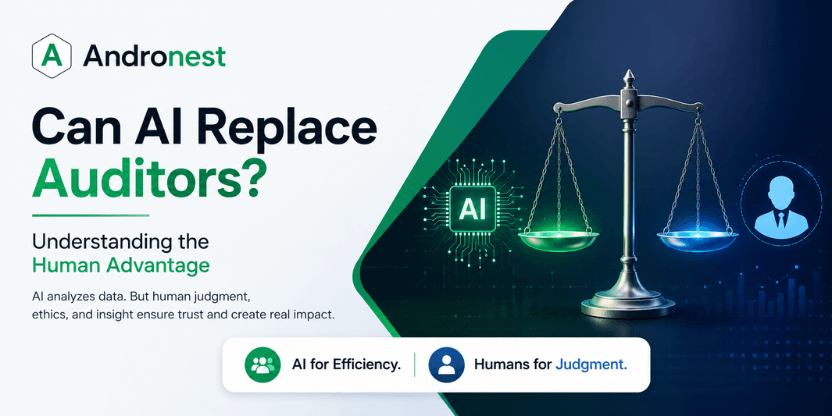
Artificial Intelligence is transforming the auditing profession—but it’s not replacing auditors. It’s redefining their role.
AI is rapidly becoming a core part of modern auditing. From automating transaction testing to identifying anomalies in millions of records within seconds, AI is enabling audit teams to work faster and more efficiently than ever before.
This rapid advancement has sparked an important question among business leaders:
Can AI replace auditors?
The short answer is no.
AI will not replace auditors. It is already replacing specific tasks that auditors used to perform. And that distinction — between replacing people and replacing tasks — is the most important clarification available to anyone trying to understand where the audit profession is actually heading.
AI adoption among internal auditors is set to double to 80% in 2026, up from 39% today, according to a Wolters Kluwer survey of 4,214 internal audit professionals. Early adopters are saving up to 8,000 audit hours annually and realizing $3.7 million in cost savings for large enterprises. The World Economic Forum projects that machines will handle approximately 65% of information and data processing tasks by 2027.
And yet: only 4% of Chief Audit Executives report substantial progress implementing AI in internal audit. 40% of institutional investors identify reduced human oversight as a primary concern about AI in the audit process. And every meaningful audit standard across every major regulatory framework in the world requires human professional judgment — not algorithmic output — as the foundation of an audit opinion.
The coexistence of AI’s demonstrated capability and these persistent constraints is not a contradiction. It is a precise description of the human advantage in audit — and the most important thing any audit professional or finance leader can understand about where the profession is going.
Read: AI Agents vs Traditional Automation – What’s the Difference and Which Should You Use?
The Rise of AI in Auditing
Audit teams have traditionally spent significant time on manual tasks such as:
- Reviewing financial records
- Sampling transactions
- Reconciling data
- Testing controls
- Identifying exceptions
- Preparing documentation
AI dramatically changes this process.
Machine learning models can analyze entire datasets rather than small samples, identify unusual transactions, detect fraud indicators, and generate insights in real time.
This allows auditors to focus on higher-value activities instead of repetitive work.
What AI is Already Doing in Audit
To understand where human judgment remains irreplaceable, it is necessary to be clear-eyed about what AI is already doing — and doing well — in audit practice in 2026.
Data processing and document review. Staff auditors have historically spent significant portions of their time manually transcribing data from PDFs and client documents, cross-referencing schedules, and performing repetitive verification tests. AI tools now handle this work automatically, processing structured and unstructured data at a scale and speed that manual processes cannot approach. A 2025 Stanford GSB study found that accountants using AI to finalise monthly statements completed the process 7.5 days faster and spent 8.5% less time on routine processing.
Anomaly detection and continuous monitoring. AI-powered audit platforms can process entire transaction populations — not the samples that manual audit methodology has historically relied on — and flag anomalies in real time rather than weeks after the fact. This capability transforms the traditional audit model from periodic retrospective testing to continuous, population-wide monitoring. When AI detects a discrepancy immediately rather than during fieldwork, the audit is faster, the client’s data is cleaner at the point of engagement, and the risk of errors embedded in the final numbers is lower.
Risk assessment and prioritization. 45% of institutional investors identify enhanced risk assessment and prioritization as a key advantage of integrating AI into the audit process, according to the Center for Audit Quality. AI can process large volumes of financial data, identify emerging patterns, flag concentration risks, and surface indicators of potential misstatement that manual review might miss — allowing audit teams to focus their judgment and scrutiny on the areas of genuine risk.
Pattern recognition across large datasets. Traditional audit training required months of manual vouching to develop pattern recognition for anomalies. AI-powered tools surface these patterns immediately, giving junior auditors access to insights that previously took years of manual work to develop. This acceleration of professional development is one of the less-discussed but most practically significant impacts of AI on the audit profession.
Reconciliation and matching. Real-time matching and anomaly detection in reconciliation processes mean that discrepancies are flagged immediately rather than discovered weeks into fieldwork. When the numbers are cleaner before the audit begins, the quality of the audit that follows is higher and its execution is faster.
The productivity impact is significant. Firms with advanced AI strategies are 3.1 times more likely to achieve ROI from their technology investments, according to Thomson Reuters’ 2025 Generative AI in Professional Services Report. 54% of firms are already seeing ROI from AI initiatives.
Also read: AI Risk vs AI Reward – Finding the Right Balance
Where AI Cannot Replace the Auditor
With AI’s capabilities in audit clearly established, the question of where the human advantage lies becomes more precise — and more important.
Professional Skepticism
Professional skepticism is the foundational disposition of the auditor: the critical mindset that questions assumptions, tests explanations, considers alternative interpretations of evidence, and maintains independence from the preferences and representations of the entity being audited.
AI processes the data it is given. It cannot independently question whether the data it has been given is the right data, whether the framing of a question by the client is the most relevant framing, or whether an explanation that is logically consistent with the numbers is actually true. These are the questions that only a trained, experienced, professionally accountable human auditor can ask and pursue.
As Thomson Reuters’ audit experts have noted, when AI handles execution, auditor skepticism becomes non-negotiable. Auditors must ask “Does this make sense?” They need to recognise when AI outputs don’t align with expectations, understand when data quality limitations affect reliability, and know when to override algorithmic conclusions with professional judgment. The firms that have already deployed AI in audit workflows report that AI has not diminished the need for professional skepticism — it has concentrated its importance. Every finding of the AI surfaces requires a human auditor to determine whether it is significant, whether the explanation offered is credible, and whether further investigation is warranted.
Ethical Judgment and Independence
The legal and regulatory requirement for auditor independence is not merely procedural. It is the foundation of the social value that audit provides. Financial markets function on the basis that audit opinions represent the independent judgment of a qualified professional who has no interest in the outcome of the opinion they issue.
AI systems do not have independence in this sense. They are products of their training data, their design parameters, and the instructions they receive. An AI model that has been trained on data from a specific client, or that has been configured to optimise for a specific outcome, does not provide the independence that audit requires. The human auditor’s ethical obligation — to form an opinion based on evidence, applying professional standards, without regard to the consequences for the client, the firm, or any other party — is not something that can be delegated to an algorithm.
This is why 64% of companies now expect their auditors to assess AI use in financial reporting, according to research cited in the 2026 audit automation literature. The auditor is not just the person who uses AI tools — the auditor is the person responsible for evaluating whether AI used by others is producing reliable, unbiased, and compliant outputs. Human independence is not just maintained in an AI-enabled audit environment — it becomes more important.
Contextual and Relational Understanding
Audit is not only a data analysis exercise. It is a professional relationship between the auditor and the client organization, conducted within a specific industry, regulatory, economic, and organizational context that no data set fully captures.
Understanding why a number looks the way it does requires understanding the business behind the number — the competitive dynamics, the management team’s track record, the industry cycle, the regulatory environment, and the specific circumstances of the period under audit. An experienced auditor brings accumulated contextual knowledge about an industry, a client, and a management team that shapes how they interpret the evidence they examine.
AI can identify that a figure is statistically unusual. The auditor can determine whether that unusual figure reflects a genuine commercial development, a change in accounting estimate, a misapplication of standards, or an intentional misstatement — because the auditor understands the business in a way that the AI, operating on data, does not.
Interpretation of Ambiguous Standards
Accounting and auditing standards are not mathematical rules with deterministic outputs. They are professional standards that require interpretation and judgment — particularly in complex, novel, or contested situations. Determining whether a particular transaction should be recognised as revenue in the current period, whether a liability should be disclosed or accrued, or whether a contingent asset meets the criteria for recognition involves professional judgment that regulatory bodies have consistently held must be exercised by a qualified human professional.
The ambiguities in accounting standards — the ones that accounting firms retain specialist teams to interpret, that audit committees engage external counsel to advise on, and that standard-setters spend years refining — are precisely the ambiguities that AI cannot resolve. AI can identify that a transaction falls into a contested area of accounting guidance. It cannot determine which interpretation is most defensible, most aligned with the substance of the transaction, and most appropriate to the specific facts and circumstances — a judgment that requires both deep technical knowledge and professional accountability.
Stakeholder Communication and Advisory Value
The relationship between an audit firm and its clients increasingly extends beyond the compliance function of the audit into the advisory relationship that provides genuine business value. Audit findings are more valuable when they are communicated clearly, contextualised within the client’s specific situation, and accompanied by practical observations about risk management, internal control improvement, and strategic considerations.
This advisory dimension — explaining complex findings to audit committees, communicating control weaknesses to management, helping boards understand the implications of accounting judgments for investor relations — requires communication skills, relationship intelligence, and situational judgment that AI cannot provide. The World Economic Forum notes that while machines will handle significant proportions of data processing, the roles that require human judgment and communication are being elevated, not displaced.
Legal Accountability
Audit opinions carry legal accountability. Auditors and audit firms can be held legally and professionally responsible for the opinions they sign. That accountability — to investors, to regulators, to the markets — requires a human professional who can be held responsible in a way that no AI system can be. The legal and regulatory infrastructure of the audit profession is built on the premise of human accountability, and that premise is not going to change because AI can process data more efficiently.
The Human Advantage in Modern Auditing
The greatest value auditors provide isn’t identifying numbers.
It’s interpreting what those numbers mean.
Human auditors contribute:
- Critical thinking
- Strategic insight
- Business understanding
- Ethical reasoning
- Stakeholder communication
- Regulatory interpretation
- Risk prioritization
These skills become even more valuable as AI automates routine work.
Check out: AI Risk Management – What Every CIO Should Know
The Future: AI-Augmented Auditing
Rather than replacing auditors, AI is creating a new model of auditing.
In this model:
AI handles:
- Data analysis
- Transaction testing
- Pattern recognition
- Document processing
- Continuous monitoring
- Risk scoring
Human auditors focus on:
- Decision-making
- Investigations
- Client advisory
- Governance
- Internal controls
- Strategic recommendations
This partnership improves both efficiency and audit quality.
Benefits of AI-Assisted Auditing
Organizations adopting AI-supported auditing can benefit from:
- Faster audit completion
- Improved accuracy
- Better fraud detection
- Reduced manual effort
- Continuous risk monitoring
- More comprehensive testing
- Higher-value audit insights
The objective isn’t replacing professionals.
It’s enabling them to deliver greater value.
Practical Implications for Audit Leaders and Finance Professionals
For Chief Audit Executives, audit committee members, and finance leaders evaluating AI adoption in their audit functions, the evidence points to a clear strategic direction:
Invest in AI as an augmentation strategy, not a replacement strategy. The productivity gains from AI in audit are real and documented. The path to realizing them runs through augmenting auditor capability — not reducing auditor headcount. Firms that position AI as a tool that reduces low-value work and elevates professional development attract and retain better talent than those that frame it primarily as a cost-reduction mechanism.
Build governance before deployment. Only 14% of firms have comprehensive AI strategies in place, despite 79% of professionals believing AI will have transformational impact within five years. The gap between strategic recognition and strategic preparation is the single most significant risk in AI adoption for audit firms. Governance frameworks, approved tool lists, documentation standards, and human review protocols should be established before AI tools are deployed at scale.
Prioritise the human capabilities that AI cannot replicate. Professional skepticism, ethical judgment, stakeholder communication, and contextual business understanding are the competencies that create audit value in an AI-enabled world. Firms and professionals who invest in developing these capabilities — alongside AI fluency — will be better positioned to differentiate their services than those who invest in AI alone.
Use AI to address the talent deficit, not just the productivity opportunity. The human capital challenges facing the audit profession — the retirement wave, the declining pipeline of new entrants, the talent shortage at every level — are as significant as any productivity opportunity. AI strategies that extend the capacity of existing talent, accelerate professional development, and make the profession more attractive to new entrants address both dimensions simultaneously.
Skills Future Auditors Need
As AI becomes part of auditing, professionals should expand their expertise beyond traditional accounting.
Future-ready auditors will need:
- Data analytics
- AI literacy
- Technology governance
- Cybersecurity awareness
- Risk management
- Business strategy
- Critical thinking
- Communication skills
Technical knowledge combined with business judgment will define the next generation of audit professionals.
How Businesses Should Adopt AI in Auditing
Organizations considering AI should:
- Start with low-risk audit automation
- Improve data quality
- Establish AI governance
- Maintain human review processes
- Train audit teams on AI tools
- Monitor model performance continuously
Successful adoption focuses on augmenting people—not replacing them.
The Role of AI in Internal vs External Audits
AI delivers value across both internal and external audits.
Internal Audit
- Continuous monitoring
- Risk identification
- Operational efficiency
- Compliance automation
External Audit
- Enhanced testing
- Financial statement analysis
- Fraud detection
- Evidence collection
Both benefit from AI while continuing to rely on human expertise.
Conclusion
Can AI replace auditors? The evidence is unambiguous: no.
Can AI dramatically change how auditors work, what tasks they perform, where they direct their professional judgment, and what value they deliver to clients? Absolutely — and this change is already well underway.
The auditors who will thrive in this environment are not those who resist AI adoption, nor those who uncritically deploy it without the governance and human oversight it requires. They are the professionals who understand both what AI can do and what it cannot — who leverage AI’s analytical power to cover more ground more thoroughly, while applying their professional judgment, ethical independence, and client knowledge to the decisions that AI is structurally incapable of making.
The human advantage in audit is not a temporary condition that will be eroded as AI becomes more capable. It is rooted in the legal, regulatory, ethical, and relational foundations of what audit is and what it is for. Professional skepticism, independence, accountability, contextual judgment, and stakeholder communication are not inefficiencies that AI will automate away. They are the reasons the audit function exists, and they will remain irreducibly human for as long as investors, boards, and markets need someone they can trust to tell them the truth about the numbers.
The question is not whether auditors have a future. They do — and it is a more intellectually demanding, strategically influential, and professionally rewarding one than the task-heavy model the profession is moving away from. The question is whether audit professionals and the firms they work for will invest in the skills, governance, and strategies that make the most of the extraordinary tools now available to them.
Navigating the intersection of AI strategy and professional services transformation?
Andronest helps organizations understand, evaluate, and implement AI-driven strategies that complement human expertise — across audit, finance, risk management, and beyond.
Key Takeaways
- AI enhances auditing but doesn’t replace auditors.
- Human judgment remains essential for complex decisions.
- AI improves fraud detection, risk assessment, and efficiency.
- Ethical reasoning and professional skepticism require human oversight.
- The future of auditing is AI-assisted, not AI-driven.
Frequently Asked Questions
Q. Can AI replace auditors completely?
No. AI can automate repetitive audit tasks but cannot replace professional judgment, ethical reasoning, or stakeholder communication.
Q. What audit tasks can AI automate?
AI can automate transaction testing, anomaly detection, document review, fraud detection, continuous monitoring, and risk analysis.
Q. Will auditors lose their jobs because of AI?
AI is expected to change the role of auditors rather than eliminate it. Auditors will spend less time on manual work and more time on strategic analysis and advisory services.
Q. Why is human judgment important in auditing?
Human auditors understand business context, evaluate complex situations, communicate findings, and make ethical decisions that AI cannot fully replicate.