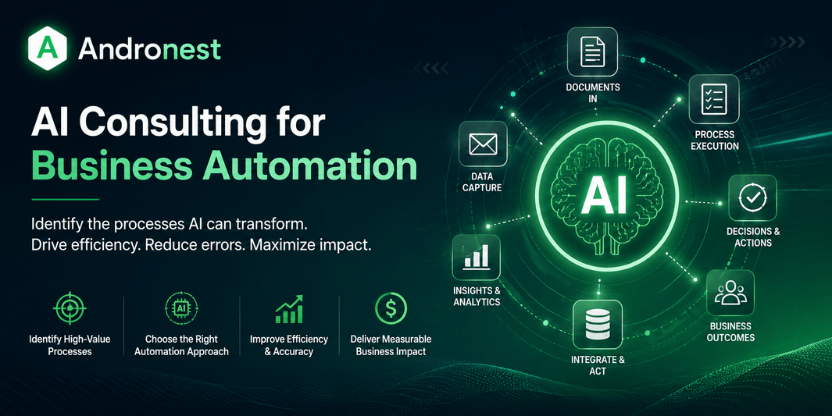
Most automation initiatives start in the wrong place.
They start with the technology — a generative AI platform, an AI agent framework, an automation tool that a vendor has just demonstrated — and then work backward to find processes it can be applied to. The result is predictable: a technically capable system that solves a problem the business did not prioritize, or a sophisticated AI solution built on top of a process that should have been redesigned rather than automated.
The organizations extracting real, measurable value from AI automation start differently. They start with the business — with the processes that consume the most time, generate the most errors, create the most friction, or limit the organization’s ability to scale — and then evaluate whether AI is the right solution, and if so, what kind.
According to McKinsey, generative AI could automate 60 to 70% of the time employees currently spend on business tasks. The World Economic Forum estimates that AI automation will displace 85 million jobs globally while creating 97 million new roles by 2030. Gartner projects that by 2027, more than 50% of the GenAI models enterprises use will be purpose-built for specific business functions or processes — a significant shift from today’s generalist deployments.
The gap between the organizations capturing this opportunity and the ones burning budget on pilots that never scale is not a technology gap. It is a process identification gap.
This guide explains how to close it — how AI consulting helps businesses identify the processes most ready for AI transformation, evaluate which automation approach fits each opportunity, and build the business case that justifies the investment.
Read: Why Every Enterprise Needs an AI Strategy Before Adopting AI
What Business Process Automation with AI Actually Means
Business process automation has existed for decades. Rules-based automation — if this condition is met, trigger this action — has been implemented in enterprise workflows since the first generation of workflow management systems in the 1990s.
AI automation is different in kind, not just degree.
Rules-based automation is explicit. It follows the logic a human defined. It handles the cases it was programmed for and fails or escalates everything else. It cannot learn, adapt, or handle variation outside its predefined parameters.
AI automation is adaptive. It can process unstructured inputs — documents, emails, images, spoken language, sensor data — that rules-based systems cannot interpret. It can handle variation and nuance. It improves with exposure to more data. It can reason across multiple inputs to reach a conclusion rather than applying a binary if-then logic.
The practical consequence is that AI automation can address a much wider range of business processes than traditional automation — particularly the processes that have historically resisted automation because they involve judgment, language, or unstructured inputs.
| Dimension | Rules-Based Automation | AI Automation |
| Input types handled | Structured, predictable | Structured and unstructured |
| Handles exceptions | Rarely — escalates | Often — reasons through variation |
| Improves over time | No | Yes — learns from data |
| Requires explicit programming | Yes — all logic defined | No — learns patterns from examples |
| Best for | High-volume, predictable workflows | Complex, variable, judgment-intensive processes |
| Examples | Invoice routing, form validation | Contract review, customer query handling, document extraction |
Understanding this distinction is the foundational step in process identification. The processes that belong in an AI automation evaluation are the ones that have historically been too complex, too variable, or too judgment-intensive for traditional automation — not just the ones that are already partially automated and need an upgrade.
Also read: How Autonomous AI Agents Will Change Enterprise Software
The Four Characteristics of a Process Ready for AI Automation
Not every business process is an AI automation candidate. Before investing in discovery and scoping, a rapid filter against four characteristics identifies which processes warrant deeper evaluation.
1. High volume and repetition
The financial return of AI automation is largely a function of volume. A process that is performed 10,000 times per month generates a far larger return from a 70% automation rate than a process performed 50 times per month with 95% automation.
High-volume, high-repetition processes are where AI automation delivers the most immediate, measurable financial return — even when the per-instance complexity is modest.
Processes that typically pass this filter: invoice processing, customer inquiry handling, purchase order matching, data entry from documents, payroll processing, compliance reporting, and employee onboarding document verification.
2. Significant human time consumption
Time is the primary cost of manual process execution. A process that consumes 40 hours per week of skilled employee time at fully-loaded employment cost has a clearly calculable return for each percentage point of automation achieved.
The calculation is straightforward: (hours consumed per week) × (fully-loaded hourly cost) × (expected automation rate) × 52 = annual labour saving. For processes consuming significant knowledge worker time — analyst research, legal document review, medical coding, financial reconciliation — the annual saving from even partial automation is large enough to justify substantial investment in the AI system.
3. Structured decision logic with available data
AI systems learn from data. A process that requires decisions but generates no data, or requires decisions based on information that is not digitally accessible, is difficult to automate regardless of how sophisticated the AI is.
The best automation candidates are processes where the inputs are available in digital form, where the decision logic can be inferred from historical examples of correct decisions, and where the output is a defined action rather than an open-ended creative judgment.
Processes that tend to fail this filter: strategic business decisions, novel creative work, interpersonal negotiation, and judgment calls that require understanding of organizational context that has never been documented.
4. High error rate or quality variance
Manual processes that produce inconsistent quality — where error rates are high, where output quality varies significantly between employees, or where compliance failures occur — are strong automation candidates because AI automation delivers a consistency and accuracy floor that human execution cannot reliably match at scale.
Processes with high error rates also have a risk reduction dimension to their ROI that pure efficiency calculations miss. An automated invoice processing system that reduces error rates from 8% to 0.5% eliminates not just the correction labour but the downstream financial exposure, customer relationship impact, and audit risk that errors create.
Also read: How Autonomous AI Agents Will Change Enterprise Software
The AI Automation Opportunity Matrix
With the four characteristics defined, the next step is mapping your organization’s process portfolio against them. This matrix provides a rapid visual prioritization of where AI automation investment is most justified.
| Process | Volume | Time Cost | Data Availability | Error/Quality Issue | Priority Score |
| Invoice processing | High | High | High | High | Very High |
| Customer email triage | High | High | High | Medium | High |
| Contract review | Medium | Very High | Medium | High | High |
| Sales lead scoring | High | Medium | High | Medium | High |
| Financial reconciliation | Medium | High | High | High | High |
| Employee onboarding | Medium | Medium | High | Medium | Medium |
| Strategic planning | Low | High | Low | Low | Low |
| Board presentation prep | Very Low | High | Low | Low | Very Low |
The top-right quadrant of this matrix — high volume, high time cost, good data availability, high error rate — is where AI automation ROI is most consistently demonstrated. Start there.
The Eight Business Functions Where AI Delivers the Highest Automation ROI
These are the functional domains where AI automation has the most established track record and the highest concentration of high-priority automation opportunities across industries.
1. Finance and Accounts Payable / Receivable
Finance operations contain some of the highest-ROI AI automation opportunities in any enterprise. The combination of high volume, structured data, clear decision rules, and significant error consequences makes financial process automation one of the most mature and well-evidenced domains.
Accounts payable automation: AI systems extract invoice data from PDFs, emails, and scanned documents using intelligent document processing, match against purchase orders in the ERP, identify discrepancies, route exceptions for human review, and process approved invoices for payment — without human involvement in the majority of cases.
Organizations implementing AI-powered AP automation typically achieve 60 to 80% reduction in processing time and 50 to 70% cost reduction in AP operations. Error rates — which average 3 to 5% in manual AP processes — fall to below 1%.
Financial reconciliation: AI automation matches transactions across accounts, identifies discrepancies, applies standard resolution logic to common patterns, and escalates genuinely novel exceptions to analysts. The analyst’s role shifts from performing reconciliation to reviewing exceptions — reducing the team’s time on the task by 60 to 80% while improving accuracy.
Financial reporting and variance analysis: AI systems can compile financial data from multiple source systems, identify significant variances against prior periods and budgets, generate natural language commentary explaining the variances, and produce draft management reports — reducing the month-end close cycle and freeing finance teams from the most time-intensive data assembly work.
2. Customer Service and Support
Customer service is the function where AI automation is most visibly transforming enterprise operations. AI agents now handle customer interactions at a sophistication level that was not achievable two years ago — understanding context, accessing customer history, reasoning across multiple data sources, and resolving a growing proportion of cases without human involvement.
Tier 1 query resolution: AI agents trained on product documentation, policy information, and historical resolution data resolve straightforward customer queries — order status, account balance, basic troubleshooting, refund status, billing questions — without human involvement. Organizations deploying AI agents for tier 1 support consistently report 40 to 60% deflection of inbound query volume, with customer satisfaction scores maintained or improved because response time falls from hours to seconds.
Case triage and routing: AI systems classify incoming cases, assess urgency and complexity, identify the appropriate handling team, extract relevant customer context, and route cases with a full brief rather than just a ticket number. The human agent who receives the case has everything they need to resolve it immediately rather than spending the first minutes of the interaction gathering information.
Sentiment analysis and escalation detection: AI systems monitoring ongoing interactions identify escalating customer frustration before the customer explicitly demands a supervisor — enabling proactive intervention that prevents avoidable churns and formal complaints.
3. Sales Operations and Lead Management
Sales operations processes are rich with AI automation opportunities that directly connect to revenue outcomes — making the ROI calculation more compelling than it is in purely cost-reduction-focused functions.
Lead scoring and prioritization: AI models trained on historical conversion data score incoming leads based on firmographic, behavioural, and engagement signals — identifying the leads most likely to convert and surfacing them for immediate sales attention. Organizations implementing AI lead scoring consistently see 30 to 50% improvement in lead-to-opportunity conversion rates, as sales effort concentrates on the leads most likely to respond.
Opportunity risk assessment: AI systems monitor the health of deals in the pipeline by analyzing engagement patterns, communication frequency, stakeholder involvement, competitive signals, and historical deal patterns. Deals showing warning signs are flagged for sales manager attention before they silently die — reducing pipeline leakage without requiring manual inspection of every opportunity.
Sales content personalization: AI systems generate personalized proposal sections, case study selections, and email sequences tailored to each prospect’s industry, company size, and identified pain points — reducing the time sales representatives spend on content customization while improving the relevance of the materials they send.
4. Human Resources and Talent Operations
HR processes are high-volume, documentation-intensive, and subject to significant compliance requirements — making them strong AI automation candidates across both the recruitment lifecycle and the ongoing employee experience.
Resume screening and candidate ranking: AI models trained on the characteristics of successful hires screen applications, extract relevant experience and qualification signals, and rank candidates against defined criteria — reducing the time-to-shortlist from days to hours and removing the inconsistency that human screening introduces when different reviewers apply different criteria to the same role.
Onboarding process automation: AI systems guide new employees through the onboarding process, answer policy and benefit questions, collect and verify required documentation, trigger downstream provisioning workflows (IT access, payroll setup, compliance training assignment), and track completion — reducing the HR team’s administrative burden while delivering a more consistent and responsive onboarding experience.
Employee query handling: HR service desk interactions — policy questions, leave balance inquiries, benefits queries, payroll questions — follow predictable patterns that AI agents handle effectively. Organizations deploying AI for HR query handling consistently report 50 to 70% reduction in HR service desk ticket volume, allowing HR teams to focus on the complex, sensitive interactions that genuinely require human judgment.
5. Legal and Contract Operations
Legal operations represent one of the highest-value AI automation opportunities in knowledge-intensive enterprises. The combination of very high labour cost per hour and very high document volume creates an ROI profile that justifies significant AI investment.
Contract review and risk extraction: AI systems trained on contract language and risk patterns review incoming contracts, extract key commercial terms (liability caps, payment terms, IP ownership, termination rights, governing law), identify clauses that deviate from standard positions, and generate a structured review summary. Legal team members review the AI’s risk flagging rather than reading every contract from scratch — reducing review time by 60 to 80% on standard contract types.
Compliance document monitoring: AI systems monitor ongoing contracts for compliance obligations — notice requirements, renewal deadlines, reporting obligations, audit rights — and generate proactive alerts before obligations are missed. The alternative — a spreadsheet that someone manually maintains — consistently produces missed deadlines and the commercial consequences that follow.
Legal research and precedent identification: AI systems search across case law, internal precedents, and reference materials to surface relevant citations and precedents for specific legal questions — reducing the time lawyers spend on preliminary research before applying judgment to the problem.
6. Supply Chain and Operations
Supply chain processes generate enormous data volumes across procurement, inventory, logistics, and supplier management — data that AI systems can analyse and act on in ways that improve efficiency, reduce cost, and decrease the risk of disruption.
Demand forecasting: AI models trained on historical sales data, seasonal patterns, market signals, and external data sources (weather, economic indicators, competitor pricing) generate more accurate demand forecasts than statistical models alone. The improvement in forecast accuracy directly reduces both stockout events (lost revenue) and excess inventory (capital tied up in stock that does not move).
Supplier risk monitoring: AI systems continuously monitor supplier financial health, news signals, delivery performance data, and geopolitical risk indicators — surfacing early warning signals of supplier reliability risks before they produce supply disruptions. The alternative — manually monitoring dozens or hundreds of suppliers — is not operationally feasible and results in supply disruptions that could have been anticipated and mitigated.
Purchase order and invoice matching: Three-way matching — purchase order, goods receipt, and supplier invoice — is a high-volume, rules-intensive process where AI automation achieves near-complete straight-through processing for matched transactions and routes only genuine exceptions for human review.
7. IT Operations and Service Management
IT operations processes are not only strong AI automation candidates in their own right — they are also the operational foundation on which every other AI automation initiative depends.
IT service desk automation: AI agents handle tier 1 IT support requests — password resets, access provisioning, standard software queries, connectivity troubleshooting — without human involvement. Organizations deploying AI service desk automation consistently report 40 to 60% first-contact resolution improvement, with mean time to resolution falling from hours to minutes for standard requests.
Incident detection and triage: AI systems monitoring infrastructure and application telemetry detect anomalies that indicate developing incidents before they produce user-visible outages — enabling proactive intervention and significantly reducing mean time to detect and mean time to resolve.
Code review assistance and security scanning: AI systems review code for security vulnerabilities, style violations, and logic errors as part of the CI/CD pipeline — providing developers with automated feedback on every commit and reducing the volume of issues that reach production code review.
8. Marketing Operations
Marketing operations contain a growing set of AI automation opportunities that connect directly to revenue generation — making marketing automation one of the most strategically compelling areas for AI investment.
Content generation at scale: AI systems generate first drafts of blog posts, email sequences, social media content, product descriptions, and ad copy based on defined briefs, audience parameters, and brand guidelines. Human editors review, refine, and approve — maintaining quality while scaling content production volume without proportional headcount increases.
Campaign performance analysis and optimization: AI systems continuously monitor campaign performance across channels, identify underperforming elements, generate hypotheses about causation, and in some cases automatically adjust budget allocation, bidding, or audience targeting within defined parameters — reducing the lag between performance signal and optimization response from days to hours.
Customer segmentation and targeting: AI models trained on behavioural, firmographic, and engagement data generate customer segments with greater precision and granularity than manual segmentation — enabling more relevant targeting and reducing the waste from broad-audience campaigns.
How AI Consulting Structures the Process Identification Engagement
An AI consulting engagement focused on process identification typically operates across four stages. Understanding the structure helps organizations set appropriate expectations and extract maximum value from the engagement.
Stage 1: Discovery and process inventory
The discovery stage maps the current process landscape across the functions in scope for the engagement. For each process, the consultant captures: what the process does, who performs it, what inputs it requires, what outputs it produces, how frequently it runs, how long it takes per instance, what the error rate is, and what the downstream consequences of delays or errors are.
This stage typically involves structured interviews with operational team leaders and process owners, observation of actual process execution where possible, and review of any existing process documentation. It results in a complete inventory of candidate processes before any prioritization occurs.
Stage 2: Prioritization scoring
With the process inventory complete, each process is scored against the four characteristics described above — volume, time cost, data availability, and error rate — and ranked by automation potential and expected ROI.
The prioritization scoring also considers implementation complexity: a process may have high automation potential but require significant data infrastructure work, legacy system integration, or regulatory approval that extends the timeline and increases the cost of realizing the return. Implementation complexity is a discount on automation potential, not a disqualifier — but it affects prioritization.
Stage 3: Solution design and feasibility assessment
For the highest-priority processes, the consultant designs the AI automation approach — the technology components required, the data sources that need to be accessible, the integration points with existing systems, the human-in-the-loop points where review or approval should be retained, and the governance requirements.
The feasibility assessment evaluates whether the data needed to train or prompt the AI system is available in sufficient quality and volume, whether the target accuracy level is achievable given current data and technology, and whether the automation rate that drives the ROI case is realistic given the variability of the process inputs.
Stage 4: ROI modelling and implementation roadmap
The final stage builds the financial model that converts the automation potential into a business case — and sequences the automation programme into a phased implementation roadmap.
The ROI model for each priority process calculates: the annual cost of the current manual process (volume × time per instance × fully-loaded hourly cost), the implementation cost of the AI automation (development, integration, testing, governance, and ongoing maintenance), the expected annual saving at the projected automation rate, and the payback period and three-year ROI.
The implementation roadmap sequences the priority processes into phases — typically beginning with the highest-ROI, lowest-complexity processes to generate early wins and build organizational confidence, then progressing to higher-complexity opportunities in subsequent phases.
Also read: AI Consulting Services — Build a Practical AI Strategy
The Three Common Process Identification Mistakes
Mistake 1: Automating broken processes
The most expensive AI automation mistake is automating a process that should be redesigned rather than automated. A process that is slow, error-prone, and high-cost because its design is wrong will be a faster, more consistent, more expensive version of a bad process after automation. AI makes it worse, not better.
Before scoping an automation solution, ask whether the process, as currently designed, produces the right outcome. If the answer is no — if the process design itself is the source of the quality or efficiency problem — redesign the process first. Automate the redesigned process, not the existing one.
Mistake 2: Ignoring the human-in-the-loop requirement
Not every step in a process should be automated. Processes involving final decisions with significant financial, legal, or reputational consequences, processes where regulatory requirements mandate human review, and processes where the AI’s confidence is below a defined threshold all require human review gates that the automation architecture must accommodate.
Designing AI automation without explicit human-in-the-loop points — on the assumption that the AI will always be right — produces systems that fail silently when the AI’s confidence is unwarranted. The right architecture routes low-confidence outputs for human review while automating the high-confidence majority.
Mistake 3: Starting with the most complex process
The natural instinct is to tackle the biggest problem first. But the biggest problem is almost never the best starting point for an AI automation programme.
Complex processes have complex data requirements, complex integration dependencies, complex governance requirements, and a longer path from initiation to measurable return. Starting with a complex process produces a protracted, expensive first engagement that may not deliver visible results in time to maintain organizational commitment to the programme.
Start with a process that is high-volume, well-documented, data-rich, and relatively bounded in scope. Automate it well. Demonstrate the return clearly. Use that success to build the organizational confidence and technical foundation for the more complex processes in subsequent phases.
Measuring AI Automation ROI: The Metrics That Matter
Demonstrating the business value of AI automation is as important as delivering it. Without clear measurement, AI automation programmes are vulnerable to budget pressure when initial investment is high and return is not yet visible.
Efficiency metrics
Time saved per process instance: Baseline time per manual instance minus AI-assisted time per instance, measured across a representative sample before and after deployment.
Straight-through processing rate: The percentage of process instances that the AI handles end-to-end without human intervention. This is the primary efficiency metric for most automation programmes and should be tracked from the day of go-live, with improvement targets for each quarter as the AI system matures.
Processing volume per FTE: The number of process instances handled per full-time equivalent per day or week. For processes where headcount is fixed rather than variable, this metric demonstrates the capacity increase that automation delivers — the same team handling significantly more volume without additional hiring.
Quality metrics
Error rate reduction: Error rate before automation vs. error rate after, measured consistently using the same error definition. For regulated processes, this should track regulatory non-compliance events as a separate metric.
Exception rate: The proportion of AI-processed instances that are escalated for human review because the AI’s confidence is below the threshold or because the input falls outside the trained parameters. A decreasing exception rate over time indicates a maturing AI system.
Rework rate: The proportion of AI-processed instances that require human correction after the fact. Rework rate is a lagging quality indicator that captures failures the exception rate did not catch.
Financial metrics
Cost per process instance: Total cost (staff time + technology cost) divided by volume processed. This metric should fall quarter-over-quarter as automation rate increases and the technology cost is amortized across larger volume.
Payback period: Time from go-live to the point where cumulative savings equal implementation cost. For well-scoped, high-volume automations, payback periods of 6 to 18 months are typical.
Three-year ROI: Net value (cumulative savings minus cumulative costs including ongoing maintenance) divided by cumulative costs over three years. This is the metric that finance leadership will use to evaluate the programme and justify continued investment.
Strategic metrics
Employee time redirected: Hours per week that employees previously spent on the automated process, now available for higher-value work. This metric should be paired with evidence of what that time is being used for — it is meaningful only if the redirected time produces value, not if it is absorbed into overhead.
Scalability headroom: The additional volume the automated process can handle without additional headcount. For businesses in growth mode, this metric captures the strategic value of automation that efficiency metrics alone do not — the ability to scale operations without proportional cost increase.
Industry-Specific AI Automation Priorities
AI automation opportunities are broadly present across industries, but the highest-priority processes vary by sector. The following provides a focused starting point for organizations in each vertical.
Healthcare
The healthcare industry processes enormous volumes of documents, codes, and records with direct patient safety and regulatory compliance consequences — making it one of the highest-value AI automation opportunities.
Priority processes: Medical coding and billing (ICD-10 and CPT code assignment from clinical documentation), prior authorization processing, clinical documentation completion, patient appointment scheduling and reminder management, medication reconciliation, and regulatory reporting.
Unique consideration: Healthcare AI automation must meet HIPAA technical safeguard requirements, and any automation touching clinical decision-making is subject to FDA oversight in the US market. Process identification for healthcare must include a regulatory pathway assessment alongside the ROI analysis.
Financial Services
Financial services organizations face a combination of high transaction volumes, strict regulatory requirements, and significant compliance consequences for errors that makes AI automation both highly valuable and governance-intensive.
Priority processes: KYC and AML transaction monitoring, loan application processing and document verification, regulatory reporting preparation, fraud pattern detection, claims processing, and client onboarding document collection.
Unique consideration: Model risk management requirements — including SR 11-7 guidance in the US — mandate that AI models used in decision-making processes be validated, documented, and monitored. The governance requirements for financial services AI automation are more extensive than in most other industries and should be scoped into the implementation cost from the outset.
E-commerce and Retail
E-commerce organizations operate processes at very high volume with direct revenue and customer experience consequences — creating strong automation ROI profiles across multiple functional areas.
Priority processes: Product catalogue management (description generation, categorization, attribute extraction), customer return processing, inventory reordering, review monitoring and sentiment analysis, personalized recommendation generation, and customer service inquiry handling.
Manufacturing
Manufacturing organizations typically have strong process documentation — a product of ISO certification requirements and lean manufacturing disciplines — that makes process identification faster and AI training data more accessible than in less-documented industries.
Priority processes: Quality inspection and defect detection (vision AI applied to production line output), predictive maintenance scheduling (AI models on sensor data), supply chain risk monitoring, production scheduling optimization, and compliance documentation management.
What Andronest Brings to AI Automation Consulting
AI automation consulting requires the intersection of process expertise, AI engineering capability, and the data architecture knowledge to build systems that perform reliably in production — not just in a demo.
Andronest’s AI Consulting and Strategy practice is built around the process-first discipline described in this article. We begin every engagement with a structured process discovery that maps your operational landscape against the four automation-readiness characteristics — prioritizing the opportunities that deliver measurable return rather than the ones that make the most impressive demonstration.
Our AI automation engagements are delivered by the same team from strategy through implementation. Our Custom AI Solutions team builds the automation systems that the consulting engagement identifies. Our AI Agent Development practice builds the autonomous agent workflows that handle customer service, sales operations, and knowledge management automation. And our RAG and Knowledge Base AI capability builds the document intelligence systems that underpin contract review, compliance monitoring, and research automation.
We work across industries — healthcare, financial services, e-commerce, manufacturing, and technology — with a consistent practice of delivering automation systems that operate reliably in production environments, not just in controlled pilots.
Talk to our AI consulting team to discuss the process automation opportunities in your organization — and which ones deserve to be first.
Conclusion
AI automation is not a technology decision. It is a business decision — one that starts with understanding which of your organization’s processes are consuming the most time, generating the most errors, and limiting your ability to scale, and then evaluating whether AI can transform those processes in ways that justify the investment.
The organizations extracting real value from AI automation share a common discipline: they identify before they implement. They score processes against volume, time cost, data availability, and quality variance before selecting a technology approach. They model the ROI before committing a budget. They start with the processes that have the clearest, most measurable return — and use those early wins to build the organizational confidence and technical foundation for more complex automation in subsequent phases.
The technology to automate the processes described in this article exists today. The AI systems required to handle intelligent document processing, natural language query resolution, predictive analysis, and autonomous workflow execution are available, mature, and production-tested across thousands of enterprise deployments.
What separates the organizations that capture these returns from the ones that produce expensive pilots is the discipline to identify the right processes, design the right architecture, and measure the right outcomes — consistently, from the first engagement through the long-term operation of production systems.
That discipline is what AI consulting, done correctly, provides.
Read next: How to Deploy AI Agents Securely in Enterprise Environments
Frequently Asked Questions
What is AI consulting for business automation?
AI consulting for business automation helps organizations identify processes suitable for AI, select the right technology, assess ROI, and implement automation solutions.
Which business processes can AI automate?
AI can automate high-volume, data-intensive processes such as invoice processing, customer service, sales operations, HR, contract review, supply chain, IT support, and marketing.
How do you identify which processes to automate with AI?
Evaluate processes based on volume, time required, data availability, and error rates. High-volume, time-consuming, data-rich processes are often strong candidates.
What is the ROI of AI business process automation?
ROI varies by process, but well-scoped automation projects can often achieve payback within 6–18 months through labor savings, fewer errors, improved compliance, and greater scalability.
What is the difference between AI automation and traditional automation?
Traditional automation follows predefined rules, while AI automation can handle unstructured inputs, variations, and more complex decisions using AI models.
How long does an AI process automation project take?
A focused automation project typically takes 8–16 weeks to reach production. Larger multi-process programs can take 6–12 months.
What data is needed for AI business process automation?
Requirements vary, but AI typically needs accessible digital data such as database records, documents, emails, API responses, or relevant knowledge-base content.
Should we start with AI automation or AI strategy?
An AI strategy usually helps identify and prioritize the best automation opportunities. However, the first automation project can begin while the broader strategy is being finalized.