Cloud computing has become the foundation of modern digital transformation. Whether you’re building applications, storing data, deploying AI solutions, or modernizing legacy infrastructure, choosing the right cloud platform can significantly impact your business performance, scalability, security, and long-term costs.
Today, three providers dominate the cloud market:
- Amazon Web Services (AWS)
- Microsoft Azure
- Google Cloud Platform (GCP)
Each platform offers powerful capabilities, but they are not identical. The best choice depends on your business objectives, existing technology ecosystem, industry requirements, budget, and future growth plans.
This guide compares AWS, Azure, and Google Cloud to help organizations make an informed cloud strategy decision.
Quick Answer: Which Cloud Platform Is Best?
There is no single “best” cloud platform for every business.
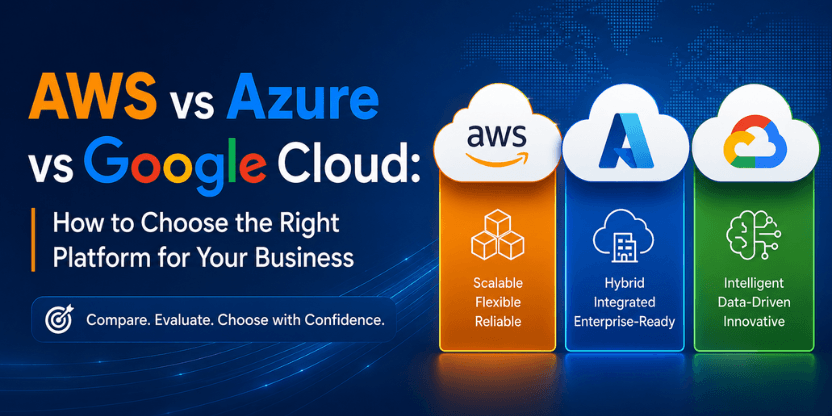
- AWS is often preferred for flexibility, scalability, and service breadth.
- Azure is ideal for organizations heavily invested in Microsoft technologies.
- Google Cloud excels in data analytics, AI, machine learning, and cloud-native development.
The right choice depends on your business priorities rather than market share alone.
Read: The True Cost of Poor Cloud Governance – Risks, Challenges, and Solutions
Understanding the Big Three Cloud Providers
Amazon Web Services (AWS)
AWS is the largest cloud provider globally and offers the most extensive portfolio of cloud services.
Since its launch in 2006, AWS has expanded into virtually every area of cloud computing, including infrastructure, databases, AI, analytics, IoT, serverless computing, security, and DevOps.
Organizations choose AWS because of its maturity, scalability, reliability, and global reach.
Microsoft Azure
Azure has become a leading choice for enterprises, particularly those already using Microsoft technologies such as Windows Server, Active Directory, Microsoft 365, SQL Server, and Dynamics 365.
Azure provides strong hybrid cloud capabilities, making it attractive for organizations transitioning from on-premises infrastructure to the cloud.
Google Cloud Platform (GCP)
Google Cloud leverages Google’s expertise in data, AI, machine learning, and large-scale infrastructure.
Many organizations choose Google Cloud for advanced analytics, Kubernetes-based architectures, artificial intelligence, and cloud-native application development.
Comparing AWS, Azure, and Google Cloud
AI and Machine Learning — The 2026 Differentiator
The AI arms race is the defining battleground of the 2026 cloud competition. Each provider has staked out a distinct strategy — and the choice between them depends heavily on which AI approach fits your needs.
AWS — Maximum AI Model Flexibility
AWS Bedrock provides access to a broad marketplace of foundation models including Anthropic’s Claude, Meta’s Llama, Amazon’s own Titan models, Stability AI, Cohere, and more. This multi-model approach gives developers flexibility to choose the best model for each use case without vendor lock-in to a single AI provider.
In early 2026, AWS expanded Bedrock with agent capabilities and fine-tuning support for most hosted models. AWS SageMaker provides the most comprehensive managed MLOps platform — covering the full ML lifecycle from data preparation through model training, evaluation, deployment, and monitoring.
AWS launched Trainium3 instances in Q1 2026 — 3x faster than Trainium2 for AI training — giving organizations training large models at scale a competitive option to NVIDIA GPU instances.
Choose AWS for AI when: You want model flexibility across multiple foundation model providers, you are building complex ML pipelines that need SageMaker’s comprehensive MLOps capabilities, or you want to avoid being locked into a single model provider.
Azure — The GPT/OpenAI Advantage
Azure’s differentiation comes from its deep, exclusive partnership with OpenAI. Azure integrated GPT-5 natively into all enterprise services in Q1 2026. Azure OpenAI Service provides enterprise-grade access to GPT-4o, GPT-5, DALL-E, and other OpenAI models with Azure’s security, compliance, and networking features.
If you need GPT-4 or GPT-5 in production with enterprise SLAs, security, and Azure’s compliance certifications, Azure is your only major cloud option. Azure Copilot integrates AI throughout the Azure management experience, and Azure AI Studio provides the tooling for building AI applications on top of OpenAI models.
Azure leads for enterprises building on OpenAI and GPT models through its exclusive partnership.
Choose Azure for AI when: Your AI strategy centers on GPT models (GPT-4o, GPT-5), your organization is deeply invested in Microsoft’s Copilot ecosystem, or you need enterprise-grade OpenAI access with Azure’s compliance and security infrastructure.
Google Cloud — Training Performance and Data Integration
Google Cloud goes all-in on its homegrown Gemini models through Vertex AI. Google leads with TPU hardware — Tensor Processing Units designed specifically for neural network workloads — that provide compelling training and inference economics for large models.
Vertex AI integrates model training, evaluation, and deployment with BigQuery for data analytics, enabling end-to-end ML pipelines where data engineering and model development share the same unified platform. For organizations where the data pipeline and the ML pipeline are the same thing, this integration eliminates the friction of moving data between separate systems.
GCP is typically 5–10% cheaper for AI workloads than AWS and Azure, and Google cut compute pricing by 8% across all regions in Q1 2026.
Google Cloud leads with TPU hardware, Vertex AI, and Gemini models for custom model training at the best price-performance. Choose Google for training large models, or if BigQuery ML integration with your analytics platform is a priority.
Choose GCP for AI when: You are training large custom models (TPU economics), your AI strategy centers on Vertex AI with BigQuery integration, or cost efficiency on AI compute is a top priority.
Compliance, Security, and Certifications
AWS Compliance
AWS holds the broadest range of third-party certifications of any cloud provider — covering SOC 1/2/3, PCI DSS, HIPAA, FedRAMP, ISO 27001, and dozens of country-specific frameworks. AWS GovCloud provides a dedicated isolated region for US government workloads with the highest compliance requirements.
AWS’s compliance breadth reflects its market maturity — it has been the default for regulated industries for long enough that its certification portfolio covers most enterprise compliance requirements.
Azure Compliance
Azure is at approximately 23–25% market share and growing fastest, driven by Microsoft 365 integration and an exclusive OpenAI partnership and the most compliance certifications of any provider.
Azure holds the most compliance certifications of the three providers — over 100 compliance offerings including global and regional standards. Azure Government and Sovereign Clouds provide data residency guarantees that satisfy strict European data protection requirements and the EU’s GDPR. For regulated industries in European markets, Azure’s sovereign cloud infrastructure is a frequently decisive factor.
Google Cloud Compliance
GCP holds strong certifications including SOC 1/2/3, PCI DSS, HIPAA, and ISO 27001. It is competitive for most enterprise compliance requirements but has fewer regional sovereign cloud offerings than Azure.
For regulated industries:
- Healthcare (HIPAA): All three providers offer HIPAA Business Associate Agreements — AWS and Azure have the most established track records with healthcare clients.
- Financial services: All three providers meet most financial services compliance requirements. Azure’s Microsoft heritage and broad certification portfolio give it an edge in some regulatory jurisdictions.
- Public sector: AWS GovCloud and Azure Government have the most established public sector compliance infrastructure. GCP is competitive in the US federal space but has less penetration than AWS and Azure.
- European data sovereignty: Azure’s Sovereign Cloud infrastructure leads for EU-based organizations with strict data residency requirements.
Kubernetes and Container-Native Workloads
Kubernetes was created by Google — and this heritage shows in GCP’s Kubernetes offering.
GKE (Google Kubernetes Engine) is widely regarded as the most mature managed Kubernetes service, with the most consistent upgrade experience, the best integration with Google’s private network backbone, and native cluster autoscaling that outperforms equivalents on other platforms for variable-workload efficiency. For agentic workflows specifically and multi-tool reasoning, Kubernetes-native architecture is increasingly important.
EKS (Amazon Elastic Kubernetes Service) is the most widely used managed Kubernetes service by volume — reflecting AWS’s market dominance. The Kubernetes control plane costs $73/month per cluster, which is non-trivial at scale. EKS integrates deeply with other AWS services through IAM, VPC, and the broader AWS ecosystem.
AKS (Azure Kubernetes Service) provides a free Kubernetes control plane — a meaningful cost advantage over AWS EKS’s $73/month charge. AKS integrates tightly with Azure Active Directory for identity and access management, making it the most natural choice for organizations standardized on Microsoft identity infrastructure.
Market Presence and Ecosystem
AWS remains the market leader with the broadest ecosystem of partners, third-party integrations, training resources, and certified professionals.
Azure follows closely behind and has gained significant enterprise adoption due to Microsoft’s existing business relationships.
Google Cloud continues to grow rapidly, particularly among data-driven organizations and technology companies.
If access to talent and partner networks is a priority, AWS and Azure typically offer larger ecosystems.
Infrastructure and Global Reach
Cloud infrastructure availability can impact performance, compliance, and disaster recovery planning.
AWS offers one of the largest global infrastructures with numerous regions and availability zones worldwide.
Azure also maintains a vast global presence and often leads in enterprise and government cloud deployments.
Google Cloud operates a highly optimized global network infrastructure powered by Google’s backbone network.
For most organizations, all three providers offer sufficient geographic coverage.
Data Analytics and Business Intelligence
Modern organizations increasingly rely on data-driven decision-making.
AWS offers services such as:
- Redshift
- Athena
- QuickSight
Azure provides:
- Synapse Analytics
- Power BI integration
- Data Factory
Google Cloud is especially strong in analytics with:
- BigQuery
- Looker
- Vertex AI
For large-scale analytics and AI-driven insights, Google Cloud is frequently viewed as a market leader.
Also read: AI Risk vs AI Reward – Finding the Right Balance
The Decision Framework — Choosing for Your Business
Choose AWS When:
You need the broadest service catalog and deepest ecosystem. AWS offers the most granular infrastructure control and AI model flexibility. If a cloud service exists as a concept, AWS probably shipped it first. The 200+ service catalog means you are unlikely to encounter a capability gap.
Your team has the most AWS expertise. AWS has the highest job demand, the most certification paths, and the broadest ecosystem — learning AWS gives you transferable cloud knowledge. AWS is the safest default for most workloads thanks to its unmatched service catalog. The community resources, documentation depth, and third-party tooling are unmatched.
You are a startup choosing your first cloud provider. AWS is the most recommended starting point. It has the highest job demand, the most certification paths, and the broadest ecosystem. The global default for venture-backed startups running cloud-native applications.
You need multi-model AI flexibility. AWS Bedrock’s multi-provider model access — Claude, Llama, Titan, Cohere, Stability AI — without vendor lock-in to a single AI model provider.
Specific workloads: Enterprise web applications, e-commerce, media streaming, gaming backends, serverless at scale (Lambda), IoT at scale, global consumer applications.
Clients: Netflix, Airbnb, NASA, Capital One.
Choose Azure When:
Your organization lives in the Microsoft ecosystem. If you run Office 365, Active Directory (now Entra ID), SQL Server, .NET applications, or Windows Server infrastructure, Azure offers a natural and streamlined path to the cloud. The integration between Azure Active Directory, Microsoft 365, and Azure services eliminates identity management complexity that other providers require additional tooling to address.
GPT and OpenAI models are central to your AI strategy. Azure has exclusive access to OpenAI models (GPT-4o, GPT-5) — if you need GPT-4 in production with enterprise SLAs and compliance, Azure is your only major cloud option. With GPT-5 integrated natively into all enterprise Azure services in Q1 2026, this exclusivity has become more significant, not less.
Hybrid cloud is a strategic requirement. Azure Arc — Microsoft’s hybrid cloud management platform — provides consistent management across on-premises infrastructure, Azure, and other cloud providers. For organizations with significant on-premises infrastructure commitments, Azure’s hybrid story is the most mature.
European data sovereignty requirements apply. Azure’s Sovereign Cloud infrastructure, designed specifically for strict EU data residency and GDPR requirements, provides capabilities that AWS’s standard regional model does not.
You need the most compliance certifications. Azure holds more compliance certifications than any other provider — important for regulated industries operating across multiple regulatory jurisdictions.
Clients: Boeing, GE Healthcare, Walgreens, HSBC, Samsung.
Choose Google Cloud When:
Data analytics and BigQuery are central to your operations. BigQuery is the most powerful serverless data warehouse available. For organizations where data analytics is a core business function — not just a reporting afterthought — BigQuery’s scale, speed, and cost model are difficult to match.
AI/ML training and Vertex AI integration is the priority. Google Cloud leads with TPU hardware, Vertex AI, and Gemini models for custom model training at the best price-performance. For organizations training large custom models, GCP’s TPU economics and Vertex AI’s integration with BigQuery create a data-to-model pipeline that has no equivalent on other platforms.
Kubernetes-native architecture is foundational. Google created Kubernetes. GKE remains the most technically mature managed Kubernetes service. For teams building cloud-native applications on Kubernetes, GKE provides the best-in-class experience.
Cost efficiency on compute is a decision driver. GCP is often the most cost efficient pricing for sustained workloads and data intensive applications. Automatic sustained-use discounts, the 8% compute price cut in Q1 2026, and GCP’s 5–10% overall compute price advantage make it the most cost-competitive option for consistent workloads.
You are building generative AI products with integrated data pipelines. Data engineering teams, ML research labs, and startups building generative AI products that need integrated data pipelines and low-friction model versioning find GCP’s stack most cohesive.
Clients: Spotify, Snap, X (formerly Twitter), HSBC.
The Decision Matrix
| Business Situation | Recommended Provider |
| Microsoft 365/Active Directory organization | Azure |
| Need GPT-4/GPT-5 in production | Azure (exclusive access) |
| Startup with no existing cloud footprint | AWS (broadest ecosystem, most talent) |
| Data analytics-first organization | GCP (BigQuery) |
| Training large custom AI models | GCP (TPU economics) |
| Kubernetes-native architecture priority | GCP (GKE maturity) |
| Maximum AI model flexibility | AWS (Bedrock multi-model) |
| European data sovereignty requirements | Azure (Sovereign Cloud) |
| Broadest compliance certification portfolio | Azure |
| Regulated US public sector | AWS (GovCloud) |
| Cost optimization on sustained compute | GCP (auto sustained-use discounts) |
| Most service catalog options | AWS (200+ services) |
| Hybrid on-premises + cloud | Azure (Azure Arc) |
| E-commerce and consumer applications at global scale | AWS |
| IoT at massive scale | AWS |
Multi-Cloud — When One Provider Is Not Enough
Multi-cloud adoption hit 89% among enterprises in 2026, up from 76% in 2024. Most large organizations are not choosing one provider — they are choosing which workloads go where.
The most common pragmatic multi-cloud pattern in 2026:
- Azure for Microsoft workloads and identity management
- AWS for global scale and specialized managed services
- GCP for data and ML workloads
That pragmatic multi-cloud is common but demands investment in FinOps, security controls, and automation to keep costs and risk under control.
Multi-Cloud Benefits
- Use the best platform for each workload type
- Avoid single-provider dependency and negotiating leverage
- Different providers for different regulatory jurisdictions
- Redundancy for business continuity
Multi-Cloud Costs and Risks
- Data transfer costs between providers (egress from one provider is ingress to another — both may charge)
- Operational complexity — separate tooling, separate credentials, separate billing
- Security governance across multiple control planes
- FinOps complexity — three separate billing systems to optimize
For most organizations under 1,000 employees, the operational overhead of multi-cloud exceeds the benefits for general workloads. Start with one provider, build expertise, and expand to a second provider when a specific workload genuinely justifies it.
Check: Managed IT Services Checklist – What Every Business Should Expect
Specific Use Case Recommendations
For Startups
AWS is the most recommended starting point — highest job demand, most certification paths, broadest ecosystem, largest community for troubleshooting. The free tier is generous. The startup credit programs are competitive. And AWS skills are the most transferable when you hire your next engineer.
GCP’s startup advantage: For AI-native or data-intensive startups, GCP’s pricing is more competitive and the BigQuery + Vertex AI stack is genuinely superior for data-first products. GCP offers significant startup credits.
The startup exception: If your founding team has deep Azure expertise, Azure is a reasonable starting point — expertise is the most important initial variable, and switching is expensive.
For Mid-Market Organizations
Mid-market organizations (200–2,000 employees) are typically the segment with the most to gain from careful provider evaluation — large enough that cost differences matter significantly, but not so large that organizational politics override technical merit.
The right choice is most often driven by: existing Microsoft investment (→ Azure), data analytics requirements (→ GCP), or general-purpose cloud with maximum tooling options (→ AWS).
For Enterprises (2,000+ Employees)
Large enterprises often end up on multiple providers because they have different teams, different workloads, and different historical decisions. The strategic question is which provider becomes the anchor — the one where identity management, governance, and primary workloads live.
For enterprises deeply standardized on Microsoft, Azure is typically the anchor. For enterprises with diverse workloads, AWS is typically the anchor. GCP is most often the specialist provider for data and AI workloads, not the primary anchor.
For DevOps and Engineering Teams
AWS is the default for DevOps engineers based on market prevalence and tooling depth. But for Kubernetes-native teams, GCP’s GKE is the superior managed Kubernetes experience. The team’s existing certifications and expertise should weigh heavily — the most optimized environment is the one the team knows best.
Need help selecting, migrating, or optimizing your cloud environment? Explore Andronest’s Cloud Computing Services to build a secure, scalable, and future-ready cloud strategy.
Conclusion: The Right Choice is the One That Fits Your Reality
There is no single winner in the cloud platform competition. Each provider serves different needs best. AWS leads with extensive services and global scale. Azure excels in Microsoft integration and hybrid environments. Google Cloud dominates in data, AI, and container innovation.
The decision matrix in this guide is designed to help you find the provider that matches your reality — not the provider with the most impressive marketing, the largest market share, or the most impressive benchmark numbers. Those metrics matter in aggregate. For your specific organization, they matter only where they align with your specific requirements.
The short version:
- AWS: Choose this as your safe default for most general-purpose workloads. The service catalog, ecosystem, and community are unmatched.
- Azure: Choose this if Microsoft is already in your infrastructure. The integration advantage and exclusive OpenAI access are genuine differentiators that cannot be replicated.
- Google Cloud: Choose this when data analytics, AI training, or Kubernetes-native architecture are your primary technical priorities. The cost efficiency and technical depth in these specific areas justify the choice.
And for most large organizations: use all three where each performs best, with a clear primary anchor that hosts your identity management, governance, and primary workloads.
The cloud wars will continue through 2026 and beyond. AWS will maintain its service lead. Azure will leverage its Microsoft relationships and OpenAI exclusivity. Google Cloud will push its AI-first agenda and competitive pricing. Your job is not to predict which provider wins the war — it is to choose the one that wins for your specific business.