Introduction: The Bill Nobody Budgeted For
Every cloud migration comes with a business case. Reduced infrastructure costs. Greater scalability. Faster deployment. Improved resilience. The numbers are presented to leadership, the migration is approved, and the organization moves to the cloud.
What rarely appears in that business case is the cost of doing it without governance.
Cloud computing has fundamentally shifted how businesses operate. Unlike legacy systems where infrastructure and operations were controlled on-premises, the cloud introduces new operational complexities. It democratizes access to technologies such as artificial intelligence, machine learning, and advanced data analytics — but also brings unprecedented risks. A single minor decision, from misconfigured security protocols to inadequate compliance measures, can trigger a cascade of failures across an enterprise.
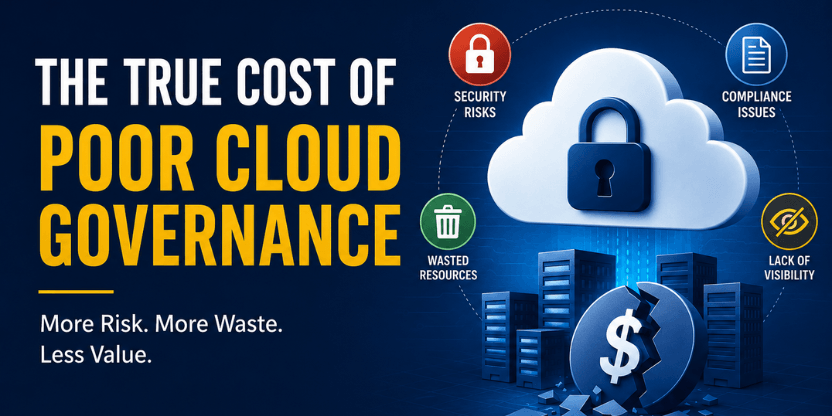
The number that most organizations discover too late: organizations waste an estimated 31% of their cloud spending on unused resources. Add to that the cost of security incidents, compliance violations, and operational downtime — and the true cost of poor cloud governance becomes one of the most significant, most underestimated financial risks in modern enterprise technology.
This guide quantifies that cost across every dimension that matters — financial, operational, security, compliance, and reputational — and provides a practical framework for addressing it before it compounds further.
What Is Cloud Governance?
Cloud governance refers to the policies, processes, controls, and standards that guide how cloud resources are managed across an organization.
It helps businesses ensure that cloud environments remain:
- Secure
- Cost-efficient
- Compliant
- Scalable
- Well-managed
Cloud governance is not about restricting innovation. It is about creating guardrails that allow teams to move quickly while maintaining control.
A strong governance strategy defines who can provision resources, how data should be managed, what security standards must be followed, and how cloud spending is monitored.
Without these controls, cloud environments can quickly become difficult to manage.
Why Cloud Governance Has Become Critical
Cloud platforms make it incredibly easy to create resources.
A developer can launch a new server in minutes. Teams can deploy applications globally with just a few clicks.
While this flexibility is one of the cloud’s greatest strengths, it can also become one of its biggest risks.
Without governance:
- Resources multiply uncontrollably
- Costs increase unexpectedly
- Security gaps emerge
- Compliance risks grow
- Visibility decreases
As organizations scale their cloud usage, governance becomes essential for maintaining operational control.
The Scale of the Problem: What the 2026 Data Shows
Before examining individual cost categories, the aggregate picture deserves direct attention.
Over 94% of enterprises now use cloud services, with organizations spending 45% of their IT budgets on cloud infrastructure. That concentration of spend makes governance failures exponentially more expensive than they were when cloud represented a smaller fraction of the technology portfolio.
The failures are widespread:
- 98% of businesses have experienced cloud breaches in the past two years
- 54% of organizations report problems managing compliance and cloud governance across diverse environments
- 68% of IT leaders identify misconfiguration as their top cloud security risk
- Only 23% of organizations consider themselves highly efficient in managing cloud costs
- 32% of cloud assets will continue to stay unmonitored, each carrying an average of 115 known vulnerabilities
The belief that cloud computing inherently eliminates risks is a dangerous misconception. Without guardrails and policies to control how the cloud operates within an organization, risks can grow unchecked. Enterprises are unknowingly declining millions of dollars in potential savings simply because they don’t invest in governance.
The Hidden Financial Cost of Poor Cloud Governance
One of the most immediate consequences of weak governance is uncontrolled spending.
Many organizations are surprised when their cloud bills continue increasing month after month despite stable business activity.
This often happens because cloud resources are created but never properly managed.
Examples include:
- Idle virtual machines
- Unused storage volumes
- Forgotten development environments
- Duplicate services
- Overprovisioned infrastructure
These resources consume budget without delivering business value.
In large organizations, cloud waste can represent a significant percentage of total cloud spending.
Poor governance also makes it difficult to understand where costs originate, preventing leaders from making informed optimization decisions.
The result is reduced return on investment and increasing operational expenses.
Security Risks Can Become Extremely Expensive
Security remains one of the most important aspects of cloud governance.
Cloud providers offer robust security capabilities, but organizations are responsible for configuring and managing them correctly.
Without governance, common issues include:
- Excessive user permissions
- Misconfigured storage buckets
- Weak access controls
- Unencrypted data
- Unmanaged identities
A single misconfiguration can expose sensitive information and create serious business risks.
Beyond direct financial losses, security incidents can lead to:
- Customer trust issues
- Brand damage
- Legal consequences
- Business disruption
The cost of recovering from a security breach often exceeds the investment required to prevent it.
Compliance Failures and Regulatory Penalties
Organizations operating in regulated industries face strict requirements for data protection and privacy.
Regulations such as:
- GDPR
- HIPAA
- SOC 2
- PCI DSS
require organizations to maintain strong controls over data and systems.
Poor cloud governance makes compliance difficult because teams may deploy resources without following required policies.
This creates challenges around:
- Data residency
- Access control
- Audit trails
- Data retention
- Security monitoring
Compliance failures can result in significant financial penalties and reputational damage.
More importantly, they can undermine customer confidence.
Reduced Operational Efficiency
Cloud technology is designed to improve agility.
Ironically, poor governance often produces the opposite effect.
As cloud environments become more complex, teams spend increasing amounts of time managing issues rather than driving innovation.
Common operational challenges include:
- Resource sprawl
- Duplicate services
- Inconsistent configurations
- Lack of visibility
- Manual processes
Without standardized governance, every team may follow different practices.
This inconsistency increases complexity and slows decision-making.
Instead of enabling agility, the cloud becomes difficult to manage.
Lack of Visibility Leads to Poor Decisions
Cloud environments generate enormous amounts of operational data.
However, without governance frameworks, organizations often lack clear visibility into:
- Resource usage
- Security posture
- Cost allocation
- Performance metrics
- Compliance status
Leaders are forced to make decisions without complete information.
This can result in:
- Over-investment
- Under-utilization
- Security blind spots
- Inefficient resource allocation
Good governance ensures that cloud operations remain transparent and measurable.
Innovation Slows Down
Many organizations assume governance restricts innovation.
In reality, the opposite is true.
Poor governance often creates uncertainty.
Teams become hesitant to move quickly because they lack confidence in the environment.
Questions arise such as:
- Is this deployment secure?
- Are we compliant?
- Who owns this resource?
- Will this increase costs?
When these questions cannot be answered easily, innovation slows.
Strong governance removes ambiguity and enables teams to innovate with confidence.
The Compounding Effect: How Poor Governance Costs Multiply
The most important thing to understand about the cost of poor cloud governance is that the five cost categories above do not operate independently. They compound.
A governance failure that creates cloud waste also creates shadow IT. Shadow IT creates unmonitored assets. Unmonitored assets accumulate configuration drift. Configuration drift creates security vulnerability. Security vulnerability leads to a breach. A breach triggers compliance penalties. Compliance penalties attract regulatory scrutiny. Regulatory scrutiny creates operational overhead. Operational overhead slows the business. A slower business loses competitive deals. Lost deals create revenue pressure. Revenue pressure reduces the governance investment. And the cycle continues.
Despite these risks, many organizations are still treating cloud governance as an afterthought. Instead, enterprises pour resources into migration and adoption at the expense of creating a governance framework meant to manage risks proactively.
The compounding effect means that governance failures in the early stages of cloud adoption are the most expensive ones — not because the immediate cost is largest, but because they establish the patterns that multiply costs over years.
Who Owns the Problem? The Shared Responsibility Misunderstanding
One of the most persistent governance failures in cloud environments is a misunderstanding of who is responsible for what.
A common misconception is that cloud security breaches are always the work of sophisticated hacking groups. The reality is that most incidents stem from a misunderstanding of the shared responsibility model.
Cloud providers (AWS, Azure, GCP) are responsible for the security of the cloud — the physical infrastructure, the hypervisor, the network fabric. The customer is responsible for security in the cloud — the configurations, the access policies, the data handling, the application security.
No matter how secure the provider’s infrastructure is, they cannot protect you from a poorly configured application or weak user credentials.
Gartner has put this more directly: 99% of cloud security failures will be the customer’s fault. This is not a criticism — it is a governance imperative. The security of your cloud environment is your responsibility, not your provider’s. Governance is the mechanism through which you exercise that responsibility.
The organizations that understand this build governance into their cloud strategy from the first workload migration. The ones that don’t discover it when the breach report arrives.
What Effective Cloud Governance Actually Looks Like
Understanding the cost of poor governance is only useful if it leads to action. Here is what the governance framework that prevents these costs requires:
- Cloud Center of Excellence (CCoE)
71% of all organizations now have a CCoE or similar structure. The CCoE defines cloud standards, enforces them through automation, and provides the organizational structure through which governance accountability flows. Organizations without a CCoE have governance by accident — inconsistent, reactive, and increasingly expensive. - Policy as Code
The gap between documented policies and enforced ones is closed by policy as code — governance rules implemented as automated checks that run against every cloud configuration change before it reaches production. Automated scanning and policy-as-code can prevent up to 75% of misconfigurations before deployment. - Continuous Compliance Monitoring
Compliance is not a point-in-time audit event — it is a continuous state. Organizations with real-time compliance scanning reduce audit failures by 60%. Continuous monitoring detects configuration drift before it becomes a breach, and produces audit-ready evidence as a byproduct of normal operations. - Tagging and Attribution Standards
Every cloud resource should be tagged with the team that owns it, the project it supports, the environment it runs in, and the data classification it handles. Tagging is the foundation of cost attribution, security accountability, and compliance evidence. Without it, governance is aspirational. - FinOps Integration
Automated cost governance tools can save enterprises up to 20% annually through real-time right-sizing and de-provisioning. FinOps is not simply a cost-cutting function — it is the financial dimension of cloud governance, ensuring that every cloud dollar is attributable, justified, and optimized. - Identity and Access Governance
With 80% of organizations facing cloud data breaches due to identity drifts, access governance is the highest-priority security investment in cloud environments. Least-privilege access, regular access reviews, automated deprovisioning, and MFA enforcement are the baseline — not optional enhancements. - Incident Response Governance
Documented, tested runbooks for the most common failure patterns. Defined escalation paths. Recovery time objectives (RTOs) and recovery point objectives (RPOs) set and tested before an incident occurs. The organizations that recover fastest from cloud incidents are not the ones with the most skilled engineers — they are the ones with the best-practiced procedures.
The ROI of Cloud Governance: What the Numbers Show
Cloud governance is not a cost center — it is a cost reduction program with a calculable ROI.
| Governance Investment | Cost Reduction Delivered |
| Structured cost optimization program | 25–30% reduction in monthly cloud spend |
| Automated cost governance tools | Up to 20% annual savings |
| Real-time compliance scanning | 60% reduction in audit failures |
| Policy-as-code implementation | Up to 75% of misconfigurations prevented |
| FinOps team with governance framework | 28–35% waste elimination |
Against these returns, the investment in governance infrastructure — tooling, staffing, process design — delivers positive ROI within the first year for most organizations. The calculation is straightforward: if your organization spends $5 million annually on cloud infrastructure and governance prevents 25% waste, the $1.25 million saved funds substantial governance capability.
The organizations that frame governance as overhead are making an accounting error. Governance is the investment that makes every other cloud investment perform as intended.
The Impact on Multi-Cloud and Hybrid Cloud Environments
Many businesses now operate across multiple cloud platforms.
Some use AWS for infrastructure, Azure for enterprise applications, and Google Cloud for analytics and AI.
Others combine public cloud with private cloud or on-premises systems.
Without governance, multi-cloud environments become extremely difficult to manage.
Challenges include:
- Inconsistent security policies
- Fragmented monitoring
- Complex compliance requirements
- Cost management difficulties
Governance provides a consistent framework that spans platforms and ensures operational alignment.
Signs Your Organization Has a Cloud Governance Problem
Many businesses do not realize governance issues exist until costs or risks become significant.
Common warning signs include:
- Cloud bills rising unexpectedly
- Difficulty tracking resource ownership
- Frequent security incidents
- Inconsistent configurations
- Compliance concerns
- Lack of cloud cost visibility
- Duplicate services across teams
- Resource sprawl
If multiple signs are present, governance improvements should become a priority.
The Governance Maturity Framework: Where Are You?
Organizations typically progress through four stages of cloud governance maturity:
Stage 1: Reactive (No Governance)
Cloud resources provisioned on demand, no tagging standards, no central oversight. Cost visibility is retrospective. Security issues discovered through breaches. Compliance evidence assembled manually before audits.
Stage 2: Defined (Basic Governance)
Documented policies exist but are not consistently enforced. Some tagging in place. A FinOps function is established. Security scanning is periodic. Compliance is audited annually.
Stage 3: Managed (Systematic Governance)
Policy as code implemented. Continuous compliance monitoring deployed. Tagging enforced at resource creation. FinOps integrated into engineering workflows. CCoE established with cross-functional membership.
Stage 4: Optimized (Adaptive Governance)
AI-assisted anomaly detection identifies waste and security risks proactively. Governance policies evolve automatically as the regulatory landscape changes. Cost, security, and compliance data unified into a single governance dashboard. New workloads automatically inherit governance baseline.
Most organizations operating without intentional governance are at Stage 1. The compounding costs described in this guide are Stage 1 outcomes. Moving to Stage 2 eliminates the most expensive acute failures. Moving to Stage 3 closes the systematic gaps. Stage 4 turns governance into competitive infrastructure.
Future Trends in Cloud Governance
Cloud governance continues to evolve alongside cloud technology.
Several trends are shaping its future:
AI-Powered Governance
Artificial intelligence is helping organizations detect anomalies, optimize costs, and improve security automatically.
FinOps Integration
Financial accountability is becoming a core component of cloud governance.
Policy-as-Code
Organizations are increasingly automating governance controls through code-based policies.
Zero Trust Security Models
Modern governance frameworks are embracing zero trust principles to improve cloud security.
Unified Multi-Cloud Governance
Businesses are investing in tools that provide centralized governance across multiple cloud providers.
Why Cloud Governance Is a Business Strategy
Many leaders view governance as an IT responsibility.
That perspective is changing.
Cloud governance directly impacts:
- Profitability
- Risk management
- Compliance
- Customer trust
- Innovation
For this reason, governance should be treated as a business strategy rather than a technical initiative.
Organizations that govern their cloud environments effectively gain greater control, better visibility, and stronger returns on their cloud investments.
Final Thoughts
Cloud computing offers incredible opportunities for growth, innovation, and operational efficiency. However, those benefits are not guaranteed.
Without governance, cloud environments often become expensive, complex, and difficult to secure.
The true cost of poor cloud governance extends far beyond higher cloud bills. It affects security, compliance, productivity, customer trust, and long-term business performance.
The organizations achieving the greatest value from cloud computing are not necessarily those spending the most on technology. They are the ones that combine cloud adoption with strong governance frameworks.
As cloud environments continue to grow in complexity, governance will become even more important. Businesses that invest in governance today will be better positioned to scale securely, optimize costs, and innovate confidently in the future.
Frequently Asked Questions
What is cloud governance?
Cloud governance is a framework of policies, processes, and controls that help organizations manage cloud resources securely, efficiently, and cost-effectively.
Why is cloud governance important?
Cloud governance helps organizations control costs, improve security, maintain compliance, and ensure cloud resources align with business objectives.
What are the risks of poor cloud governance?
Common risks include overspending, security breaches, compliance failures, operational inefficiencies, and reduced visibility into cloud environments.
How does cloud governance reduce cloud costs?
Governance helps identify unused resources, enforce spending controls, improve resource utilization, and optimize cloud investments.
What is the difference between cloud management and cloud governance?
Cloud management focuses on operating cloud resources, while cloud governance establishes the rules, policies, and standards that guide how those resources are used.
What is FinOps in cloud governance?
FinOps is a cloud financial management practice that helps organizations improve accountability, optimize cloud spending, and maximize business value.
How can businesses improve cloud governance?
Organizations can improve governance by implementing clear policies, automating controls, improving visibility, enforcing security standards, and continuously monitoring cloud environments.