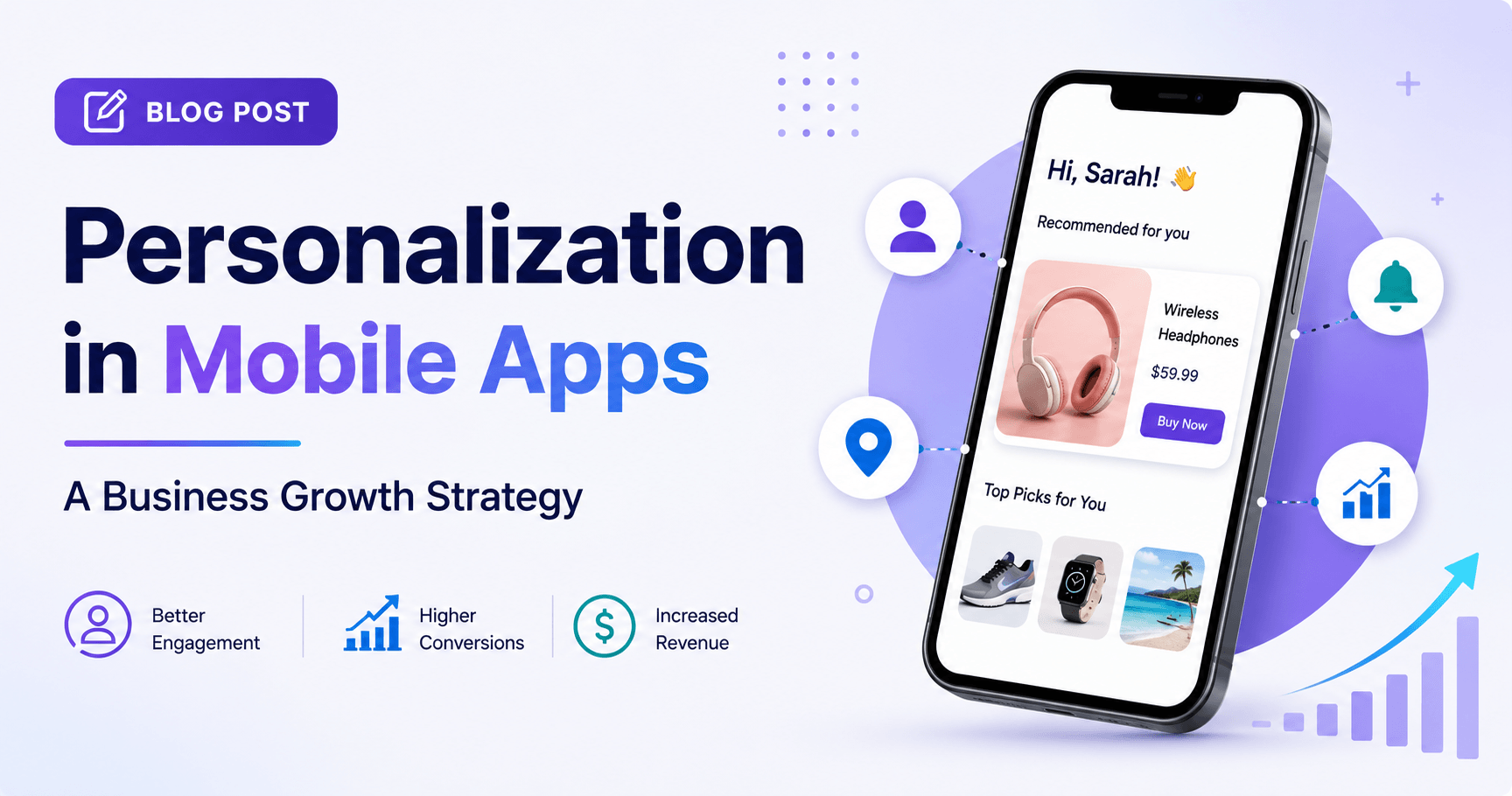
The mobile app market has become increasingly competitive, with millions of applications competing for user attention. Businesses can no longer rely solely on attractive designs or advanced features to retain customers. Today’s users expect personalized experiences that align with their preferences, behaviors, and needs.
Personalization in mobile apps has emerged as one of the most effective strategies for driving customer engagement, increasing retention rates, boosting revenue, and fostering brand loyalty. By leveraging user data, artificial intelligence (AI), and behavioral analytics, businesses can create unique experiences that make users feel valued and understood.
This article explores how mobile app personalization drives business growth, its benefits, implementation strategies, challenges, and future trends.
What is Mobile App Personalization?
Mobile app personalization is the practice of delivering individualized content, recommendations, interfaces, and interactions based on each user’s unique data — including behavioral history, preferences, demographics, location, device context, and real-time actions.
It operates across multiple layers of the user experience:
| Personalization Layer | What It Changes | Example |
| Content personalization | What information is displayed | News app showing articles matching the user’s reading history |
| Recommendation engines | What products or content are suggested | E-commerce app surfacing items based on browse and purchase history |
| UI/UX personalization | How the interface is presented | Fitness app rearranging home screen based on most-used features |
| Notification personalization | When and what push messages are sent | Retail app sending back-in-stock alert for a previously viewed item |
| Pricing and offer personalization | Which promotions are shown | Loyalty app surfacing reward offers based on purchase patterns |
| Onboarding personalization | How new users are introduced to the app | Learning app adjusting difficulty and content based on initial assessment |
| Search personalization | How results are ranked and displayed | Shopping app ranking search results based on the user’s brand preferences |
The Personalization Spectrum: From Basic to Hyper-Personalized
Understanding where your app sits on this spectrum defines what investment is needed and what returns are achievable:
Segment-based personalization (Basic): Groups users by broad characteristics (age, location, device type) and delivers slightly differentiated content to each group. This is the floor, not the ceiling.
Behavioral personalization (Intermediate): Adapts content based on individual user actions within the app — what they clicked, viewed, purchased, or skipped. This is where most personalization investment is currently concentrated.
Predictive personalization (Advanced): Uses machine learning to anticipate what a user wants next — before they explicitly signal it — based on patterns in their historical behavior and comparison with similar users.
Hyper-personalization (Cutting edge): Hyper-personalization uses AI and data analytics to customize every aspect of the app experience. This goes far beyond simple recommendations — it reshapes the entire user journey. Real-time signals including time of day, device context, location, weather, and in-session behavior all inform a continuously adapting experience.
Personalization Is No Longer a Feature. It Is the Foundation.
Open Netflix and it knows what you want to watch before you do. Open Spotify and it has already built you a playlist based on your last three days of listening. Open Amazon and the first product you see is something you did not know you needed — until you did.
This is not magic. It is personalization infrastructure — and it has permanently raised the bar for what every mobile app user expects from every mobile app experience.
In 2026, AI isn’t a differentiator — it’s an expectation. Users now expect personalized recommendations powered by on-device intelligence, interfaces that adapt to how they use the app, and content that feels relevant to their specific context and moment. The era of one-size-fits-all mobile experiences is decisively over.
For businesses, this shift represents both a challenge and a massive opportunity. The challenge: building and maintaining genuine personalization at scale is technically complex, data-intensive, and requires organizational alignment across product, engineering, and marketing. The opportunity: the businesses that get it right are pulling ahead of the competition at a rate that is becoming very difficult to close.
This guide covers the complete picture — what mobile app personalization is, why the data makes an overwhelming case for it, the specific strategies that drive the most growth, how AI has transformed what is now possible, and how to build a personalization engine that scales with your business.
Why Personalization Matters in Mobile Apps
Modern consumers expect brands to understand their needs. Personalized experiences create stronger emotional connections between businesses and customers.
Key Reasons Personalization Matters
- Improves User Experience
Users prefer apps that quickly provide relevant information and recommendations. Personalization eliminates unnecessary friction and helps users find what they need faster. - Increases User Engagement
Personalized content captures attention more effectively than generic messaging. Users are more likely to interact with content tailored to their interests. - Boosts Customer Retention
When users receive relevant experiences, they are less likely to abandon the app. Personalized engagement encourages long-term usage and customer loyalty. - Enhances Customer Satisfaction
Customized experiences make users feel understood and appreciated, improving overall satisfaction levels. - Drives Revenue Growth
Personalized product recommendations and targeted promotions often lead to higher conversion rates and increased spending.
The Business Case: What the Data Actually Shows
Before exploring strategy, the numbers deserve a direct examination. These are not marginal improvements. They are business-defining outcomes.
Revenue Impact
McKinsey research reveals personalization can reduce customer acquisition costs by half while simultaneously lifting revenues by 5–15% and increasing marketing ROI by 10–30%. This triple benefit creates a compounding effect where improved targeting reduces waste, higher conversion rates increase revenue per visitor, and better customer experiences drive retention.
Personalized CTAs outperform generic CTAs by 202%, and 80% of companies see increased consumer spending — on average approximately 38% more — following personalization implementation. Personalized marketing can drive up to 25% of a brand’s total revenue.
AI-powered product recommendations drive a 300% revenue increase for companies implementing sophisticated recommendation engines. Amazon’s recommendation engine alone drives 35% of annual sales, demonstrating the transformative power of AI-driven personalization at scale.
Customer Retention and Loyalty
76% of consumers are more likely to purchase from brands offering personalized experiences, while 71% feel frustrated with impersonal interactions.
60% of consumers become repeat buyers after personalized experiences. First-time buyers receiving personalized experiences show dramatically higher repeat rates — a behavior change that justifies investment in first-party data collection and activation.
Early adopters of AI personalization show 41% better retention metrics than AI laggards.
Omnichannel Multiplier Effect
Brands using in-app messaging, push notifications, email, and web push together see 6.5x more purchases compared to single-channel approaches. The dramatic purchase lift validates omnichannel investment strategies.
ROI Timeline
Most businesses see initial improvements within 30–60 days of implementing personalization, with measurable conversion and revenue impacts typically appearing within 60–90 days. Full ROI realization usually occurs within 6–12 months as AI systems learn from customer behavior and optimize their predictions.
89% of marketers report positive ROI from personalization efforts, and 65% of companies say their personalization efforts exceeded targets.
The conclusion is unambiguous: mobile app personalization is not a nice-to-have feature. It is a growth lever with measurable, repeatable, and compounding returns.
How AI Has Transformed Mobile App Personalization
The biggest shift in mobile app personalization over the past two years is not what personalization does — it is how it operates.
Nowadays, personalization engines now operate in real time, adjusting content, UI flows, and recommendations dynamically. AI is no longer a feature — it is the foundation. Apps are being architected around machine learning models from the outset rather than adding AI as an afterthought.
Real-Time Behavioral Processing
Traditional personalization operated on batch data — user preferences collected over days or weeks, processed overnight, and applied to the next session. AI-native personalization in 2026 processes behavioral signals in milliseconds, updating recommendations, interface elements, and notifications within the same session based on actions the user is taking right now.
A user who searches for “running shoes” and immediately bounces from the results page is telling the app something. An AI personalization engine reads that signal and adjusts — maybe surfacing a different product category, a size guide, or a social proof element — before the user decides to close the app.
On-Device Machine Learning
Users now expect personalized recommendations powered by on-device intelligence — a shift driven by both performance improvements and growing privacy expectations. On-device ML processes behavioral data locally, enabling real-time personalization without transmitting raw user data to cloud servers. This architecture simultaneously improves personalization speed and strengthens privacy compliance — a critical advantage in increasingly regulated markets.
Predictive Next-Best-Action
Beyond showing users what they have previously liked, AI personalization engines in 2026 are increasingly capable of predicting what a user needs before they search for it. Predictive search, proactive content surfacing, and anticipatory notification timing all fall into this category.
44% of mobile apps now use AI personalization to deliver tailored content, and 70% of mobile apps use AI features to improve user experience. These numbers will accelerate: generative AI adoption in enterprises is expected to exceed 80% by 2026, with early adopters showing 41% better retention metrics than AI laggards.
The 7 Core Mobile App Personalization Strategies That Drive Growth
Strategy 1: Behavioral Recommendation Engines
The most proven and highest-ROI personalization strategy in mobile apps. Recommendation engines analyze individual user behavior — what they viewed, purchased, skipped, rated, and searched — to surface relevant content or products that the user is statistically likely to engage with.
Companies implementing sophisticated recommendation engines see 150% conversion rate increases and 50% growth in average order values.
Implementation considerations:
Collaborative filtering (what users similar to you engaged with) combined with content-based filtering (what matches your demonstrated preferences) outperforms either approach alone
Cold start problem: new users with no behavioral history require a fallback strategy — typically editorial “most popular” or onboarding questionnaires that seed initial preferences
Real-time recency weighting: recent behavior should be weighted more heavily than older behavior to reflect current intent
Strategy 2: Personalized Push Notifications
Push notifications are one of the highest-leverage personalization channels available to mobile apps — and one of the most abused. Generic broadcast notifications train users to disable notifications entirely.
Personalized, behaviorally-triggered notifications drive meaningful engagement.
Back-in-stock emails and push notifications deliver 7.28% conversion rates, generating 12x higher revenue per message than standard broadcast campaigns. Personalized product waitlists achieve 11.3% conversion rates with 42% of conversions occurring within one hour.
High-performing personalized notification types:
- Back-in-stock alerts for previously viewed items
- Price drop notifications for wishlisted products
- Behavioral re-engagement triggers for users showing churn signals
- Milestone and achievement notifications in gamified apps
- Contextual reminders based on time of day, location, or usage patterns
- Replenishment reminders based on estimated consumption timing
The key principle: every personalized push notification should be triggered by user behavior or a user-defined preference — not by a marketing calendar.
Strategy 3: Dynamic Onboarding Personalization
First impressions in mobile apps are permanent. A user who does not understand your app’s value within their first two sessions is unlikely to return for a third. Personalized onboarding addresses this by adapting the introduction to match each user’s stated goals, experience level, and context.
Onboarding personalization tactics:
- Preference questionnaire: Ask users two or three targeted questions at signup and use answers to seed their initial experience (fitness app: “What are you training for?”)
- Use-case branching: Route users through different onboarding flows based on their role or goal (project management app: “I’m a manager” vs “I’m an individual contributor” leads to different feature introductions)
- Skill-level adaptation: Learning apps that assess prior knowledge and begin at the appropriate difficulty level see dramatically lower early churn
- Progressive disclosure: Don’t show all features upfront. Surface features as users become ready for them based on their usage patterns
Strategy 4: Personalized In-App Content and UI
Beyond recommendations, the structural elements of the app interface itself can adapt to individual user behavior — creating an experience that feels built specifically for each person.
Practical implementations:
- Rearranging home screen modules to surface the features each user uses most frequently
- Adapting navigation based on the user’s most common pathways through the app
- Showing or hiding features based on user tier, usage maturity, or explicitly stated preferences
- Personalizing empty states and zero-data screens with user-specific context rather than generic placeholders
- Adapting content density and information architecture based on observed engagement patterns
Apps now learn from how people use them, adapting content, recommendations, and interactions in real time to create experiences that feel smarter, more relevant, and genuinely engaging. Personalization is deeply integrated with back-end systems such as analytics platforms, payment services, and customer data platforms.
Strategy 5: Contextual and Location-Based Personalization
Mobile devices provide a layer of contextual intelligence unavailable to desktop applications: location, time of day, weather, device orientation, and activity state (walking, driving, stationary). The most sophisticated mobile personalization engines use this contextual data to deliver experiences that match not just who the user is, but where they are and what they are doing right now.
High-impact contextual personalization examples:
- Retail apps surfacing in-store promotions when a user is detected near a physical location
- Food delivery apps adjusting cuisine recommendations based on time of day and local weather
- Travel apps displaying relevant destination content when a user is detected at an airport
- Fitness apps adapting workout recommendations based on detected activity level and available time
- Banking apps surfacing relevant financial products based on inferred life events (new city, recent large purchase)
Strategy 6: Personalized Loyalty and Reward Experiences
Loyalty programs delivering positive ROI generate 5.2x returns on average, with top performers boosting revenue 15–25% annually from members alone, while members generate 12–18% more incremental revenue growth than non-members.
The key to loyalty personalization is moving beyond generic point accumulation to offers and rewards that feel individually selected. A user who always buys coffee in the morning should receive a morning coffee reward, not a generic discount on a category they never purchase.
Loyalty personalization levers:
- Personalized reward recommendations based on purchase history
- Tier-specific benefits communicated in the context of achievable milestones
- Birthday and anniversary rewards triggered by user lifecycle events
- Behavioral bonus points tied to specific actions each user is likely to take
- Surprise-and-delight rewards triggered by loyalty signals (nth purchase, referral activity)
Strategy 7: Omnichannel Personalization Consistency
Brands using in-app messaging, push notifications, email, and web push together see 6.5x more purchases compared to single-channel approaches. The multiplier effect of omnichannel personalization comes from consistency — the same user profile, the same behavioral context, and the same personalization logic applied across every touchpoint.
A user who browses a product in the mobile app should see that product referenced in the email they receive that evening, available as a fast-reorder in the next app session, and remembered if they visit the web version from a different device.
The technology enabling this is the Customer Data Platform (CDP). The Customer Data Platform market grows from $3.28 billion in 2025 to $12.96 billion by 2032, reflecting the critical need for unified customer data to power personalization and retention strategies.
Industries Benefiting from Mobile App Personalization
E-Commerce
Personalized shopping experiences drive:
- Product discovery
- Cross-selling
- Upselling
- Customer retention
Healthcare
Healthcare apps use personalization for:
- Health tracking
- Medication reminders
- Fitness recommendations
- Personalized wellness plans
Finance
Banking and fintech apps personalize:
- Financial insights
- Spending analysis
- Investment suggestions
- Budget recommendations
Education
Educational apps deliver:
- Customized learning paths
- Skill-based recommendations
- Personalized assessments
Entertainment
Streaming and media platforms personalize:
- Content recommendations
- Playlists
- Viewing suggestions
- User preferences
Common Personalization Mistakes That Undermine Business Results
Mistake 1: Personalizing Without Enough Data
Personalization based on insufficient behavioral data produces recommendations that feel random or irrelevant — which is worse than no personalization at all. Implement a minimum data threshold before personalization activates, and use editorial defaults (popular items, curated content) until that threshold is reached.
Mistake 2: The Filter Bubble Problem
Overly narrow personalization that only shows users what they have previously engaged with creates filter bubbles — limiting discovery and reducing the diversity of engagement. The best personalization engines balance relevance with serendipity, deliberately introducing novel content that the user is statistically likely to enjoy based on adjacent preferences.
Mistake 3: Ignoring the Cold Start Problem
New users arrive with no behavioral history. Without a cold start strategy, they receive generic, impersonalized experiences that fail to demonstrate your app’s value. Onboarding questionnaires, social login preference imports, and contextual default personalization are the standard solutions.
Mistake 4: Personalization Without Permission
Personalizing using data users did not knowingly consent to provide — or in ways they would find intrusive — creates the “creepy” effect that damages trust permanently. The line between helpful and intrusive is primarily about transparency and expected relevance. Seeing a recommendation for a product you viewed is expected. Being addressed with data you never knowingly shared is alarming.
Mistake 5: Measuring Only Short-Term Conversion
Personalization that optimizes exclusively for immediate conversion can damage long-term retention by recommending high-value items too aggressively. Balance conversion optimization with engagement and satisfaction metrics to build experiences that are sustainable as well as profitable.
Mistake 6: Treating Personalization as a One-Time Project
Personalization is not a feature you ship and forget. User behavior evolves, preferences change, and model performance drifts over time. Effective personalization requires continuous monitoring, regular model retraining, and ongoing A/B testing to maintain and improve performance.
Challenges of Mobile App Personalization
Data Privacy Concerns
Users increasingly value privacy and expect transparency regarding data collection and usage.
Businesses must comply with regulations such as:
- GDPR
- CCPA
- Regional privacy laws
Data Quality Issues
Poor-quality data can lead to inaccurate recommendations and negative user experiences.
Maintaining clean, accurate, and updated data is essential.
Over-Personalization
Excessive personalization can feel intrusive and create discomfort among users.
Businesses should balance relevance with privacy and user control.
Technical Complexity
Advanced personalization often requires:
- AI integration
- Data analytics infrastructure
- Continuous optimization
Proper planning and technology investments are necessary.
Future Trends in Mobile App Personalization
Hyper-Personalization
Hyper-personalization combines AI, real-time data, and predictive analytics to deliver highly individualized experiences.
Voice-Based Personalization
Voice assistants and conversational interfaces will offer more personalized interactions.
Predictive Experiences
Apps will increasingly anticipate user needs before users actively search for solutions.
AI-Powered Customer Journeys
Future personalization will optimize every stage of the customer journey automatically.
Privacy-First Personalization
Businesses will focus on delivering personalized experiences while maintaining strict privacy standards and user control.
Best Practices for Successful Mobile App Personalization
To maximize business growth, organizations should:
- Obtain clear user consent
- Focus on data security
- Start with simple personalization strategies
- Continuously test and optimize experiences
- Use AI responsibly
- Provide users with customization controls
- Monitor personalization performance metrics
Measuring Personalization ROI: Key Metrics and Benchmarks
Effective personalization measurement requires connecting behavioral changes to business outcomes. These are the metrics that matter:
| Metric | Benchmark | Measurement Method |
| Conversion rate lift | 5–15% per personalization test | A/B test vs. control group |
| Revenue per user | 5–15% increase (McKinsey) | Cohort comparison over 6+ months |
| Day-30 retention | Varies by category; track lift vs. baseline | Cohort analysis |
| Push notification CTR | 4–8% for personalized vs. 1 | 2% for generic Campaign analytics |
| Average order value | Up to 50% higher with recommendations | Transaction data |
| Customer lifetime value | 12–18% higher for members with personalization | Multi-year cohort |
| NPS | Track post-personalization vs. baseline | Periodic surveys |
Frequently Asked Questions
Q: What is mobile app personalization?
Mobile app personalization is the practice of tailoring content, recommendations, notifications, and user experiences to individual users based on their behavior, preferences, demographics, and contextual data. It ranges from basic segment-based content differentiation to real-time AI-driven hyper-personalization that adapts every element of the app experience to each user.
Q: Why is personalization important for mobile app business growth?
Personalization drives business growth through three compounding mechanisms: higher conversion rates (personalized CTAs outperform generic ones by 202%), better retention (60% of consumers become repeat buyers after personalized experiences), and higher revenue per user (McKinsey benchmarks show 5–15% revenue lift). Combined, these outcomes directly improve customer lifetime value and reduce acquisition cost.
Q: What data is needed for mobile app personalization?
The most important data for mobile app personalization includes in-app behavioral data (what users click, view, purchase, and skip), declared user preferences (profile settings, notification preferences), transaction history, session context (device, time of day, location), and demographic data where consented. Behavioral data is generally more accurate and more privacy-compliant than demographic data.
Q: How does AI improve mobile app personalization?
AI enables real-time personalization at scale — processing behavioral signals in milliseconds and adapting recommendations, content, and interfaces within the same session. AI also enables predictive personalization: anticipating what a user needs before they explicitly search for it. 44% of mobile apps now use AI personalization, and apps using AI show 41% better retention metrics than those that do not.
Q: How do you measure the ROI of mobile app personalization?
Measure personalization ROI through A/B testing (personalized vs. control groups), cohort analysis comparing retention and lifetime value over 6–12 months, conversion rate tracking by feature, and revenue attribution. Most businesses see initial improvements within 30–60 days, with full ROI realization within 6–12 months as AI models optimize on accumulated behavioral data.
Q: What is hyper-personalization in mobile apps?
Hyper-personalization uses AI and real-time data to customize every aspect of the app experience for each individual user — going beyond product recommendations to adapt the UI layout, navigation, notifications, content, and offers in real time based on behavioral, contextual, and predictive signals. It is the most advanced expression of mobile app personalization and the standard to which leading consumer apps are increasingly moving.
Q: How can small businesses implement mobile app personalization?
Small businesses should start with high-impact, lower-complexity personalization: behavioral push notifications, a basic recommendation engine for their most visited category, and a simple onboarding questionnaire that seeds initial preferences. Tools like Braze, CleverTap, and Firebase provide accessible personalization infrastructure at SMB price points. Start with one use case, measure the lift, and expand based on data.
Q: Is mobile app personalization compatible with privacy regulations?
Yes — privacy-first personalization is not only compatible with GDPR and CCPA but is increasingly advantageous. First-party behavioral data (collected with clear consent) is more accurate and more sustainable than third-party data. Transparency about how data is used, user-controlled preference centers, and on-device processing architectures enable powerful personalization within a privacy-compliant framework.
Conclusion: The Personalization Imperative Is Already Here
The data makes an overwhelming case. 76% of consumers are more likely to purchase from brands offering personalized experiences. 89% of marketers report positive ROI from personalization. 92% of businesses are now using AI-driven personalization to stimulate growth.
Personalization in mobile apps has moved from competitive advantage to competitive necessity. The question for businesses in 2026 is not whether to personalize — it is how quickly they can build the data infrastructure, personalization capabilities, and measurement systems to do it well.
The gap between personalization leaders and laggards is widening. Personalization leaders are 48% more likely to exceed revenue goals. The compounding nature of personalization — where better data leads to better models, which leads to better experiences, which leads to more behavioral data — means that the advantage of early movers grows over time.
Start with your highest-impact use case. Build your first-party data foundation. Deploy your first behavioral trigger. Measure the lift. Iterate.
The mobile app that feels like it was built specifically for each user is the mobile app that earns the loyalty, the lifetime value, and the word-of-mouth that sustains long-term business growth. In 2026, building that app is not just a product strategy — it is a business growth imperative.