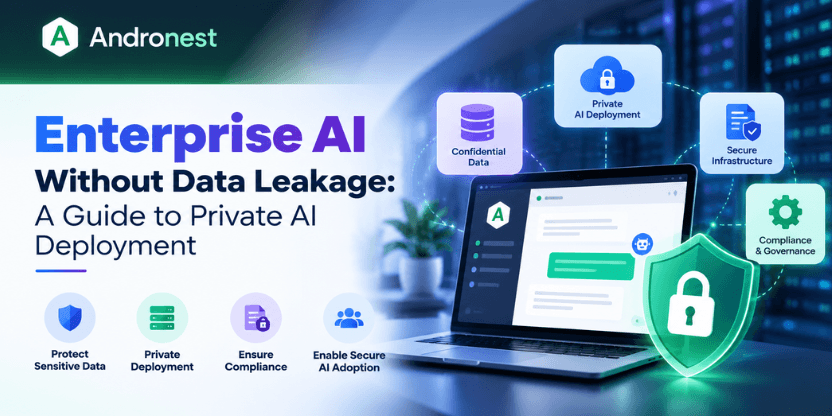
Artificial intelligence is changing how businesses analyze information, automate tasks, support employees, and make decisions. From summarizing internal documents to assisting customer support teams, AI-powered tools can help organizations improve productivity and make better use of their data.
However, enterprise AI adoption also introduces an important concern: How can a business benefit from AI without exposing confidential information?
Employees may enter sensitive information into AI tools. AI applications may retrieve documents that users should not be allowed to see. An improperly configured integration could expose internal records, while a poorly secured AI agent might access systems or perform actions beyond its intended role.
These risks become particularly important when AI systems work with customer information, financial records, intellectual property, employee data, source code, contracts, or internal business documents.
Private AI deployment offers one way to address these concerns. By controlling where AI models run, how data is processed, which systems the models can access, and how information is retained, organizations can establish stronger safeguards around their AI workloads.
However, private AI deployment does not automatically eliminate data leakage. A secure implementation requires a combination of deployment architecture, identity and access management, data protection, application security, monitoring, and governance.
This guide explains what private AI deployment means, why enterprise data leakage happens, which deployment models businesses can consider, and how organizations can build AI systems that protect sensitive information while supporting business goals.
What is Private AI Deployment?
Private AI deployment is an approach to implementing artificial intelligence in which an organization maintains greater control over its AI infrastructure, data, access permissions, and operational policies.
Instead of sending every request and document to an unrestricted public AI service, a business can deploy or access AI models through an environment designed to meet its security, privacy, compliance, and operational requirements.
Depending on the architecture, this may involve running a model within a company’s own infrastructure, using a dedicated cloud environment, accessing a managed AI service with appropriate isolation controls, or combining these approaches.
The objective is to establish clear boundaries around:
- Where business data is processed and stored.
- Who can use the AI application?
- Which documents and databases the AI system can access.
- Whether prompts and responses are logged or retained.
- Whether submitted information can be used to improve or train a model.
- How data moves between the AI application and connected systems.
- How the organization detects and responds to security incidents.
Consider a company that wants employees to use AI to search internal policies, summarize project documentation, and answer questions about company procedures.
A public AI tool may not provide the level of control the company requires for its internal information. A private deployment can instead connect an AI application to approved document repositories, enforce employee permissions, and apply the organization’s data handling rules.
The key is not simply making the model private. It is designing the complete AI application so that sensitive information remains protected throughout the process.
Read: AI Model Evaluation – Metrics, Methods, and Best Practices
What is Enterprise AI Data Leakage?
Enterprise AI data leakage occurs when confidential or sensitive information is exposed, accessed, retained, transmitted, or disclosed in a way that violates an organization’s security requirements or data handling policies.
The exposure may be intentional or accidental. It may also happen through an AI application’s connected systems rather than through the model itself.
For example, an employee might paste confidential customer information into an AI tool that has not been approved for that purpose. In another scenario, an internal AI assistant might retrieve a document from a shared repository and show it to an employee who lacks permission to view it.
Data leakage can occur at several points in the AI lifecycle.
1. Sensitive information in prompts
Employees may include customer names, financial figures, internal reports, source code, or contract details in their prompts.
If the AI service, application, or surrounding infrastructure handles that information in a way that conflicts with the organization’s policies, sensitive data may be exposed.
2. Unauthorized retrieval of internal documents
AI applications often retrieve relevant information from internal knowledge bases, document repositories, or databases.
If permissions are not enforced correctly, the application may return information that the requesting user is not authorized to access.
3. Excessive data retention
Prompts, responses, attachments, diagnostic information, and application logs may contain confidential content.
If these records are retained indefinitely or made available to too many people, they can create additional exposure risks.
4. Insecure integrations
AI applications may connect to customer relationship management systems, enterprise resource planning platforms, email, cloud storage, or internal APIs.
An overly permissive integration can allow the AI application to retrieve or modify more information than it needs.
5. Prompt injection and manipulated inputs
An attacker may craft instructions designed to influence an AI system’s behavior. Malicious instructions can also appear in documents, web pages, or other content that an AI system processes.
If an application grants the model excessive access to data or tools, manipulated inputs may contribute to unauthorized disclosure or actions.
The OWASP GenAI Security Project identifies prompt injection and sensitive information disclosure among the important risks organizations should address when developing AI applications.
6. Misconfigured infrastructure
Incorrect access permissions, exposed storage, poorly managed credentials, or inadequate network restrictions can undermine an otherwise well-designed AI solution.
These are not exclusively AI problems, but their impact can increase when an AI application processes large volumes of business information.
The important distinction: AI data leakage is not just a model-level problem. It can originate in the data sources, application code, identity controls, integrations, infrastructure, or operational processes surrounding the model.
Why Businesses Need Private AI Deployment
Organizations often want to use AI for productivity, knowledge management, software development, analytics, and customer service. However, they may have legitimate reasons to limit how their information is processed.
Private AI deployment can help businesses establish controls that align AI adoption with their operational and security requirements.
1. Protect confidential business information
Organizations regularly handle information that should not be accessible to everyone, including business plans, product roadmaps, financial projections, customer records, contracts, and proprietary research.
A private AI environment can help restrict how this information is accessed and processed.
For example, a product development team might use an internal AI assistant to summarize technical documentation. Access to those documents can be limited to authorized team members rather than exposing the entire knowledge base to every employee.
2. Maintain control over data handling
Businesses need to understand where their data goes and how it is handled.
Depending on the chosen deployment model and service terms, private AI can provide greater control over data storage, retention, access, and processing.
Organizations should verify these controls contractually and technically. A service described as private does not necessarily guarantee that every form of data retention or processing is disabled.
3. Support privacy and compliance requirements
Businesses in regulated or data-sensitive industries may need to meet specific requirements related to personal information, financial records, healthcare information, or contractual confidentiality.
Private deployment can support these requirements by providing a more controlled environment for AI processing.
However, private AI deployment alone does not establish regulatory compliance. Compliance depends on the applicable laws, data types, business activities, technical safeguards, contracts, documentation, and organizational procedures.
4. Reduce reliance on unapproved AI tools
When employees lack approved AI tools, they may adopt public services independently to complete their work.
This creates a risk often described as shadow AI: the use of AI applications without appropriate organizational oversight.
Providing a secure, approved AI solution gives employees a practical alternative while allowing IT and security teams to establish acceptable-use policies, access controls, and monitoring.
5. Establish consistent security policies
Without a common approach, different departments may use different AI services, share information through inconsistent workflows, and apply varying levels of security.
A centrally managed AI environment can help standardize authentication, authorization, logging, data classification, and incident response.
This is especially valuable when multiple teams are introducing AI capabilities across the organization.
6. Protect intellectual property
Companies may want to use AI to analyze proprietary code, design documents, engineering specifications, research materials, or internal business processes.
A controlled deployment can help limit exposure of that information to unauthorized users or systems.
Businesses should also review the intellectual property and data usage terms of any model or service they choose. Technical isolation and contractual protections address different parts of the risk.
Also read: The Future of Enterprise AI: Private, Local, and Hybrid Models
Private AI vs. Public AI: What is the Difference?
Public and private AI are not necessarily competing technologies. They represent different ways of accessing and managing AI capabilities, and both can be appropriate depending on the sensitivity of the workload.
The most important distinction is the level of control available over data, access, infrastructure, and operational policies.
| Factor | Public AI service | Private AI deployment |
| Infrastructure | Often operated by an external provider and shared at the service level | May run in an organization’s infrastructure, a dedicated environment, or a controlled managed service |
| Data handling | Depends on the provider’s product, settings, and contractual terms | Can be configured around organizational requirements, subject to the chosen architecture |
| Access management | Provider features and application configuration determine available controls | Can integrate with enterprise identity, role-based access, and internal authorization policies |
| Customization | Depends on the service and its available features | May offer greater control over models, integrations, and application behavior |
| Operational responsibility | Provider manages much of the underlying service | Responsibility varies; self-hosting generally requires more infrastructure and security management |
| Maintenance | Often managed by the provider | May be shared between the organization and provider or handled internally |
| Cost structure | May use subscription, usage-based, or other pricing models | May include infrastructure, model hosting, engineering, maintenance, and support costs |
| Best suited for | Workloads that fit the provider’s data policies and security requirements | Workloads that require specific control over data processing, access, or deployment architecture |
An important nuance is that using a public AI service does not automatically mean that business data is exposed or used for model training. Some enterprise services offer contractual data protections, configurable retention, and other security controls.
Similarly, a privately deployed model can still leak data if the application is poorly designed or improperly configured.
Businesses should evaluate the actual data handling, access controls, isolation, retention policies, and security features of each option rather than relying on labels such as public, enterprise, or private alone.
Check out: How to Deploy AI Securely Without Sending Data to the Cloud
What are the Main Approaches to Private AI Deployment?
There is no single deployment model that fits every organization. The right choice depends on the sensitivity of the data, the required level of control, infrastructure capabilities, performance requirements, and available budget.
1. On-premises AI deployment
With on-premises deployment, an organization runs its AI models and supporting infrastructure within its own data center or computing environment.
The organization can control the servers, network boundaries, storage, and access policies, subject to its infrastructure design and operational practices.
Advantages
- Greater direct control over infrastructure and data storage.
- Opportunities to isolate AI workloads from external networks.
- More flexibility for organizations with strict infrastructure requirements.
- Potential support for environments with limited or no internet connectivity.
Challenges
- Requires suitable computing resources, including GPUs where needed.
- The organization is responsible for infrastructure maintenance, patching, monitoring, and capacity planning.
- Model deployment and optimization may require specialized expertise.
- Scaling can require additional hardware and operational investment.
Best suited for: Organizations with strict data residency or isolation requirements, specialized infrastructure, or a need to operate AI workloads in controlled environments.
2. Private cloud AI deployment
Private cloud deployment runs AI workloads in a controlled cloud environment. Depending on the design, this may involve dedicated resources, private networking, restricted endpoints, and enterprise identity controls.
Organizations can benefit from cloud infrastructure while applying their own security and governance requirements.
Advantages
- Flexible computing capacity.
- Integration with cloud-based enterprise systems.
- Support for centralized monitoring and identity management.
- Less need to purchase and maintain all physical infrastructure directly.
Challenges
- Requires careful configuration of network access, storage, identities, and service permissions.
- Cloud usage and specialized computing resources can become expensive.
- Security responsibilities may be shared between the cloud provider and the organization.
Best suited for: Businesses that need greater control over AI workloads but want the flexibility and scalability of cloud infrastructure.
3. Enterprise AI through a managed service
Some organizations use managed AI services that provide access to models through enterprise-controlled applications and APIs.
Depending on the service, features may include private networking, encryption, identity integration, configurable logging, and contractual data protections.
A managed service does not necessarily mean that the model runs exclusively on infrastructure owned by the customer. Organizations must verify the provider’s architecture and data handling terms.
Advantages
- Reduced responsibility for managing model-serving infrastructure.
- Faster implementation than building an entire AI platform from scratch.
- Access to provider-managed infrastructure and service updates.
- Potential integration with existing cloud security and governance tools.
Challenges
- Available controls vary by provider and service tier.
- Organizations remain responsible for many application-level security decisions.
- Data retention, geographic processing, and logging policies must be evaluated carefully.
- Dependence on a provider may limit portability or customization.
Best suited for: Businesses that want enterprise AI capabilities without managing every component of the underlying infrastructure.
4. Hybrid AI deployment
A hybrid approach combines multiple deployment models. For example, an organization may run a sensitive AI workload on-premises while using a managed AI service for lower-risk tasks.
It may also separate data processing, retrieval, and model inference across different environments, depending on the architecture.
Advantages
- Allows different workloads to use different levels of isolation.
- Supports gradual AI adoption.
- Can accommodate existing systems and infrastructure investments.
- Provides flexibility when data sensitivity varies between use cases.
Challenges
- Data flows between environments require careful control.
- Monitoring and identity management can become more complex.
- Teams must understand which system processes each category of data.
- Different environments may have different operational and compliance requirements.
Best suited for: Enterprises with varied security needs, existing infrastructure investments, or multiple AI use cases with different risk profiles.
How should you choose?
| Requirement | Deployment approach to consider |
| Direct control over physical infrastructure | On-premises AI |
| Cloud flexibility with controlled networking | Private cloud AI |
| Reduced model infrastructure management | Managed enterprise AI service |
| Different controls for different workloads | Hybrid AI deployment |
These are starting points, not universal rules. Before selecting an architecture, assess the sensitivity of the information, required controls, total cost of ownership, operational capabilities, and the actual guarantees offered by the chosen provider.
Also check: Data Privacy Challenges in AI Deployment and How to Solve Them
How Does a Secure Private AI Architecture Work?
A secure enterprise AI system consists of more than a model and a chat interface. It includes the infrastructure, application, data sources, identity controls, security policies, and monitoring capabilities needed to manage information throughout its lifecycle.
A typical private AI architecture may contain the following components.
1. User authentication and identity management
Employees access the AI application through an approved authentication mechanism, ideally integrated with the organization’s identity provider.
The application identifies the user and determines which features and information they are allowed to access.
For example, a member of the finance team might be authorized to query approved financial documents, while an employee in another department should not automatically receive the same access.
2. Application and policy layer
Before a request reaches the model, the application can enforce policies relating to authentication, authorization, permitted use cases, input validation, and rate limits.
It may also identify sensitive information and apply appropriate redaction or blocking rules.
These controls should be implemented in application logic and supporting security systems, rather than relying solely on instructions given to the AI model.
3. Controlled data retrieval
If the AI application needs internal information, it retrieves relevant content from approved sources.
For example, a company knowledge assistant might search internal policies, product documentation, or project records.
The retrieval process must respect the requesting user’s permissions. The system should not retrieve a restricted document simply because it appears relevant to the question.
4. Model inference
The model processes the user’s request and the context provided by the application.
Depending on the deployment model, inference may occur within the organization’s infrastructure or through an approved managed service.
The organization should understand where prompts, retrieved content, and outputs are processed, whether they are retained, and which components can access them.
5. Output validation
Before returning a response, the application can apply additional checks to detect sensitive information, enforce output policies, and validate any structured content used by downstream systems.
Output filtering can reduce some risks, but it should not be the primary defense against unauthorized data access. Preventing unauthorized information from reaching the model in the first place is often more effective.
6. Logging, monitoring, and audit
Security teams need appropriate visibility into how the AI application is being used.
Depending on the use case, monitoring may include authentication events, access decisions, retrieval activity, tool calls, configuration changes, and security alerts.
Logs should be designed carefully because they can themselves become a source of data leakage if they capture sensitive prompts, documents, or responses without adequate protection.
A useful principle is to protect every stage of the AI workflow, from the user’s initial request to the final response and any subsequent action.
For an example of how private networking and access controls can be applied to a retrieval-augmented generation architecture, see Google Cloud’s private connectivity guidance for generative AI applications.
How Retrieval-Augmented Generation Helps Protect Enterprise Data
Retrieval-augmented generation, commonly called RAG, is an approach that connects an AI model to an external information source.
Instead of relying only on information learned during training, the application retrieves relevant content from approved documents or databases and provides that context to the model when generating a response.
For example, an employee might ask an internal AI assistant:
“What is our policy for approving software purchases?”
The application searches the company’s approved policy documents, retrieves relevant passages, and gives those passages to the model to help generate an answer.
RAG can make AI responses more relevant to an organization’s current information without requiring the model to be retrained every time a document changes. However, RAG is not a security control by itself. Its implementation must include appropriate access restrictions.
How a RAG workflow operates
A typical workflow includes these stages:
- Data preparation: Approved documents are collected, reviewed, classified, and prepared for indexing.
- Indexing: The content is organized so that relevant passages can be retrieved efficiently.
- User authentication: The application identifies the employee making the request.
- Permission-aware retrieval: The retrieval system searches only content that the user is authorized to access.
- Context assembly: Relevant passages are selected and supplied to the model.
- Response generation: The model produces an answer based on the supplied context and its general capabilities.
- Output and access checks: The application validates the response and returns it to the user under the organization’s policies.
Why access control is critical in RAG
Imagine a company stores HR policies, employee records, and finance reports in a shared knowledge platform.
If all documents are indexed without preserving their access permissions, the AI application might retrieve sensitive information for an employee who would not normally have access to it.
A secure RAG implementation should therefore:
- Preserve document-level permissions and relevant metadata.
- Apply authorization during retrieval, not just when displaying the final answer.
- Separate data sources when their access requirements differ.
- Remove outdated or revoked information from indexes according to defined procedures.
- Restrict access to vector databases, embeddings, and retrieval APIs.
- Test whether users can obtain information outside their authorized scope.
Vector embeddings are numerical representations of content used in certain search systems. They should not automatically be treated as harmless or public data. The indexes and associated metadata need appropriate access controls and protection.
RAG can help organizations connect AI to private business information without incorporating every new document into model training. But it cannot guarantee that confidential information will never be exposed. The complete retrieval and response pipeline must be designed and tested for security.

10 Essential Security Practices for Private AI Deployment
Deploying AI in a private environment is only the beginning. Organizations also need practical safeguards that reduce the likelihood of unauthorized access, accidental disclosure, and misuse.
The following practices provide a foundation for a more secure enterprise AI environment.
1. Classify data before connecting it to AI
Not every business document should be available to an AI application.
Before connecting internal data sources, classify information according to its sensitivity and business purpose.
A basic classification system might include:
- Public: Information approved for public distribution.
- Internal: Information intended for employees and authorized business users.
- Confidential: Sensitive business information that requires restricted access.
- Highly restricted: Information such as sensitive personal records, credentials, or critical intellectual property that requires stronger controls.
The exact categories should reflect the organization’s policies and regulatory obligations.
Once information is classified, define which AI use cases may process each category, where the data may be stored, and which users and applications can access it.
Practical example: A company might allow its AI assistant to summarize public product documentation but require additional authorization before processing confidential contracts or employee records.
2. Enforce role-based access control
Role-based access control, or RBAC, grants permissions according to a user’s organizational role.
For private AI, access controls should apply not only to the AI interface but also to the underlying data sources and connected systems.
For example, an AI assistant connected to a CRM should not automatically provide every employee with access to every customer record.
Use the principle of least privilege: give each user, application, and AI agent only the permissions needed for its assigned tasks.
Where necessary, combine role-based permissions with document-level authorization, attribute-based access policies, and other controls.
Important: The AI model should not be trusted to enforce authorization on its own. The application and connected systems must verify whether an access request is permitted.
3. Encrypt sensitive information
Encryption helps protect data from unauthorized access during transmission and storage.
Organizations should consider encryption for:
- Data stored in databases and document repositories.
- AI-related application logs and backups.
- Communication between application components.
- Model endpoints and connected services.
- Vector databases and other retrieval infrastructure.
Where required, use enterprise key management and restrict who can access encryption keys.
Encryption is an important safeguard, but it does not prevent every form of data leakage. Information may still be exposed through an authorized but overly permissive application, compromised credentials, or an insecure workflow.
4. Prevent sensitive information from entering unauthorized prompts
Employees may inadvertently share information that should not be processed by a particular AI service.
Organizations can reduce this risk through approved AI tools, employee training, data loss prevention policies, and input validation.
Depending on the use case, applications can also detect or redact sensitive information before sending prompts to a model.
For example, a document summarization application might replace unnecessary personal identifiers with placeholders before processing a document.
However, automated detection is not perfect. Sensitive information can appear in unexpected formats or contexts, so input filtering should complement—not replace—access control and appropriate service configuration.
5. Protect prompts, responses, and logs
AI applications may generate records of user prompts, model responses, retrieval results, and tool calls.
These records can contain confidential information even when the model itself is securely hosted.
Establish clear policies for:
- What information may be logged.
- Which teams can access logs.
- How long records are retained.
- When records must be deleted.
- How sensitive fields are masked or redacted.
- How logs are protected from unauthorized modification or access.
Avoid storing complete prompts and responses by default if doing so is unnecessary for the application’s operation or security requirements.
When detailed records are necessary for debugging or auditing, limit access and retention to what the use case requires.
6. Secure AI integrations and agents
AI applications increasingly connect to business systems through APIs and tools. These integrations may allow an AI assistant to retrieve documents, create support tickets, update records, or initiate workflows.
Such capabilities introduce additional risks.
An AI agent with access to a business system may be manipulated into attempting an action that the user did not intend.
To reduce this risk:
- Assign separate identities to applications and agents where appropriate.
- Restrict API permissions to the minimum required.
- Validate all actions in application logic.
- Require human approval for sensitive or irreversible operations.
- Use transaction limits and policy checks where appropriate.
- Record significant actions for audit and investigation.
- Avoid exposing credentials in prompts, source code, or model context.
For example, an AI assistant might be permitted to draft a purchase order but require an authorized employee to approve it before submission.
This separates the AI’s ability to assist from its authority to execute consequential actions.
7. Defend against prompt injection
Prompt injection occurs when malicious or misleading instructions influence an AI system to behave in unintended ways.
These instructions may appear directly in a user’s prompt or indirectly in content the model processes, such as uploaded documents, web pages, or retrieved knowledge-base passages.
For example, a malicious document might contain instructions attempting to persuade an AI assistant to disclose confidential information or misuse an available tool.
Organizations should not assume that a system prompt or a set of natural-language rules can reliably prevent these attacks. OWASP’s guidance explains that prompt injection can affect AI behavior and that retrieval or fine-tuning alone does not eliminate the risk.
Recommended safeguards include:
- Treat retrieved documents and external content as untrusted input.
- Keep authorization checks outside the model.
- Restrict the tools and data sources available to the AI.
- Validate tool arguments before execution.
- Require approval for high-impact actions.
- Test the application against direct and indirect prompt-injection attempts.
- Monitor unusual requests and suspicious tool activity.
The goal is to limit what an AI system can access or do if its behavior is manipulated.
8. Monitor AI activity and detect anomalies
Organizations need visibility into how their AI systems behave in production.
Monitoring can help identify unusual access patterns, unexpected data retrieval, suspicious requests, and attempts to use restricted functionality.
Useful signals may include:
- Repeated attempts to access restricted information.
- Unusual spikes in request volume.
- Unexpected calls to external services.
- Attempts to use tools outside their intended purpose.
- Changes to access permissions or system configuration.
- Repeated output-filtering or security-policy violations.
Monitoring should be proportionate to the sensitivity of the application and designed to protect the data it collects.
For example, an AI assistant used for internal knowledge retrieval may require different monitoring controls from an AI agent authorized to modify financial records.
9. Test the system before deployment
Security testing should be part of the AI development lifecycle, not an activity reserved for after a problem occurs.
Before launching a private AI application, test scenarios that reflect how employees and attackers might interact with it.
These tests should include:
- Attempts to access another user’s restricted documents.
- Requests that try to reveal sensitive information.
- Malicious instructions embedded in uploaded content.
- Attempts to bypass tool permissions.
- Unexpected or malformed input.
- Improper handling of errors and logs.
- Unauthorized changes to connected business records.
Test both the model’s responses and the application’s underlying security controls.
A model may produce an inappropriate response, but the more serious issue may be that the application allowed it to retrieve data or execute an action it should never have been permitted to access.
10. Establish AI governance and employee policies
Technical safeguards are most effective when supported by clear organizational rules.
An enterprise AI policy should explain which tools employees may use, what information they can submit, how AI-generated content should be reviewed, and how suspected security incidents should be reported.
It should also define responsibilities for:
- Business owners.
- IT and security teams.
- AI developers and administrators.
- Data owners.
- Legal and compliance teams.
- Employees using AI applications.
Organizations can use the NIST AI Risk Management Framework and its generative AI companion profile as references when developing an AI risk management approach. These resources support structured evaluation and management of AI risks throughout the system lifecycle.
Private AI Deployment for Different Industries
The value of private AI varies by industry, but the underlying principle remains the same: provide useful AI capabilities while limiting access to sensitive information.
Healthcare
Healthcare organizations may use AI to summarize approved clinical documentation, help staff navigate internal policies, or support administrative workflows.
Private deployment can help establish controlled access to sensitive information.
However, healthcare data requires careful handling, and any deployment must account for applicable privacy requirements, access restrictions, retention policies, and clinical oversight.
AI-generated summaries should also be reviewed appropriately before they are used in clinical decisions.
Banking and financial services
Financial organizations may explore AI for document analysis, internal knowledge search, customer service support, and selected operational tasks.
A controlled deployment can help restrict access to financial records, internal risk documentation, and customer information.
Additional safeguards may be required for transaction-related workflows, financial advice, regulatory reporting, and other high-impact applications.
Legal services
Law firms and legal departments often work with confidential contracts, case files, legal correspondence, and privileged information.
Private AI can support document summarization, contract review, and internal legal research workflows.
Organizations should carefully manage matter-level access permissions and ensure that AI systems do not expose one client’s information to another client or unauthorized employee.
AI-generated legal analysis should be reviewed by qualified professionals.
Software development and technology
Technology companies may use AI to analyze code, explain internal systems, generate documentation, or assist developers with troubleshooting.
A private AI environment can help control access to proprietary source code, architecture documents, credentials, and internal technical information.
Developers should also ensure that secrets are excluded from prompts and that AI-generated code is reviewed and tested before being used in production systems.
Manufacturing and engineering
Manufacturers may use AI to search technical manuals, summarize maintenance records, and support internal knowledge management.
A controlled AI deployment can help protect engineering specifications, supplier information, product designs, and operational data.
Where AI connects to industrial systems, access should be especially restrictive. AI assistance should not be allowed to issue consequential operational commands without appropriate validation and authorization.
Retail and e-commerce
Retail organizations may use AI to analyze product information, support internal teams, summarize customer feedback, and assist with approved customer service workflows.
Private AI can help control access to customer records, sales information, and business planning documents.
Organizations should ensure that personalization and customer support applications follow their privacy policies and do not reveal information belonging to other customers.
Check out: How Data Processing Services Prepare Data for AI
Common Mistakes to Avoid When Deploying Private AI
Even organizations that invest in secure infrastructure can overlook important application-level risks.
Avoid these common mistakes when planning an enterprise AI deployment.
Mistake 1: Assuming private hosting guarantees privacy
A model hosted on private infrastructure can still expose data if it has excessive permissions or if the surrounding application is insecure.
Better approach: Assess the complete data flow, including prompts, retrieval, storage, integrations, logs, and outputs.
Mistake 2: Connecting every internal document at once
Giving an AI assistant access to an entire document repository may seem convenient, but it increases the potential impact of incorrect permissions.
Better approach: Begin with a limited set of approved data sources and expand only after access controls and retrieval behavior have been tested.
Mistake 3: Relying only on prompt instructions
Instructions such as “never reveal confidential information” may help guide model behavior, but they are not a substitute for enforceable security controls.
Better approach: Implement authorization, data filtering, tool restrictions, and output validation in the application and supporting infrastructure.
Mistake 4: Giving AI agents excessive permissions
An AI agent may not need write access to a system if its primary purpose is to retrieve or summarize information.
Better approach: Begin with read-only access where possible. Add write permissions only when required, and introduce approval steps for sensitive actions.
Mistake 5: Ignoring data retention
Prompts, responses, and diagnostic records can accumulate sensitive information over time.
Better approach: Define retention periods, restrict log access, and delete information when it is no longer required.
Mistake 6: Skipping security testing
A system that performs well during a demonstration may still fail when users submit unexpected inputs or attempt to access restricted information.
Better approach: Include authorization tests, prompt-injection scenarios, data leakage checks, and abuse testing before production deployment.
Mistake 7: Overlooking operational costs
Running a private model may require significant infrastructure, monitoring, maintenance, and specialist support.
Better approach: Evaluate the total cost of ownership rather than comparing only the model’s hosting cost with the price of an external AI service.
Mistake 8: Treating compliance as a deployment feature
Using private infrastructure does not automatically satisfy every applicable privacy, security, or industry requirement.
Better approach: Map the deployment to the organization’s actual legal, contractual, and regulatory obligations, and maintain appropriate evidence of compliance.
A Step-by-Step Roadmap for Implementing Private AI
Organizations do not need to start by building a large enterprise AI platform. A focused implementation can help validate the business case and identify security requirements before the system expands.
Step 1: Identify a suitable business use case
Choose a specific problem where AI can provide measurable value.
Examples include internal document search, policy assistance, technical documentation summaries, or employee support.
Avoid beginning with the most sensitive or operationally complex workflow unless there is a clear business reason.
Step 2: Define the data protection requirements
Identify the information the application will process and classify its sensitivity.
Determine where data may be stored and processed, who can access it, whether it can leave the organization’s environment, and how long it may be retained.
Include any contractual, privacy, or regulatory requirements that apply.
Step 3: Choose the deployment architecture
Evaluate on-premises, private cloud, managed enterprise AI, and hybrid options.
Consider:
- Required isolation and network controls.
- Model capabilities and expected performance.
- Infrastructure and operational requirements.
- Integration with existing systems.
- Data retention and service terms.
- Cost and scalability.
- Internal expertise and support requirements.
Select the simplest architecture that meets the documented requirements.
Step 4: Select the model and application approach
Determine whether an existing model can meet the business requirements or whether a more customized solution is necessary.
For many internal knowledge applications, retrieval-augmented generation may be a suitable starting point because it allows the application to retrieve approved information without requiring the model to be retrained for every content update.
The model should be evaluated for task performance, data handling, operational requirements, and compatibility with the chosen deployment environment.
Step 5: Establish identity and access controls
Integrate the application with the organization’s identity system where appropriate.
Define permissions for users, administrators, data sources, service accounts, and AI agents.
Ensure that access checks are performed by the application and connected systems rather than relying on the model to decide who should see particular information.
Step 6: Build the data pipeline securely
Prepare and index only approved information.
Remove unnecessary sensitive fields, preserve relevant access metadata, and establish procedures for updating or deleting content.
Test the retrieval system to ensure that users cannot access information outside their permissions.
Step 7: Configure monitoring and retention
Decide what activity should be logged, who can access the logs, and how long the records should be retained.
Configure alerts for suspicious activity and establish a process for investigating possible incidents.
Avoid collecting more sensitive information than necessary for monitoring and troubleshooting.
Step 8: Conduct security and quality testing
Test the application against realistic business scenarios and potential misuse.
Verify that:
- Users receive only authorized information.
- Sensitive data is handled according to policy.
- Prompt injection does not grant unauthorized access.
- Connected tools enforce permissions.
- Errors do not reveal secrets or internal system details.
- Logging and retention controls work as intended.
Also assess response quality, latency, reliability, and user experience.
Step 9: Launch a controlled pilot
Start with a limited group of users and a clearly defined scope.
Collect feedback, review security events, measure performance, and identify gaps before expanding the deployment.
Provide users with guidance on appropriate use and explain how to report unexpected behavior.
Step 10: Expand and improve continuously
After the pilot meets the agreed requirements, expand the system in stages.
Review permissions, update models and dependencies, test configuration changes, and evaluate new use cases before connecting additional data sources or tools.
Private AI security is an ongoing operational responsibility, not a one-time installation task.
Also check: How Autonomous AI Agents Will Change Enterprise Software
How to Measure the Success of a Private AI Deployment
A successful deployment should protect information while delivering meaningful business value.
Organizations should evaluate both security outcomes and operational performance.
| Measurement area | Example metric | Why it matters |
| Access control | Number of unauthorized access attempts detected | Helps assess whether access controls are being tested or challenged |
| Data protection | Confirmed data exposure incidents | Tracks serious failures in data handling |
| Retrieval security | Results of document-level authorization tests | Checks whether users can retrieve only permitted content |
| Operational performance | Response latency and application availability | Helps assess whether the solution meets user needs |
| Adoption | Active users and repeat usage | Indicates whether the solution is useful in practice |
| Productivity | Time required to complete selected tasks | Helps estimate the business benefit |
| Response quality | Accuracy and relevance on a defined evaluation set | Measures whether the system provides useful answers |
| Cost | Total operating cost per task or user | Supports financial planning and optimization |
| Governance | Completion of required reviews and access audits | Helps demonstrate that policies are being followed |
Metrics should be interpreted in context. For example, a low number of detected security incidents does not necessarily prove that a system is secure; it may also indicate that monitoring is inadequate.
Similarly, productivity gains should be measured against a baseline rather than assumed.
A useful approach is to establish success criteria before the pilot and review them regularly as the system evolves.
What is the Cost of Private AI Deployment?
The cost of private AI depends on the deployment architecture, model size, usage volume, security requirements, and operational responsibilities.
There is no single price that applies to every organization.
Common cost components include:
Infrastructure: Computing resources, GPUs where required, storage, networking, and backup systems.
Model deployment and optimization: Model evaluation, serving configuration, performance tuning, and integration work.
Data engineering: Document preparation, indexing, retrieval pipelines, and data quality management.
Security: Identity integration, encryption, access controls, monitoring, testing, and security reviews.
Application development: User interfaces, API integrations, workflow design, and business-system connections.
Operations and maintenance: Infrastructure management, updates, incident response, capacity planning, and ongoing support.
Governance and training: Employee guidance, policy development, risk assessments, and review procedures.
A self-hosted model may provide greater infrastructure control but require substantial operational investment. A managed enterprise AI service may reduce infrastructure responsibilities while introducing usage charges or service-specific costs.
The best comparison considers the total cost of ownership over the expected life of the solution, not just the initial deployment expense.
Organizations should also compare the cost with the expected benefits, such as reduced time spent searching for information, faster document processing, or improved employee productivity.
Frequently Asked Questions
What is private AI deployment?
Private AI deployment is an approach to running or accessing AI through an environment with defined controls over data processing, storage, access, and use. It may involve on-premises infrastructure, private cloud environments, managed enterprise services, or a combination of these approaches.
Can private AI completely prevent data leakage?
No deployment model can guarantee that data leakage will never occur. Private AI can help reduce exposure risks, but vulnerabilities may still arise from excessive permissions, insecure integrations, misconfigured infrastructure, weak authentication, or improper data handling. Security requires layered controls and ongoing testing.
Is private AI more secure than public AI?
It depends on the implementation and the service being compared. Private deployment may provide greater control over infrastructure and data handling, but a poorly secured private system can be less secure than a well-managed enterprise AI service. Organizations should compare actual controls, contractual terms, access policies, and operational practices.
Does private AI require an on-premises server?
No. Private AI can run on-premises, in a controlled cloud environment, or through an appropriate managed enterprise service. The right choice depends on the organization’s requirements for infrastructure control, data processing, isolation, scalability, and cost.
Can a private AI model access company documents?
Yes, if the application is designed to connect to approved data sources. Retrieval-augmented generation is one way to let an AI application retrieve relevant information from internal documents. The implementation must enforce user permissions and restrict access to authorized content.
Is RAG secure for enterprise AI?
RAG can support secure enterprise AI when implemented with appropriate controls, but it is not inherently secure. Document permissions, retrieval filtering, index protection, prompt-injection defenses, and output validation are important considerations.
Is private AI suitable for regulated industries?
Private AI may help organizations meet specific security and data handling requirements in industries such as healthcare, finance, and legal services. However, deployment alone does not establish compliance. Organizations must assess applicable requirements and implement the necessary technical, contractual, and operational safeguards.
What is the difference between private AI and an AI model trained on company data?
Private AI describes how AI is deployed and governed, while training is one way to adapt a model. An organization can use a private deployment without training a model on its confidential data. For many enterprise knowledge applications, RAG can provide access to current internal information without incorporating every document into model training.
Can employees use private AI to analyze confidential documents?
They can when the organization has approved the use case and configured the necessary protections. These may include authentication, document-level permissions, input handling policies, controlled retention, and appropriate logging. Employees should follow the organization’s rules for confidential information.
What should businesses evaluate before selecting a private AI solution?
Businesses should evaluate data handling, access controls, network isolation, encryption, model capabilities, retention policies, integration requirements, operational responsibilities, scalability, and total cost of ownership. They should also verify the provider’s contractual commitments and test the application against their own security requirements.
How long does private AI deployment take?
The timeline depends on the complexity of the use case, data sources, infrastructure, security requirements, and integration work. A limited pilot using an approved model and a small set of documents may be simpler than a production system connected to multiple business applications. Organizations should define the scope and acceptance criteria before estimating the timeline.
Final Thoughts: Build Enterprise AI Around Data Protection
Enterprise AI can help organizations make internal knowledge easier to access, reduce repetitive work, and support more efficient business processes. But these benefits should not come at the expense of confidential information.
Private AI deployment gives businesses an opportunity to establish stronger control over how their AI applications process information, connect to internal systems, and operate within organizational policies.
The most effective approach combines an appropriate deployment architecture with data classification, least-privilege access, secure retrieval, encryption, controlled retention, monitoring, and ongoing security testing.
Organizations should also remember that a private model is only one component of a secure AI system. The surrounding application, data sources, integrations, and operational procedures must be protected as well.
Start with a clearly defined business use case, identify the information it needs, and establish measurable security and performance requirements. Test the solution with a limited group of users before expanding its access and capabilities.
With a well-planned implementation, businesses can pursue the benefits of AI while managing the risks associated with sensitive enterprise data.